Updated March 12, 2026
Most organizations do not fail at goal setting because they chose the wrong framework. They fail because they have no system to keep goals alive between planning cycles. Goals get written in January, disappear into a spreadsheet by March, and surface again during the annual review — usually when it is too late to change anything.
The 2026 Betterworks State of Performance Enablement Report, which surveyed 2,387 employees, managers, and executives across industries, found that executives are six times more likely than employees to believe their current performance reviews and goal-setting processes have kept pace with how work actually gets done. That is not a culture gap. It is a systems gap.
Goal setting software exists to close it by connecting strategic objectives to daily work, giving managers visibility into what is on track without chasing updates, and making goal progress part of performance conversations year-round rather than a point-in-time snapshot.
This guide compares 13 of the best goal setting software platforms available in 2026, from lightweight OKR tools built for small teams to enterprise-grade platforms built for organizations with hundreds of thousands of employees. For each platform, we cover what it does well, where it falls short, and the specific conditions under which it earns a genuine recommendation.
Compare the best employee goal setting software
Choosing the right goal management software starts with clarity. This snapshot highlights the leading platforms, their standout features and functionalities, and the types of organizations they’re best suited for. Whether you’re focused on aligning company goals, boosting employee goal progress, or helping managers keep teams on track, this overview makes it easy to see which solutions deserve a closer look.
| Tool | Best For | Key Features | Best Fit For |
|---|---|---|---|
| Betterworks | Enterprise and mid-market orgs needing goals, reviews, and manager workflows in one system | OKR alignment, AI goal drafting, Slack/Teams/Jira/SFDC integrations, feedback & reviews | Large enterprises (500–100k+ employees) |
| Lattice | Mid-market teams that buy OKRs as a separate add-on | Goal cycles, dashboards, feedback, reviews, integrations | Mid-market to large orgs |
| 15Five | SMBs prioritizing manager coaching over OKR depth | OKRs, weekly check-ins, surveys, recognition | Small to mid-sized businesses |
| Leapsome | Mid-market orgs consolidating performance and HRIS in one vendor | OKRs, learning, surveys, feedback | Mid-market orgs (100–5,000 employees) |
| Profit.co | OKR-mature teams that need deep customization | OKRs, KPI linking, dashboards, integrations | SMB to enterprise, high OKR maturity |
| Cascade | Strategy teams focused on planning and visualization | Strategy maps, KPI linking, dashboards | Mid-large enterprises |
| PeopleBox | Mid-market teams wanting goals and feedback without a full performance stack | OKRs, check-ins, feedback, reviews, dashboards | Mid-market orgs (100–5,000 employees) |
| Engagedly | Mid-sized orgs combining goal tracking with learning management | Goals, reviews, recognition, LMS, surveys | Mid-sized orgs (200–5,000 employees) |
| Weekdone | Startups adopting OKRs for the first time | OKRs, weekly check-ins, dashboards, feedback | Startups & small teams (10–200 employees) |
| Goalscape | Individuals and small teams preferring visual goal maps | Circular goal maps, prioritization, progress tracking | Individuals & small teams |
| Tability | Small distributed teams wanting lightweight async OKR tracking | OKRs, AI drafting, check-ins, integrations | Startups & small orgs (10–500 employees) |
| Perdoo | Mid-market teams tracking OKRs and KPIs without enterprise complexity | OKRs, KPIs, dashboards, strategy maps, integrations | Mid-market orgs (100–5,000 employees) |
| Teamflect | Organizations fully committed to Microsoft 365 | OKRs, reviews, 1:1s, feedback, recognition in Teams | MS-centric SMBs (50–2,000 employees) |
Workday | Enterprises where goal setting is secondary to core HCM | Goal cascading, HCM data integration, workforce planning | Large enterprises already committed to Workday; goals are a secondary module |
SAP SuccessFactors | SAP-committed enterprises managing goals within a broader HR ecosystem | Goal library, alignment maps, compensation and succession integration | SAP-committed enterprises; depth varies by tier |
PerformYard | SMBs needing flexible, configurable review workflows | Custom review forms, continuous feedback, goal tracking, HRIS integrations | Mid-market orgs 50 to 500 employees that need configurable but lightweight workflows |
What goal setting software actually does (and what it doesn't)
Goal setting software and goal tracking software are used interchangeably by most vendors, but they describe different levels of capability. Understanding the difference helps explain why many OKR programs fail even after organizations buy dedicated software.
Goal tracking software records what goals exist and shows whether they are complete. A spreadsheet is goal tracking software. A basic project management tool with a progress bar is goal tracking software. It answers the question: are we done yet?
Goal setting software does more. It helps teams write better goals using AI or structured frameworks. It connects individual goals to company strategy through cascading logic. It surfaces progress automatically through integrations with tools teams already use, so employees do not have to log into a separate platform to update a percentage. It feeds goal data into performance conversations so managers can coach based on evidence rather than memory.
The reason most complaints about OKR programs sound the same — "nobody updates them," "they feel disconnected from real work," "managers stopped using them after Q1" — is that organizations bought goal tracking software and expected it to function as goal setting software. When evaluating any platform in this list, the most important question is not whether the tool can store your OKRs. It is whether the tool makes goals a natural part of how your teams work every day.
Top enterprise goal management software choices for 2026
Enterprises need more than goal tracking. They need systems that connect strategy to execution at scale. The leading platforms go beyond simple dashboards, blending performance management software with tools for coaching, feedback, and alignment. They link strategic priorities to daily work, support cascading goals, and reduce manual effort so HR leaders focus on impact instead of administration.
For each platform, we evaluated:
Core features for goal setting and tracking
Ease of use and integrations with daily workflows that save time
Ideal customer size and fit by organization type
Strengths and limitations based on user feedback
Customer quotes from real reviews to ground each profile
Betterworks — Enterprise performance management built around continuous goal alignment
Summary
Betterworks was founded in 2013 with a specific premise: goal setting only works if it is continuous, not annual. It was among the first platforms to bring the OKR framework to enterprise software at the scale that organizations like Intuit, Kuehne+Nagel, and ATB Financial actually operate at. More than a decade later, the platform has expanded into a full continuous performance management system, but goals remain the operational spine that connects everything else.
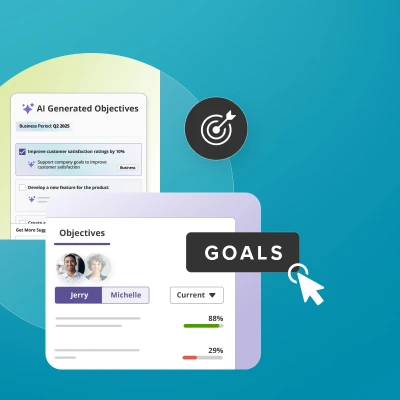
The core difference from most platforms on this list is where goals live. In Betterworks, goal updates happen inside Slack, Microsoft Teams, Outlook, Gmail, Jira, and Salesforce — the tools employees are already in. Progress surfaces automatically through those integrations. Managers receive intelligent nudges when goals go stale or fall behind, before it becomes a review cycle problem. AI-powered Goal Assist coaches employees through writing clearer, more strategic objectives by drawing on job title, past goals, and team priorities.
For HR leaders and executives, the platform's analytics give real-time visibility into performance trends across the organization. Goal data feeds directly into calibration and review workflows, so performance conversations are grounded in continuous evidence rather than a manager's recency-biased recollection of the past 90 days.
The 2026 Betterworks State of Performance Enablement Report — based on research across 2,387 respondents — found that executives are six times more likely than employees to believe current performance systems reflect how work actually gets done. Betterworks is designed precisely to close that gap, at the organizational scale where it matters most.
Features
Company-to-individual OKR alignment; AI Goal Assist for contextual goal drafting; weekly goal updates and intelligent nudges in the flow of work; Slack, Teams, Outlook, Gmail, Jira, Salesforce integrations; check-in conversations and 1:1 prep; peer feedback and recognition; performance reviews and calibration; centralized analytics and reporting; dashboards for executives and HR; AI-assisted bias detection in reviews.
Best fit for: Mid-market to large enterprises — 500 to 100,000+ employees — that need organizational-wide alignment, manager enablement at scale, and goal data connected to formal performance processes.
Strengths & limitations
Strengths: Enterprise-grade scale, deep workflow integrations, AI that improves goal quality before goals are even saved, continuous performance loop in one system.
Limitations: Breadth of features means setup and change management require thoughtful rollout.
Customer quote
"We evaluated 19 performance management platforms before selecting Betterworks." — Kuehne+Nagel (hear the full story)
"Using Betterworks to track performance goals has been a game-changer for our team."
Take a tour of Betterworks today.
Lattice — Unified goals & performance suite
Summary
Lattice combines performance reviews, continuous feedback, and goal management in one unified platform. Teams set and track goals (OKRs or SMART), align them to company priorities, and visualize progress via dashboards. The platform integrates with tools like Slack, Teams, and Jira so goals stay visible in daily workflows. HR and leadership get analytics on goal progress, feedback trends, and calibration inputs. Lattice introduced an AI Agent in 2025 to help automate HR tasks and support users across the platform.
Features
Customizable goal cycles (quarter, annual) with alignment; visual progress tracking; integrations with Slack, Microsoft Teams, Jira; feedback & recognition modules; 360° reviews; calibration and performance review workflows; growth/development goal types; analytics and reporting dashboards.
Ideal customer size
Best suited for mid-market to large organizations (hundreds to several thousand employees) seeking to consolidate goals, reviews, and feedback in one system.
Strengths & limitations
Strengths: Integrated performance + goals suite, good UX for users, strong analytics.
Limitations: Lattice's OKRs and Goals module is sold separately at a minimum annual spend of $4,000, which affects total cost of ownership for teams evaluating it as a bundled solution.
Customer quote
“They are continuously rolling out new features, have prioritized AI functionality, and have a really great customer support team to help us with all of our questions along the way.”
15Five — Performance + goal alignment platform
Summary
15Five is a performance management platform built around continuous check-ins, feedback, and goal alignment. It enables companies to build OKRs that cascade from the top and integrates goal tracking into weekly check-ins and 1:1s. Users get real-time visibility into goal progress and obstacles, helping surface issues earlier. The platform also includes modules for engagement surveys, recognition (“High Fives”), and manager coaching. Its design emphasizes simplicity and adoption, especially for organizations shifting from manual methods. 15Five earns its strongest reviews from organizations where continuous feedback culture and manager coaching are the primary outcomes, and where OKR depth is a secondary priority.
Features
Goal/OKR hierarchies and tracking; real-time status updates; weekly check-ins and reflections; AI-assisted goal guidance; integration with feedback, reviews, and recognition tools; engagement surveys; 1:1 conversation templates; dashboards for alignment visibility.
Ideal customer size
Works well for companies in the mid-market segment (50–5,000 employees) that want a more integrated performance + goal tool without heavy complexity.
Strengths & limitations
Strengths: Easy adoption, strong integration between goals and feedback, clean UI.
Limitations: Some users report that customer support can be limited beyond email, and the guidance during setup could be stronger.
Customer quote
“Overall, 15Five has helped us build a more engaged, aligned, and motivated team. I highly recommend it to any company that cares about people development and culture.”
Leapsome — all-in-one people & performance hub
Summary
Leapsome bundles OKR/goal setting, performance reviews, continuous feedback, employee engagement, and learning into a single platform. Goals can cascade across individual, team, and company levels, and progress is auto-updated through integrations and workflows. AI features recommend initiatives and help users write better goals. Because Leapsome spans multiple HR functions, goal progress is tightly connected to reviews, surveys, and learning paths. It’s marketed to reduce tool fragmentation and support holistic people processes.
In 2025, Leapsome significantly expanded into HRIS, adding payroll prep, time tracking, absence management, e-signatures, and employee records. Organizations evaluating Leapsome should first clarify whether they need an HRIS replacement or a dedicated performance and goals platform — these are different decisions with different vendor requirements.
Features
Goal & OKR alignment across levels; automatic progress tracking; AI suggestions for goal initiatives; integration with reviews, surveys, and learning; feedback & recognition; dashboards and heatmaps; custom workflows and templates; API and integration support.
Ideal customer size
Best for mid-sized organizations (100–5,000 employees) that want a full people enablement suite rather than a standalone goals tool.
Strengths & limitations
Strengths: Holistic approach, rich feature depth, AI-powered suggestions.
Limitations: Complexity in setup for less mature HR teams, and some users say OKR features can be less flexible in highly complex environments.
Customer quote
“Leapsome has become an essential tool in our organization for managing performance reviews, continuous feedback, goal tracking, and employee development.”
Leapsome Goal Setting Software
Profit.co — Full-stack OKR & execution engine
Summary
Profit.co combines OKR goal setting, execution workflows, and performance management into one unified system. You can cascade OKRs, track progress via weekly check-ins, and link tasks/KPIs directly to goals. Its dashboards provide visibility across teams and portfolios, alerting leaders to risks, bottlenecks, and misalignment. The platform integrates with Slack, Microsoft Teams, Jira, Salesforce, and others so goal updates can surface in tools people already use. Its customization and workflow engine let companies tailor processes to their maturity level or structure.
Features
OKR alignment and cascading; weekly check-ins and updates; task/KPI linking to goals; dashboards & heatmaps; risk/flag alerts; performance reviews & calibrations; robust integrations (Slack, Teams, Jira, Salesforce); custom workflows & templates.
Ideal customer size
Works across small to large enterprises (50–10,000+ employees), especially those evolving in OKR maturity and needing flexibility.
Strengths & limitations
Strengths: Deep flexibility and customization, robust integrations, all-in-one execution & review capabilities.
Limitations: Steep learning curve for new users; customization can become complex for non-technical teams.
G2 or Capterra review quote
“The platform provides a clear structure for managing OKRs, offering good visibility of progress and alignment across the organization.”
Profit.co Goal Setting Software
Cascade — strategy-driven goal alignment
Summary
Cascade is a strategy execution platform built to ensure high-level vision translates into measurable goals and outcomes. Users break down strategic objectives into initiatives, link KPIs, and connect work across teams to that strategy. Real-time dashboards and visual alignment maps help leaders spot gaps, overlaps, or misallocations. Because it’s built for strategic orchestration, it often becomes the source of truth for aligned goal structures and accountability. Cascade works best as a strategy visualization and execution layer. Organizations that want goal progress wired into employee performance conversations and HR workflows typically use it alongside or replace it with a dedicated performance management platform.
Features
Strategy & objective hierarchy builder; KPI & metric linking; initiative/roadmap management; alignment maps & dependency views; dashboards & progress reporting; real-time updates; alerts & notifications; permissions & access control.
Ideal customer size
Best for mid to large enterprises (500–20,000 employees) that prioritize top-down strategy alignment and want to avoid disconnected goal systems.
Strengths & limitations
Strengths: Strong strategic visualization, dependency mapping, executive visibility.
Limitations: Less depth in people-centric performance features; can feel heavy for organizations just starting with OKRs.
Customer quote
“Cascade has significantly enhanced our strategic planning activities, enabling a higher level of sophistication to our approach.”
PeopleBox — people-centric OKRs & feedback hub
Summary
PeopleBox focuses on aligning objectives while embedding feedback and performance workflows. Organizations set OKRs or KPIs at multiple levels, run automated check-ins, and loop feedback into goal progress. The performance review module, feedback engine, and one-on-one tools are tightly integrated with goal metrics so conversations stay grounded in data. The platform also automates reminders, nudges, and reporting to reduce manual follow-up.
Features
Cascading and aligned OKRs/KPIs; automated check-ins & status updates; performance reviews & calibration; peer/manager feedback; one-on-one meeting tools; dashboards & progress visibility; reminders and nudges; integrations with Slack, Teams, HR systems.
Ideal customer size
Ideal for mid-sized organizations (100–5,000 employees) who want a single solution for goal + feedback processes without stitching multiple tools.
Strengths & limitations
Strengths: Integrated feedback + objectives, strong usability, automation reduces admin burden.
Limitations: Advanced customization or complex reporting sometimes limited; some users mention UI navigation friction in review workflows.
Customer quote
“Peoplebox covers everything to evaluate and provide valuable feedback to the team … I really like the analytics on 1-1s, progress graph, progress breakdown, etc.”
PeopleBox Goal Setting Software
Engagedly — Goals plus talent development
Summary
Engagedly combines goal setting with performance, learning, and talent development features. Organizations can cascade OKRs or SMART goals, track progress, and link them to development conversations and feedback. Its multi-module design supports reviews, recognition, surveys, and learning management, making it a broader people enablement system. For leaders, dashboards surface progress and highlight where teams may need coaching. Engagedly positions itself as a way to drive both accountability and employee growth.
Features
Goal and OKR management; goal cascading and alignment; performance reviews and 360° feedback; real-time recognition; learning management system (LMS); surveys and engagement tools; dashboards and analytics; integrations with Slack, Teams, HRIS.
Ideal customer size
Best for mid-sized companies (200–5,000 employees) that want goal setting integrated into a broader talent and engagement suite.
Strengths & limitations
Strengths: Strong combination of goals + learning, modular flexibility, holistic approach.
Limitations: Breadth can feel heavy for companies only wanting goal tracking; some reviewers note UI complexity.
Customer quote
“The goal setting feature is great and has worked to help evolve how our organization approaches goal setting.”
Engagedly Goal Setting Software
Weekdone — lightweight OKRs & weekly check-ins
Summary
Weekdone is a simple OKR and weekly planning tool designed for smaller teams and startups. It helps align company goals with team OKRs, then reinforces them with weekly check-ins and status reports. The focus is on making progress visible without creating heavy process overhead. Managers can see weekly summaries, spot blockers, and provide quick feedback. Its simplicity and affordability make it attractive for teams new to structured goal setting.
Features
Company, team, and individual OKRs; weekly planning and check-ins; progress dashboards; team reports and summaries; feedback and recognition; integrations with Slack and Teams; visual goal tracking; reminders and notifications.
Ideal customer size
Best for small businesses and startups (10–200 employees) needing lightweight goal alignment without enterprise complexity.
Strengths & limitations
Strengths: Very easy to use, lightweight, strong for early-stage OKR adoption.
Limitations: Lacks advanced reporting and enterprise integrations; not ideal for complex goal hierarchies.
Customer quote
“Weekdone is focusing on the individual efforts and productivity … impediments can be notified to the management once the team member updates in the team report.”
Weekdone Goal Setting Software
Goalscape — Visual goal mapping
Summary
Goalscape is a goal management solution known for its unique circular, visual goal maps. Instead of lists or dashboards, it displays goals as segments of a circle, helping users visualize relative importance and progress at a glance. This approach makes it easier to prioritize and balance objectives. Goals can be broken down into sub-goals, and progress is tracked visually. While it’s less focused on enterprise-scale performance management, it offers a different, intuitive way to organize goals.
Features
Visual goal maps; hierarchical goal breakdowns; progress tracking; prioritization by importance; simple status updates; export & sharing options; collaboration for teams; desktop and web versions.
Ideal customer size
Best for individuals, small teams, and project groups (up to a few hundred users) who value visual simplicity over complex integrations.
Strengths & limitations
Strengths: Unique visualization, intuitive for prioritization, lightweight.
Limitations: Lacks enterprise integrations and advanced performance features; limited scalability.
Customer quote
“Goalscape provides excellent visibility of your goals and what needs to be done to achieve them. It is also very easy to use which is great.”
Goalscape Goal Setting Software
Tability — Lightweight async OKR platform
Summary
Tability is designed for teams that want to adopt OKRs with minimal friction. It supports AI-assisted goal drafting, check-ins, dashboards, and goal alignment to help teams stay focused on outcomes. Its clean UI and built-in reminders reduce the burden of manual updates. Tability also provides a “focus page” that surfaces updates, flags, and priorities to reduce noise. Tability's AI assistant, Tabby, generates complete OKR plans from a prompt, reviews existing goals for quality, and automates weekly check-in workflows, making it one of the more AI-forward lightweight tools on this list.
Features
AI-assisted goal editing; check-ins and progress updates; dashboards and visual reporting; strategy map for alignment; automated reminders; integrations (Slack, Teams, Jira, Asana); custom dashboards; task/initiative linking under goals.
Ideal customer size
Best fit for startups, small to mid-sized teams (10–500 employees) wanting a lightweight, low-overhead OKR tool.
Strengths & limitations
Strengths: intuitive interface, low setup cost, strong for small / distributed teams;
Limitations: lacks advanced enterprise features (deep reporting, complex hierarchies), limited customization and fewer integrations than full-suite platforms.
Customer quote
“The implementation of Tability was very easy to do … our teams made their first check-ins by the end of week.”
Tability Goal Setting Software
Perdoo — OKRs + KPIs for strategic alignment
Summary
Perdoo blends OKRs and KPIs into one unified system, helping organizations not just set aspirational objectives but also track measurable metrics. It offers cascading of goals, visualization via scorecards, and integration with common tools like Slack, Teams, and Jira. The platform also includes features around coaching, consulting, and strategy execution to help users adopt best practices. With a reputation for user-friendliness and visibility, Perdoo is often chosen by organizations that want alignment without complexity.
Features
Cascading OKRs and KPIs; strategy maps and roadmaps; scorecards and dashboards; check-ins and progress tracking; integrations (Slack, Teams, Jira, Asana, Google, etc.); coaching and consulting support; reporting & analytics; reminders and nudges.
Ideal customer size
Best for mid-sized organizations (100–5,000 employees) seeking a balance of strategy and execution in one clean tool.
Strengths & limitations
Strengths: Easy to use, solid balance of OKRs + KPIs, good visibility and alignment tools.
Limitations: Some limitations in advanced customization or reporting interfaces, learning curve for new OKR adopters.
Customer quote
“Goal setting and progress updates are easy to manage, and the platform encourages accountability.”
Teamflect — Microsoft Teams native performance & goals
Summary
Teamflect embeds goal setting, performance reviews, feedback, and recognition directly inside Microsoft Teams and Outlook, making it seamless for organizations grounded in the Microsoft ecosystem. Employees can set and track OKRs or SMART goals without leaving their daily tools, and managers can run 1:1s, reviews, and recognitions in the same interface. The platform supports continuous check-ins and links goals to performance workflows, reducing friction in adoption.
Features
Goal / OKR setting & tracking inside Teams; cascading & alignment; continuous check-ins and status updates; performance reviews & calibrations; feedback & peer recognition; 1:1 meeting agendas & follow-ups; integrations with Outlook, Microsoft Planner, Microsoft 365; dashboards & reporting.
Ideal customer size
Good fit for small to mid-sized organizations (e.g. 10–2,000 employees) especially those already using Microsoft Teams and Outlook as their primary collaboration tools.
Strengths & limitations
Strengths: Frictionless adoption for Microsoft environments, intuitive interface, goal + performance workflows in one place.
Limitations: Limited flexibility in report templates and advanced customization; some complain that features depend heavily on being within the Microsoft stack.
Customer quote
“The ability to maintain schedules, meeting notes and agendas, set goals and objectives, and complete reviews has been exceptionally helpful.”
Teamflect Goal Setting Software
How AI is changing goal setting software in 2026
Not all AI features in goal setting software are equally useful. Here is what to evaluate and what to look past.
AI goal drafting is now a standard feature across most platforms on this list. The quality gap is in how contextual the AI is. Does it know the employee's job title, their team's active goals, and the company's current strategic priorities before generating suggestions? Does it pull from a generic OKR template library? Betterworks Goal Assist draws on job history and company-level goal data. Leapsome's initiative generator uses review and survey data. Both are meaningfully better than template-based suggestion tools. When evaluating any platform's AI drafting, ask vendors to show you a live example with an actual employee record, not a demo account with clean sample data.
Intelligent nudges and at-risk detection is where AI adds the highest practical value for enterprise teams. Writing goals is not where most OKR programs fall apart. It's sustaining them where they do fall apart. Platforms that use AI to detect when a goal has gone quiet, flag it to the manager, and prompt an update before it becomes a year-end problem are significantly more valuable than platforms where "AI" means a chatbot on the help page. Learn more about how Betterworks approaches this in AI for HR.
AI in performance review workflows is still emerging, but it is the area with the clearest ROI potential. The 2026 Betterworks State of Performance Enablement Report found that 49% of HR leaders rank AI skill use as a top influencer on employee performance — but only 9% of employees believe AI skills have become more important to their own success. That gap means most performance management systems are measuring the wrong things. Goal setting platforms that connect AI-assisted work and goal progress in the same data layer — rather than adding AI as a separate reporting module — are the ones most likely to close it.
Three questions worth asking every vendor on AI: What data does the AI use to draft goals — live employee records or a generic template? Can the system detect when a goal is at risk without the manager manually flagging it? Is goal data connected to the review workflow, or does someone have to export it?
Goal setting software for enterprise vs. SMB
Not every goal setting platform is built for the same scale. The needs of a global enterprise look very different from those of a 50-person startup, and the right software should reflect that. Here’s how the leading options stack up for each.
Enterprise organizations need more than goal tracking. They need scale, integrations, and insights. Platforms like Betterworks deliver enterprise-grade features such as AI-assisted OKRs, deep integrations with tools like Slack, Teams, and Salesforce, and analytics that give leaders real-time visibility across thousands of employees. These systems turn goal setting into a continuous loop of alignment and coaching rather than an annual ritual.
For small and mid-sized businesses, simplicity matters more than scale. Tools like 15Five, Weekdone, and Tability focus on lightweight OKR tracking, weekly check-ins, and ease of adoption. They help smaller teams stay aligned and agile without overwhelming them with enterprise complexity.
Choosing the right platform comes down to matching capabilities with company size: enterprises need data and integration power, while SMBs thrive on tools that are fast to adopt and easy to maintain.
How to choose the best goal tracking software
The best goal setting software fits your organization’s size, culture, and pace of change. The strongest platforms make it easy to create and adjust performance goals so they stay aligned with business priorities. As you evaluate options, keep these factors in mind:
Scalability: Can the platform support thousands of users and multiple levels of goals, or is it better suited for smaller teams?
Ease of use: Will employees adopt it quickly, or will it feel like another HR system they have to log into?
Integrations: Does it work inside tools your teams already use, like Slack, Teams, Jira, or Salesforce?
Manager enablement: Does it help managers coach in the moment, or just collect updates?
Analytics: Will leaders get real-time visibility into progress, risks, and alignment?
For smaller organizations, simplicity and quick adoption may be the deciding factors. For enterprises, it’s about scale, integrations, and insights that help leaders steer the business without waiting for quarterly updates.

Why Betterworks is the best goal setting software for teams
Enterprise organizations need a system that scales across thousands of employees, integrates with the tools people use every day, and provides leaders with real-time insights instead of end-of-quarter surprises. That’s where Betterworks stands apart.
Betterworks aligns company, team, and individual OKRs in one continuous loop. AI helps employees draft clearer goals, nudges teams when progress stalls, and surfaces risks before they snowball. Managers can hold check-ins, run 1:1s, and deliver feedback in the same platform, turning performance management into an ongoing conversation rather than an annual event.
Deep integrations with Slack, Microsoft Teams, Jira, Salesforce, and other enterprise systems keep goals in the flow of work, so employees update progress without breaking focus. Executives gain visibility into alignment and performance trends at every level, helping organizations stay agile and adapt quickly.
With Betterworks, goals don’t live in isolation. Instead, they’re part of a broader cycle of feedback, check-ins, and reviews. This continuous approach to performance management goal setting helps managers coach in the moment and keeps employees engaged in their growth.
Take the next step in goal setting
Betterworks transforms goal setting and goal achievement from discrete annual rituals into a continuous loop that keeps teams aligned, engaged, and agile. If you’re ready to move beyond spreadsheets and static reviews, it’s time to see what a modern enterprise platform can do. Request a demo today.
Goal setting software FAQs
What is goal setting software?
Goal setting software is a tool that helps organizations define, track, and align objectives across teams and individuals. It goes beyond simple task management by connecting individual goals to team and company-level strategy, automating progress tracking through integrations with tools like Slack, Jira, and Microsoft Teams, and feeding goal data into performance review workflows. Enterprise goal setting platforms like Betterworks also include AI to help employees write better goals and alert managers when goals fall behind.
What is the difference between OKR software and goal setting software?
OKR software is a type of goal setting software built specifically around the Objectives and Key Results framework. OKRs pair a qualitative objective with measurable key results and typically operate on quarterly cycles. Goal setting software is a broader category that may support OKRs, SMART goals, KPIs, or custom frameworks depending on the platform. Most enterprise goal setting platforms support OKRs as the primary methodology.
What features should goal setting software have?
The most important features are alignment (connecting individual goals to team and company objectives), workflow integration (so progress updates happen inside tools employees already use), AI-assisted drafting (to improve goal quality before goals are set), manager visibility (real-time dashboards and at-risk alerts without manual reporting), and review integration (so goal data informs performance conversations automatically). For enterprise organizations, calibration tools and analytics that surface trends across large populations are also critical.
How does goal setting software improve employee performance?
Goal setting software improves performance by making objectives visible year-round rather than just at review time, giving employees clarity on how their work connects to company priorities, and providing managers with the data they need to coach in the moment rather than react at the end of a cycle. Research from Betterworks' 2026 State of Performance Enablement Report found that the biggest driver of the executive-to-employee performance gap is not effort or skill — it is ambiguity about how individual work connects to organizational goals.
What is the best goal setting software for enterprises?
For enterprises — organizations with 500 to 100,000+ employees — the best goal setting software is a platform that integrates with existing enterprise tools, supports complex goal hierarchies across business units and regions, and connects goal data to formal performance review and calibration processes. Betterworks is the only platform purpose-built around continuous performance management from day one, rather than a goal module added to a broader HCM or engagement suite.
How is AI used in goal setting software?
AI is used in goal setting software in three primary ways. First, AI drafts suggested goals based on an employee's role, past objectives, and company priorities — helping teams write clearer, more strategic OKRs faster. Second, AI monitors goal progress and sends intelligent nudges to employees and managers when goals go stale or fall behind. Third, AI assists in performance reviews by surfacing goal completion data, detecting potential bias in ratings, and generating narrative summaries for managers. The quality of AI implementation varies significantly across platforms — contextual AI that draws on live employee data is more valuable than template-based suggestion tools.
How does goal setting software connect to performance reviews?
In the most effective platforms, goal progress data feeds directly into the performance review workflow. When a review cycle opens, managers can see an employee's goal completion rate, update history, and manager check-in notes without having to search for them. This eliminates the recency bias that affects most annual reviews — where performance is evaluated based on what a manager remembers from the last few weeks rather than the full year of documented progress. Betterworks is purpose-built around this connection: goals, check-ins, feedback, and reviews are in the same system, so the data flows without manual export.
What is the difference between goal setting software and performance management software?
Goal setting software focuses specifically on the creation, tracking, and alignment of objectives. Performance management software is a broader category that includes goal setting alongside performance reviews, feedback, calibration, engagement surveys, and development planning. Many organizations start with goal setting software and expand into full performance management platforms as their processes mature. Betterworks operates as both: the goal management layer and the full performance management system are the same product, which means goal data is available natively across every performance workflow.