Key Takeways
-
Completion rates measure activity, not capability — most organizations can't say whether training actually changed how someone works.
-
Research on training transfer shows a large share of formal learning never gets applied on the job, and that share grows the longer you wait to check.
-
Formal courses were never meant to carry the whole load: the classic 70-20-10 model puts formal training at roughly 10% of how people actually develop.
-
Connecting an LMS (Udemy, Docebo, LinkedIn Learning) directly to goals and Development Goals in Betterworks turns course progress into a visible signal tied to real priorities, not an isolated completion badge.
-
Pairing that with Conversational Intelligence means development priorities come from real coaching context, not guesswork — and Individual Development Plans keep the plan current instead of static.
Most L&D teams can tell you exactly how many courses got completed last quarter. Fewer can tell you whether any of it changed what people are actually able to do on the job.
That gap is the real problem. Completion rates measure activity. They don't measure capability. And when a business needs to know whether it has the skills to hit next year's priorities, "76% completion" isn't an answer.

Completion has become a stand-in for progress
Learning teams have gotten good at tracking enrollment, completion, and satisfaction scores. What's harder to track is whether a course changed how someone works.
This isn't a new problem. Decades of research on training transfer have found that a large share of what people learn in formal training never shows up in how they actually perform their jobs — and that share grows the further out you measure it since studies have found that 38%, 56%, and 66% of training goes untransferred to work immediately, six months later, and 12 months later, respectively. In other words, the moment a course is marked "complete" is often the moment the organization stops paying attention — right when the harder part, applying it, is supposed to begin.
A few symptoms show up when learning and performance operate separately:
Employees complete assigned courses with no clear line to a business need
Managers can't say which of their team's skill gaps are actually being closed
HR can report completion rates but not capability growth
Development plans get written once a year and rarely revisited
Learning content recommendations are generic, not tied to the person's actual role or goals
None of this means training doesn't work. It means completion was never the right thing to optimize for.
Formal training was never supposed to carry the whole load
Part of the disconnect comes from expecting a course catalog to do more than it can. The Center for Creative Leadership's foundational research on how executives actually develop put the split at roughly 70% on-the-job experience, 20% learning from others, and only 10% formal coursework. The exact ratio has been debated since — ATD's own review of the evidence points out that the underlying research is thinner and older than the popularity of the 70:20:10 shorthand would suggest — but the core idea holds up: formal learning is one input among several, not the whole system.
That's exactly why treating an LMS as a standalone system creates a ceiling. A course can teach a concept. It can't, by itself, tell you whether someone applied it, whether a manager reinforced it, or whether the business actually needed that skill in the first place. That context lives in goals, in coaching conversations, and in the work itself — not in the LMS.
Make learning part of the goal, not a parallel track
The fix isn't more courses. It's connecting the learning that already exists to the development priorities and goals people are actually working toward.
That's the idea behind Individual Development Plans in Betterworks. Instead of a static plan written once and forgotten, employees build development around specific skills or aspirations, and the system helps carry that forward:
Employees select a skill to develop, or create a custom development goal outside a skill
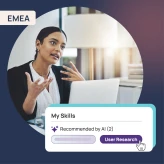
AI recommends personalized development steps based on role, skill, and current proficiency, which employees review and choose to add
Relevant courses from connected learning platforms are recommended based on that same context
Managers see development goals and progress inside the same goals experience they already use for coaching
Development stops being a document that gets revisited once a year. It becomes something that moves alongside the work.
Connect the LMS you already have
Most organizations don't need another learning platform. They need their existing one to talk to performance.
Betterworks has native integrations with Udemy Business, Docebo, and LinkedIn Learning. In each case, the pattern is the same:
Employees search and attach relevant courses directly from a goal, milestone, or Development Goal
AI-recommended courses surface based on the employee's role, target skill, and skill level
Course progress syncs back to Betterworks automatically, so it shows up next to the goal it supports — no manual updates required
The point isn't just convenience. It's visibility. When course progress lives next to the goal it's meant to support, a manager can see whether learning is actually moving someone toward something, instead of just seeing a completion badge in a separate system. Betterworks customer data on the LinkedIn Learning integration bears this out: organizations that connect learning progress to goals see meaningfully higher completion rates than typical industry benchmarks, because the learning finally has a visible reason behind it.

Feed real coaching conversations back into development
Connecting learning to goals solves half the problem. The other half is making sure development priorities come from real signals, not guesswork.
That's where Conversational Intelligence comes in. It surfaces themes, commitments, and goal-related signals from manager-employee conversations — the kind of context that often reveals exactly where someone is ready to grow, or where they need support, long before it makes it into a formal development plan. Betterworks connects those signals to the same goals and development experience, so a coaching conversation about a stretch opportunity can turn into a Development Goal without the manager and employee having to reconstruct it later. (We covered how this works in more detail in our recent post on turning 1:1s into performance intelligence.)
What this means for workforce readiness
None of this is about replacing your LMS or asking L&D to track a new metric. It's about giving the metrics you already have — completions, progress, engagement — a place to mean something.
When development is connected to real goals, real coaching context, and real learning activity, HR and talent leaders can answer a different question than "how many courses did people finish." They can start answering "what capabilities are we actually building, and are they the ones the business needs next." That's the same visibility that shows up in Skills Intelligence and the Unified Talent Profile — a clearer, evidence-based picture of workforce capability instead of a stack of completion certificates.
We covered the full Summer 2026 release, including Individual Development Plans, Adaptive Learning & Upskilling, and Conversational Intelligence, in more detail here, and went deeper on the development and learning side specifically in this companion post.
Curious what your own LMS data would show if it were connected to real goals?
Talk to an Expert