From conversation to performance intelligence: how Betterworks turns 1:1s into more than meeting notes
By Aimie LimSeptember 10, 20266 minutes read
Share
Share
The most useful part of a 1:1 can be the part that never makes it into the performance system.
A manager and employee might spend 30 minutes talking through a goal that has stalled, a project that needs to change direction, or a challenge the employee hasn’t encountered before. They work through what’s getting in the way, agree on what needs to happen next, and sometimes uncover something broader — a development need, a new priority, or an opportunity to take on more responsibility.
Then the meeting ends, and everyone gets back to work.
Some of that context might make it into notes. An action item might get written down somewhere. The rest may simply stay in the manager’s head until the next conversation.
That creates a problem for organizations trying to make performance management more continuous. The conversations are happening, but much of what they reveal isn’t carried forward into the performance process. Managers have to reconstruct context later, employees have to remember what they committed to, and HR leaders may be working with an incomplete picture when performance reviews and talent decisions come around.
Betterworks Conversational Intelligence is designed to close that gap by turning everyday manager-employee conversations into useful performance context.
1:1s already contain valuable performance signals
Performance doesn’t only show up during a formal review.
It comes through when a manager asks how a goal is going and learns that a project is blocked. It shows up when an employee raises a challenge, asks for coaching, or talks about a skill they want to develop. A change in business priorities can surface in conversation long before anyone updates a formal plan.
These interactions happen all the time. They’re part of the work.
The problem is that most performance systems weren’t built to make much use of them. They’re better at storing the formal artifacts of performance — goals, feedback, reviews — than preserving the context that connects those things over time.
That matters because performance is not a series of isolated events. It develops through the work employees do, the goals they pursue, and the conversations they have with their managers. Betterworks’ broader approach is built around making those performance signals more continuous and connected to the work itself.
Most managers don’t need another place to document their 1:1s. They need to be able to build on what was discussed the last time they met. When that context gets lost, it becomes harder to follow through on commitments, recognize patterns across conversations, or bring the right context into a performance review or talent discussion. The opportunity is to make those conversations more useful without adding another documentation task.
What if the context from every 1:1 could stay connected?
That’s the idea behind Conversational Intelligence in Betterworks.
Conversational Intelligence uses AI to turn meeting transcripts and notes into performance-relevant insights and recommendations — not simply a recap of what was said. The analysis is focused on the parts of the conversation that can help a manager coach, keep work moving, and maintain a more complete view of performance over time.
Here’s how that context moves from conversation into action.
How Conversational Intelligence works in practice
Capture the conversation without creating another task
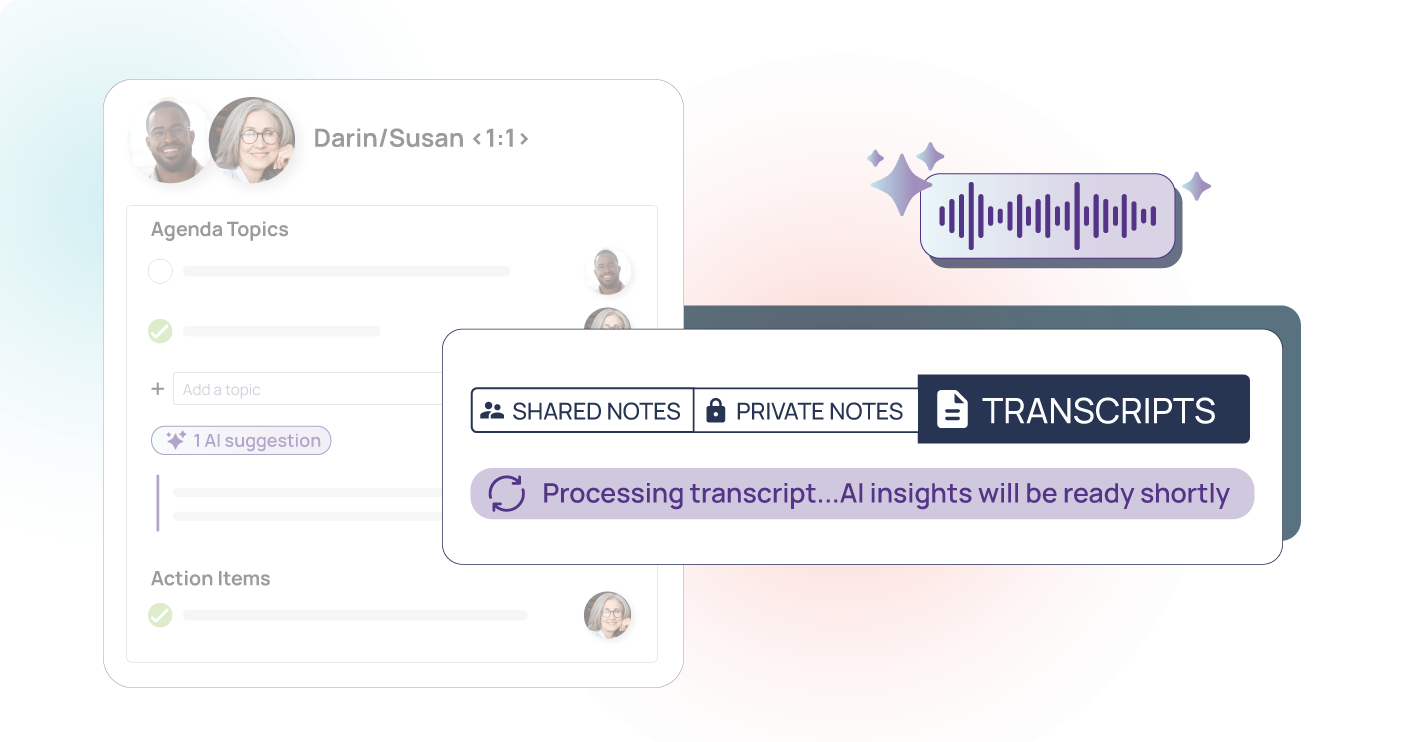
For 1:1 meetings on Zoom, Betterworks can retrieve completed meeting transcripts through the Zoom API and connect them with the corresponding 1:1 in the Betterworks platform. There’s no Betterworks meeting bot joining the call. Teams using other meeting or transcription tools can upload or paste transcripts, notes, or summaries for processing.
Managers and employees already have enough to manage. Now, the context from their conversations can automatically flow into Betterworks, where it can be used in the performance workflow without requiring them to create another set of notes.
Surface the parts that matter
Once the conversation is captured, Betterworks AI can surface the information most relevant to ongoing performance.
Managers and employees can see a concise summary of what was discussed, along with suggested action items and agenda topics. When a conversation includes a discussion about a goal, Betterworks can identify progress, suggest a milestone update, or surface an opportunity for a new goal.
The important part is what happens next. Recommendations can be reviewed, edited, discarded, or confirmed rather than automatically becoming part of a formal performance record. That keeps managers and employees in control of what gets confirmed and carried forward.
Bring the right context into the next 1:1
The value of a conversation shouldn’t end when the meeting closes.
Before an upcoming 1:1, AI Meeting Prep brings together relevant context from recent meetings, open action items, and current goals in a private preparation brief for each participant. That gives managers and employees a clearer view of what needs attention before the conversation starts.
Consider a manager and employee who have been working through a project that has stalled. The last conversation surfaced a blocker and an action item that’s still open. Ahead of their next 1:1, that context is brought forward alongside the employee’s current goals.
They can spend the meeting working through the issue rather than trying to reconstruct where things left off. If the conversation leads to a goal or milestone change, Betterworks can surface that recommendation for review afterward.
The next conversation has a clearer starting point — and the context can continue to build from there.
What sets Betterworks apart from a typical meeting summary?
There’s no shortage of tools that can summarize what was said in a meeting. Betterworks goes further by identifying what the conversation means for performance.
A conversation about a delayed project might reveal that a goal needs attention. A recurring coaching topic might point to an area where an employee needs support. A shift in priorities might lead to a change in a goal or milestone. Over several conversations, those signals can add important context to the way an employee is progressing.
That’s what sets Betterworks Conversational Intelligence apart from a typical meeting summary. It identifies the performance signals inside everyday conversations and connects them to the workflows where performance is managed.
That approach extends across Betterworks. Goals, feedback, 1:1s, reviews, and talent intelligence become more useful when they contribute to a connected view of performance rather than remaining separate activities.
Why this matters beyond the 1:1
For managers, better context makes it easier to prepare for coaching conversations and follow through on what was agreed. They don’t have to depend as heavily on memory or spend time reconstructing previous discussions.
Employees get a clearer thread from one conversation to the next. Commitments are easier to keep visible, and discussions around goals and development don’t have to start over every time.
For HR and talent leaders, the opportunity is broader still. More of the context generated through everyday performance conversations can contribute to a richer, more continuous record of performance — one that can support reviews and talent decisions without asking managers to take on more administrative work.
Audience
What changes with Conversational Intelligence
Managers
More context before coaching conversations, stronger follow-through, and less reliance on memory.
Employees
Clearer commitments and greater continuity between conversations and goals.
HR & talent leaders
A richer, more continuous view of performance context to support reviews and talent decisions.
Performance intelligence should start where performance happens
The broader shift isn’t about making meetings more efficient for the sake of efficiency.
It’s about recognizing that some of the information organizations need most is generated in the flow of work. A manager and employee talk about what’s going well, what isn’t, and what should happen next. Those conversations can reveal progress, challenges, development opportunities, and changes in priorities that won’t necessarily appear anywhere else.
When those signals can stay connected over time, performance becomes easier to understand as it actually happens — rather than reconstructed later from a handful of formal checkpoints.
Conversational Intelligence provides an automated way to bring useful context from manager-employee conversations into 1:1s and goals, helping managers coach with more context and giving leaders a more complete view of performance as work unfolds.
The conversation was always part of performance.
Now more of its value can carry forward.
Conversational Intelligence FAQs
What is Conversational Intelligence for performance management?
Conversational Intelligence for performance management uses AI to identify useful performance context from manager-employee conversations. Betterworks analyzes meeting transcripts or notes to generate recaps, surface action items and goal-related signals, and prepare participants for future 1:1s.
How does Betterworks capture meeting content?
For Zoom 1:1s, Betterworks can retrieve completed meeting transcripts through the Zoom API. Users can also upload or paste transcripts, notes, or summaries from other meeting and transcription tools for processing.
Does a Betterworks bot join the meeting?
No. Betterworks does not use a transcription bot for Zoom. The transcript is retrieved through the Zoom API after the meeting.
What can Betterworks AI identify from a 1:1?
Depending on the conversation, Betterworks can generate a meeting recap, suggest agenda topics and action items, identify goal progress or milestone opportunities, surface potential new goals, and create a meeting prep brief for a future 1:1.
Does AI automatically add information to an employee’s performance record?
No. AI-generated recommendations remain pending until a user reviews and confirms them. Users can edit or discard recommendations before they become part of Betterworks records.
Turn every 1:1 into a source of performance insight.