Individual development plans and adaptive learning: building skills that matter to the business
By Aimie LimSeptember 8, 20268 minutes read
Share
Share
An employee knows where they want to grow.
Maybe they’re taking on a broader role and need a new skill. Maybe they’ve identified an area where they could be more effective. Maybe they’re thinking about what they want to do next in their career.
Usually, there’s a process for capturing that ambition. A development goal gets written down. A manager talks it through. Someone points the employee toward learning resources.
And then the employee has to make it happen.
That’s where development gets harder.
Knowing that someone wants to build a skill is useful. Knowing how they should build it, what learning will help, and how a manager can support the effort is much more valuable. Yet those pieces often live in different places, which makes development harder to sustain and harder for organizations to connect to the capabilities they’ll need in the future.
Betterworks is bringing Individual Development Plans and Adaptive Learning & Upskilling together to make that process more practical. Employees can create development goals around the skills they want to build, add personalized development actions, connect relevant learning, and track progress within the broader performance experience.
The idea is simple: make development easier to act on, not just easier to document.
A development plan can tell you where someone wants to go. It doesn’t always tell them how to get there.
Most organizations don’t have a development problem because they lack good intentions.
They have one because the path from intention to action is often unclear.
An employee may know they need to strengthen a skill, but the development plan doesn’t necessarily help them decide what to practice. Learning teams may have an extensive catalog of content, but the employee still has to figure out which courses are relevant. The manager may support the goal but have limited visibility into how the employee is progressing.
That creates a familiar pattern: development gets planned, but the experience around it remains fragmented.
The consequences extend beyond the employee. When development stays disconnected from performance and skills, managers have less context for coaching, internal mobility can become harder to support, and HR has less visibility into whether development investments are actually helping build workforce capability.
The answer isn’t another layer of administration.
It’s connecting development more closely to the work and performance systems employees and managers already use.
Individual Development Plans make the development goal a place to work from
Individual Development Plansin Betterworks give employees a structured way to define a development priority and build a Development Goal around it.
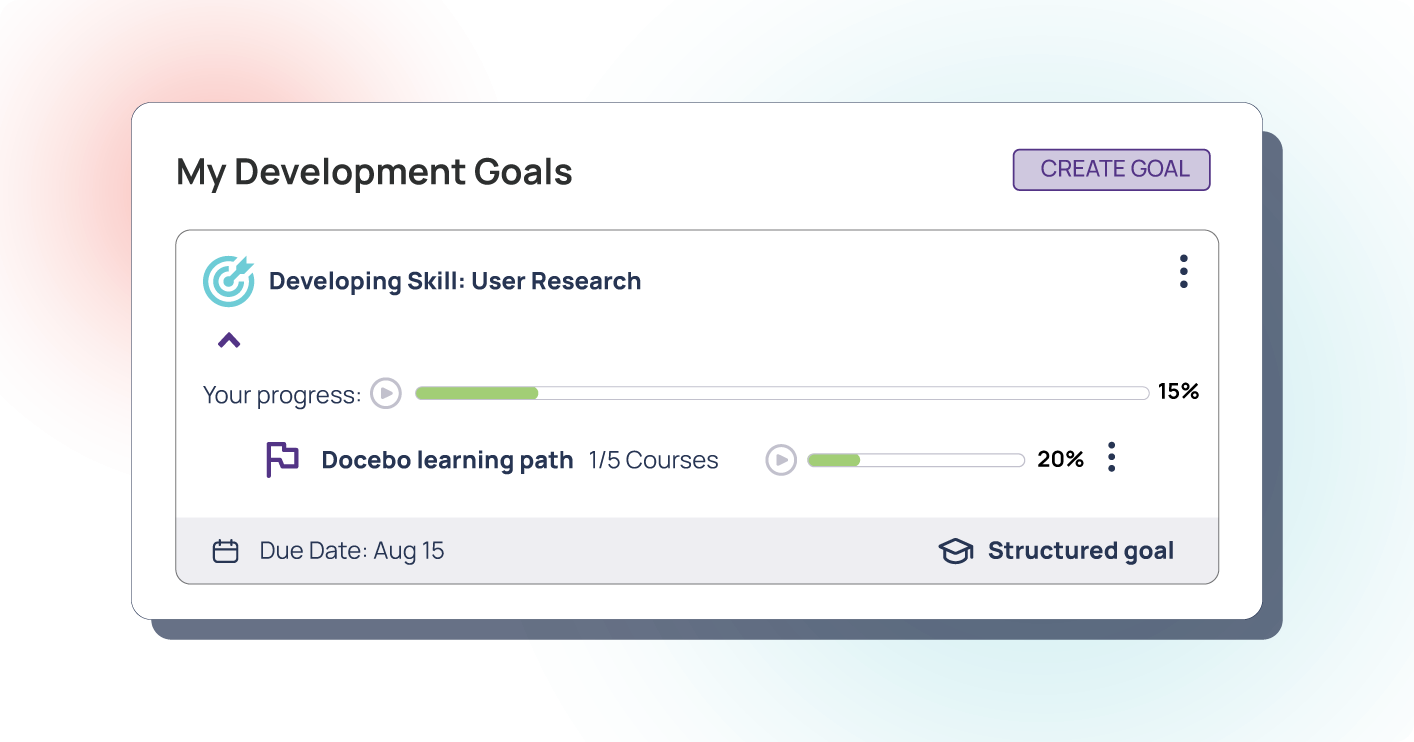
A goal can be tied to a specific skill or created as a custom development goal. From there, employees can add milestones and track progress as development takes place.
That changes the role of the development plan.
Instead of capturing a broad statement such as “become a stronger people leader,” the employee has a place to work through what that development actually involves. The goal can hold the actions and learning that support it, giving the employee something concrete to come back to as they make progress.
That structure also matters for the manager. Development is easier to coach when there’s something visible to discuss — what the employee is working on, what they’ve completed, and where they may need more support.
It’s a small but important distinction: the plan is no longer just a record of development. It becomes part of development itself.
What should the employee actually do next?
This is one of the places where AI can make a useful difference.
Betterworks can recommend personalized development steps using context such as the employee’s role, the skill they’ve selected, their skill level, and their existing capabilities. Employees review those recommendations and choose what to add to the plan.
AI can help employees build a personalized development plan while also giving them practical guidance on what to do next. Betterworks can generate personalized development steps based on context such as the employee’s role, the skill they’ve selected, their skill level, and their existing capabilities. Employees can review those recommendations and choose what to add to their plan.
That gives employees a more practical starting point and a clearer path from a development priority to the actions that can help them build it.
Learning is more useful when the development goal comes first
The problem most organizations run into regarding learning content is usually relevance.
An employee trying to build a skill can search a learning catalog, but a list of courses doesn’t tell them which one is the right next step for their development. It also doesn’t necessarily explain why that learning matters to the work they’re doing.
Adaptive Learning & Upskilling changes the starting point.
Rather than beginning with the catalog, the experience begins with the development need. Betterworks can recommend learning using the employee’s role context, target skill, skill level, and existing capabilities. Selected learning can then be added directly to the Development Goal as a milestone.
That makes the connection between development and learning much easier to understand.
An employee isn’t simply taking a course because it was assigned.
They can see how the learning supports the capability they’re trying to build.
Betterworks also makes it easier to bring learning from the systems your organization already uses into the development experience. Supported integrations include Udemy for Business and Docebo, along with updates to LinkedIn Learning. Once connected, employees can search available learning, select courses that support a goal or Development Goal, and track that learning as part of their development work. Supported integrations can also update the associated milestone in Betterworks as course progress changes.
The result is a tighter connection between the learning an employee completes and the capability they’re trying to build.
Development gets stronger when managers can see it, too
Employees own their growth, but managers play an important role in helping that growth happen.
That’s difficult when development is something the manager only sees during a formal review or an annual planning exercise.
Development also stays visible in the Unified Talent Profile, giving managers a fuller view of an employee’s performance, skills, development priorities, and growth. Managers can use that context in ongoing coaching conversations, while Development Goals and learning activity provide a clearer view of what the employee is working toward and how they’re progressing.
That gives the manager something much more useful to work with. A conversation can move beyond whether an employee “has a development plan” and into what they’re actually trying to build, what they’ve done so far, where they may be getting stuck, and what could help them move forward.
This matters because manager effectiveness is central to whether development becomes part of the employee experience or remains an HR process that happens around the edges of work. Betterworks’ broader approach is to give managers more context from goals, feedback, conversations, skills, and development so coaching can stay connected to what employees are actually doing.
The real measure of development isn’t how many courses people completed
For HR leaders, there’s a bigger question underneath all of this.
Most learning programs can tell you what employees completed. That’s useful, but it doesn’t fully answer whether the organization is becoming more capable.
The more important question is: What capabilities are we building?
That’s a different way to think about development.
When development goals, learning, skills, performance, and coaching are connected, the organization has a better foundation for understanding how people are growing and where development is needed. That has implications for internal mobility and succession, particularly when business priorities change and leaders need to know where capability exists today and where more investment is needed.
It also changes the conversation around the value of learning.
The objective isn’t simply to increase learning activity. It’s to help employees build capabilities that matter to their current work and future opportunities, while giving the organization a clearer view of how workforce capability is evolving.
Development has to keep up with the work
The traditional development process assumes the future can be planned in advance.
But the work itself is changing.
An employee may take on a new responsibility. A team may shift priorities. A capability that mattered less a year ago may suddenly become critical. Development needs to be useful in that environment, rather than tied to a single planning moment.
That’s why development belongs closer to performance.
Employees are already working toward goals, receiving feedback, solving problems, and talking with their managers about what they need to do next. Those are the moments where development becomes real.
Individual Development Plans give those priorities a place to live. Adaptive Learning & Upskilling helps connect them to practical actions and relevant learning. Together, they make it easier to move from identifying a development need to actually doing something about it.
That connection is especially important for organizations trying to build workforce capability ahead of demand rather than waiting until a critical skill gap becomes urgent.
What changes for the employee, the manager, and HR?
For the employee, development becomes more tangible. They can define a Development Goal, get personalized suggestions for development actions, connect relevant learning, and track progress in one place.
For the manager, development becomes easier to coach. The employee’s priorities and progress are visible within the broader performance experience, providing more context for ongoing development conversations.
For HR and talent leaders, the opportunity is broader still. Development can become part of a connected approach to workforce capability — one that supports internal mobility, succession, manager effectiveness, and readiness as business needs evolve.
That’s a more useful role for an Individual Development Plan.
It doesn’t just record what someone wants to improve.
It helps create the conditions for that improvement to happen.
Build the skills the business will need next
The workforce an organization needs tomorrow is being built today.
Some of that work happens in formal learning programs. Much of it happens closer to the job — in the skills employees are trying to develop, the goals they’re working toward, the experiences they’re gaining, and the conversations they’re having with their managers.
Individual Development Plans and Adaptive Learning & Upskilling bring more of that development into the flow of performance.
Employees can define what they want to build and get practical guidance on how to move forward. Learning can be tied directly to that development work. Managers can keep growth in view as they coach. And organizations can take a more connected view of how employee development contributes to workforce capability.
That’s the shift worth making.
Not development for the sake of having a plan. Development that helps people build the capabilities the business will need next.
Ready to turn employee development into workforce capability?