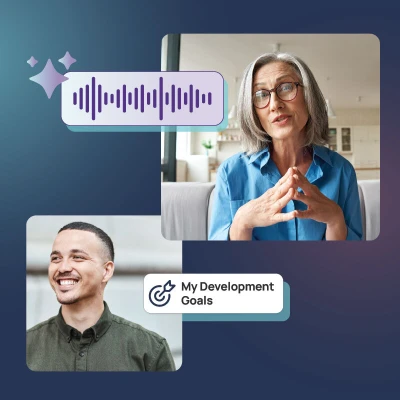
Turn everyday conversations into useful performance context, turn development priorities into action, and connect employees with relevant learning — all within the flow of performance.
The workforce your business will need tomorrow is already taking shape today.
The challenge is knowing whether it’s taking shape in the right ways. Organizations often discover capability gaps only when they become urgent: a critical role needs to be filled, a new strategic priority demands different skills, or leaders realize the people they need aren’t ready yet.
Employee development should help organizations get ahead of those moments. But much of the information that could guide development is generated through everyday work and is disconnected from what happens next.
Some of the best signals about employee growth show up naturally in conversations between managers and employees. A 1:1 might reveal a new challenge someone is ready to take on, an area where they need support, or a skill they want to develop. Yet translating that context into a focused development plan — and then finding the right learning to support it — often requires employees and managers to bridge the gaps themselves.
Our Summer 2026 release brings those experiences closer together.
New Conversational Intelligence captures useful performance context from manager-employee conversations. Individual Development Plans give employees a structured way to turn development priorities into action. And Adaptive Learning & Upskilling connects those priorities to personalized development steps and relevant learning.
Together, they create a more connected approach to employee growth, helping organizations build workforce capability before a gap becomes a business problem.
Development has to move closer to the work
For years, organizations have treated employee development and performance as related but largely separate activities. Development plans may sit in one workflow, learning in another, while important growth conversations happen between managers and employees throughout the year.
That fragmentation makes it difficult to turn what managers and employees are learning about performance into meaningful development while it still matters. A development plan created at the beginning of the year can quickly lose relevance as responsibilities change, new priorities emerge, or an employee discovers an entirely different area where they want to grow.
Development works better when it can evolve with the employee and the work.
That means making it easier to carry context from everyday conversations into development, translate development priorities into practical next steps, and connect those next steps with learning that supports the capabilities employees are trying to build.
Turn 1:1 conversations into performance context
Managers and employees generate valuable performance context every time they talk about priorities, progress, blockers, commitments, and development. The problem is that much of that context disappears once the meeting ends or remains scattered across notes and other tools.
That leaves managers and employees to create their own record of what happened — taking notes, keeping track of commitments, and piecing together context from previous meetings. When the next 1:1 or performance conversation comes around, they may be searching through notes or relying on memory to reconstruct what happened weeks or months earlier.
Conversational Intelligence gives those conversations more continuity.

Betterworks AI analyzes that content through a performance lens, creating a concise meeting recap and surfacing suggested action items, discussion topics, and goal-related recommendations. If progress toward an existing goal comes up in the conversation, for example, Betterworks can identify it and suggest an update rather than relying on someone to remember to make that connection later. Users review recommendations before confirming them, so they remain in control of what gets saved.

This goes beyond summarizing a meeting. The value is in carrying useful context forward so conversations can lead to better follow-through, more focused coaching, and a richer understanding of performance over time.
Turn development priorities into an actual plan
Better context can help a manager and employee identify where growth needs to happen. But identifying a development opportunity and acting on it are two different things.
That’s where Individual Development Plans come in.
Employees can create Development Goals around a specific skill they want to build or create a custom goal based on another growth priority. From there, they can build out milestones and track progress, giving development more structure than a broad aspiration that gets documented and revisited months later.
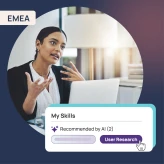
AI can help employees move from the goal to the next step by recommending personalized development actions based on context such as their role, selected skill, skill level, and existing capabilities. Employees can review those suggestions, refine their plan, and choose which actions they want to add as milestones.

A development plan becomes much more useful when it can change along with the person it belongs to.
Make learning part of the development path
A good development plan still needs opportunities for employees to build the capabilities they’ve identified. That’s where learning often becomes disconnected again.
Employees may know the skill they want to develop but still have to search through a large learning catalog to figure out what could help. Managers may know that someone needs development without knowing which resources are available. And once training begins, it can be difficult to see how that activity relates to the employee’s broader development goals.
With Adaptive Learning & Upskilling, Betterworks can recommend relevant learning courses from connected LMS platforms based on an employee’s development context, including their role, target skill, skill level, and existing capabilities. Betterworks has native integrations with Udemy for Business, Docebo, and LinkedIn Learning, allowing employees to review relevant courses and add selected learning directly to a Development Goal as a milestone.
Connected course progress can then flow back into Betterworks, keeping learning progress visible alongside the employee’s development goal rather than requiring a separate manual update.

What this means for workforce readiness
Taken separately, a better 1:1, a development goal, or a relevant course can improve an individual moment in the employee experience. The larger opportunity comes from connecting those moments over time.
A manager can carry useful context from one conversation into the next and use it to coach with a clearer understanding of what has happened. Employees can turn development priorities into goals with concrete actions and learning attached. As they make progress, development stays connected to the performance experience rather than becoming a parallel process that only resurfaces during a formal development conversation.
For HR and talent leaders, that creates a stronger connection between the development programs they invest in and the capabilities employees are actively working to build.
This matters because workforce readiness isn't something an organization can solve after the business identifies a gap. By then, the clock is already running. Building capability earlier requires development to become an ongoing part of how people work, learn, and talk about performance.
The Summer 2026 release moves Betterworks further in that direction.
What’s new in Betterworks this summer
What’s new | What it helps you do |
Turn 1:1 conversations into meeting recaps, action items, goal-related recommendations, and context for future conversations | |
Create structured Development Goals around skills or other growth priorities and track progress | |
Adaptive Learning & Upskilling | Recommend personalized development actions and relevant learning from connected LMS platforms, including Docebo, LinkedIn Learning, and Udemy, based on employee and skill context |
Zoom integration | Connect completed Zoom transcripts with Betterworks 1:1s without a Betterworks meeting bot |
Question Logic (Branching) | Add rule-based follow-up questions to scale ratings in scheduled Conversations, so managers see questions relevant to how they rated an employee |
Mobile App | Access meetings, recognition, goals, feedback, and Conversations from anywhere, with quick 1:1 agenda and action-item capture |
Calibration Enhancements | Give admins more control over who’s included in calibration cycles, self-serve reporting on outcomes, and full-language localization |
Build capability before the gap becomes urgent
The skills and capabilities an organization will need next aren't built the day a new role opens or a strategic priority changes. They're built over time as employees take on new challenges, get coaching, develop new skills, and apply what they've learned.
That’s why we're connecting more of those moments in Betterworks.
With Conversational Intelligence, Individual Development Plans, and Adaptive Learning & Upskilling, the Summer 2026 release gives employees and managers a more continuous way to turn what they learn through everyday work into meaningful development.
And it gives organizations a better opportunity to start building the workforce they'll need tomorrow while there's still time to develop it.
Ready to turn everyday performance conversations into meaningful employee development?
Book a Demo