360 Degree Feedback: Benefits, Barriers, & How to Use Them
By Melanie BaravikJune 20, 20179 minutes read
Share
Share
Updated August 10, 2026
A manager doesn’t see every part of an employee’s work. Peers may see how someone collaborates across teams. Direct reports may have a clearer view of a leader’s communication and coaching. Cross-functional partners may see how well that person follows through when priorities change.
That’s the appeal of 360 degree feedback: it gathers input from multiple perspectives.
But more feedback doesn’t automatically produce better insight. A 360 performance review can still be affected by bias, incomplete information, rushed responses, and weak follow-through. The process works best when human resources teams are clear about what they want to learn, choose people who have worked closely with the employee, ask focused questions, and use the findings for professional development.
A strong 360 process should complement regular feedback and formal performance evaluations, not replace them.
What is 360 degree feedback?
360 degree feedback is a structured feedback process that gathers input about an employee from multiple sources, often including their manager, peers, direct reports, cross-functional partners, and the employee through self-assessment.
Unlike a traditional performance review, which is usually led by the employee’s manager, 360 degree reviews focus on how different people experience an employee’s behavior at work.
That makes them especially useful for evaluating interpersonal skills that one manager may not observe directly, like communication, collaboration, delegation, and leadership behavior.
The best reviewers are people who work closely with the employee and have recent examples to draw from. Choosing reviewers because of title or familiarity alone can weaken the results.
A 360 performance review should also start with clear goals and connect to your organization’s leadership and talent strategy. If the goal is development, tell participants that. If the results will inform a broader performance management strategy, explain how.
Employees are more likely to take the process seriously when they know why HR is asking them to gather feedback and what will happen afterward.
3 benefits of using the 360 feedback process
Although managers remain an important source of performance feedback, they’re rarely the only people who can speak to an employee’s impact.
An effective 360 degree feedback system can add perspectives that are difficult to capture in a manager-only performance review.
Collect multifaceted feedback
A 360 degree feedback process brings together feedback from multiple sources rather than relying on one evaluator.
Managers, peers, team members, and cross-functional partners each see different parts of an employee’s work. A supervisor may have the clearest view of goals and business outcomes. Peers may see how the employee communicates and collaborates across teams. Direct reports can offer insight into managers’ style of delegating, coaching, sharing information, and problem-solving.
That wider perspective is useful, but it shouldn’t be treated as automatically objective. Every reviewer still sees only part of the picture.
The goal is to identify patterns across people who have worked closely with the employee, then consider those patterns alongside other evidence of employee performance.
Identify development opportunities
One of the strongest uses of a 360 performance review is finding development needs that a direct manager might miss.
For example, people on a cross-functional project may have better information about an employee’s communication or collaboration than a manager who wasn’t involved in the work.
The process can also reveal gaps between intent and impact. A manager might think they’re giving their team autonomy, while direct reports experience the same behavior as a lack of direction.
Those differences can give managers and employees a useful starting point for learning and development.
Rather than trying to respond to every comment, look for recurring themes. Then set goals around one or two behaviors that matter to the employee’s role.
That might mean:
Explaining priorities more clearly
Delegating with clear ownership
Giving feedback sooner
Handling disagreement more constructively
Following through on shared commitments
Greater self-awareness, feedback from multiple sources, and guidance on specific behaviors are the key benefits of well-designed 360 assessments.
Improve leadership effectiveness
360 degree reviews are particularly useful for managers and senior leaders because different groups experience their leadership in different ways.
A manager’s supervisor may focus on results and strategic alignment. Peers may see how that manager works across departments. Team members can speak to communication, coaching, fairness, and day-to-day leadership behavior.
The value, however, comes from what happens next. Managers need support to interpret the results, choose meaningful development priorities, and change behavior over time.
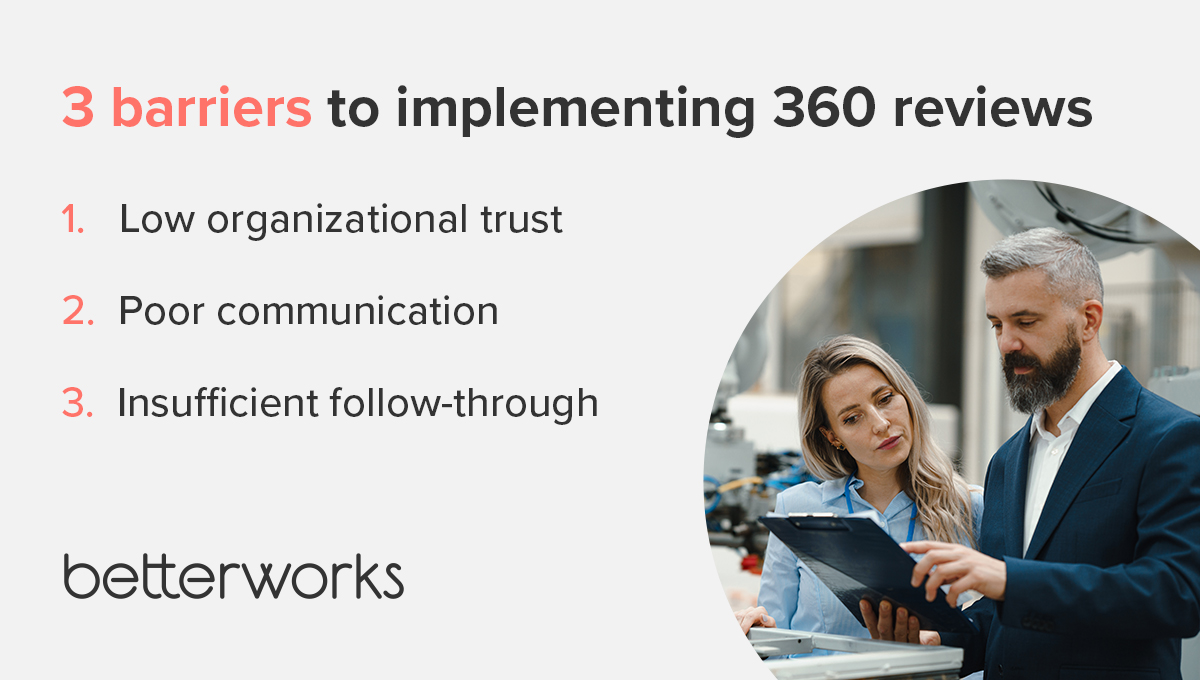
The mechanics of a 360 review matter, but organizational conditions matter too. Three barriers can undermine the process before the feedback is even collected.
Low organizational trust
Employees are unlikely to give useful upward or peer feedback if they don’t trust the process.
They may worry that negative comments will be traced back to them or that honest feedback will damage their relationship with a manager or colleague.
Your HR team should explain:
Who will see individual responses
Which feedback will be anonymous or aggregated
How small reviewer groups will be handled
How the organization will use the results
Whether feedback will affect formal performance evaluations
Trust also depends on what employees have seen before. If prior feedback disappeared into a report with no visible action, they’re less likely to give thoughtful feedback again.
Poor communication
Participants need to know what good feedback looks like.
Without clear instructions, reviewers may make broad judgments, comment on personality, or answer questions about behaviors they have not observed.
Before asking employees to gather feedback, explain that useful responses should focus on:
Work the reviewer observed directly
Specific behavior
The effect of that behavior
Patterns rather than isolated incidents
Suggestions the employee can act on
Open-ended questions can help when they are specific.
“Needs to communicate better” provides little direction. “Changes priorities without explaining what changed or who owns the next step” gives the employee something concrete to discuss.
Betterworks also offers practicalemployee feedback examples that HR teams can use to prepare employees and managers to give more actionable feedback.
Insufficient follow-through
A feedback process loses credibility when nothing changes afterward.
“One of the most frustrating things for people is that very rarely does anything ever come of these 360s,” Caitlin says. “There’s no benefit; there’s no output.”
A useful process ends with action.
Managers and employees should agree on one or two development priorities, decide what different behavior would look like, and revisit those goals during regular conversations.
This is where 360 degree feedback becomes part of professional development rather than a stand-alone HR exercise.
Examples of 360 performance reviews in action
A 360 performance review works best when reviewers have direct experience with the behaviors being assessed.
Leadership development programs
360 degree evaluations can help leaders understand how their behavior affects managers, peers, and direct reports. Learning and development teams can use recurring themes to focus coaching on specific behaviors such as communication, delegation, and collaboration.
Project-based feedback cycles
For cross-functional work, a direct manager may not see enough of an employee’s day-to-day contribution. Gathering feedback from people who worked closely with the employee can provide useful context while the work is still recent.
Open-ended questions might include:
What helped this project succeed?
What should this person do differently next time?
What should they continue doing?
Manager coaching and enablement
360 degree feedback can help managers understand how team members experience their leadership. HR can use recurring themes to guide coaching around areas such as expectations, feedback, delegation, and professional development.
The goal isn’t to label someone a good or bad manager. It’s to identify behaviors that help team performance or hold it back.
LivePerson’s AI-powered approach to 360s
Betterworks customer LivePerson offers one example of how an organization can make 360 feedback part of a broader performance process.
LivePerson uses Betterworks Feedback, AI Feedback Assist, and Feedback Summaries to gather and organize performance input, including bespoke 360 reviews. Its broader performance program also connects reviews with employee development and manager support.
LivePerson reports a 93% on-time review completion rate and a 50%–75% reduction in time spent on performance reviews after modernizing its approach with Betterworks.
The lesson is not that AI replaces managerial judgment. It is that technology can reduce some of the administrative work around gathering and organizing feedback, while managers remain responsible for interpreting the evidence, adding context, and coaching employees.
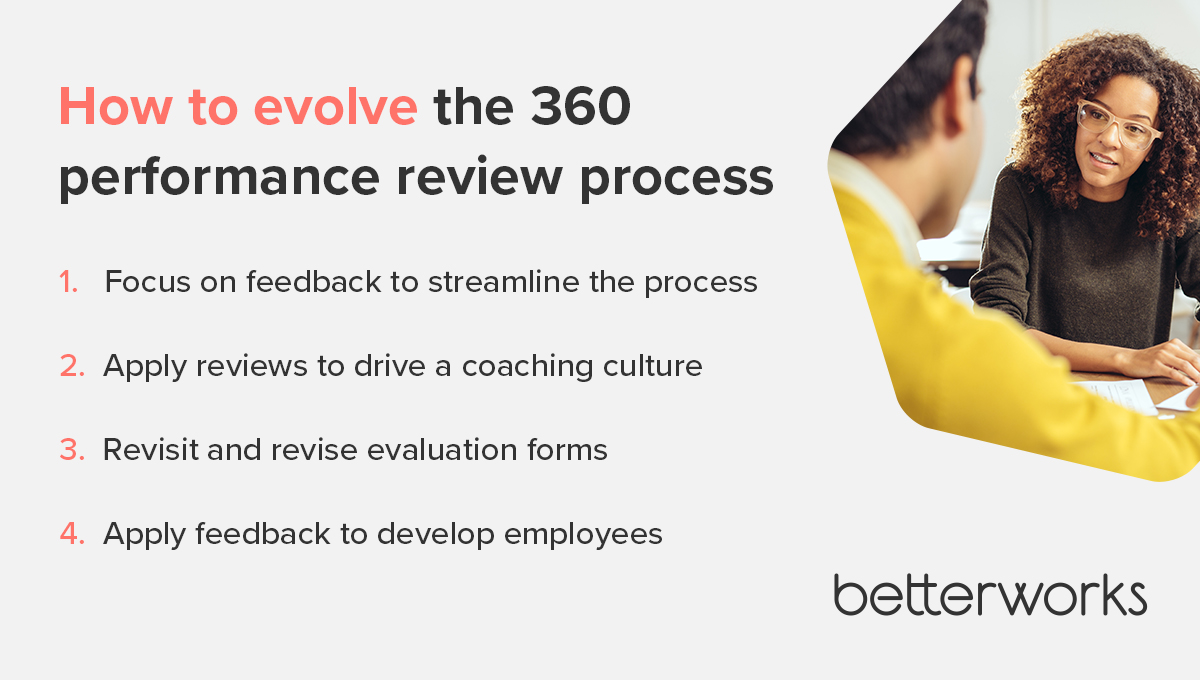
Organizations don’t necessarily need to abandon 360 degree reviews. If you want to keep using them, make them easier to complete, more useful for development, and better connected to the work employees are already doing.
Focus on feedback to streamline the process
Don’t wait for a formal 360 assessment to collect every useful observation about employee performance. Encourage managers, peers, and team members to give feedback closer to when work happens, creating a more real-time view of performance.
That creates more context over time and reduces the pressure to reconstruct months of work during a single review cycle.
A continuous record of real-time feedback can also make a later 360 review easier to interpret. Managers can compare point-in-time perceptions with examples, goals, and feedback already captured during the year.
Apply reviews to drive a coaching culture
A report doesn’t change behavior. Coaching does.
Managers need to talk through the feedback, help employees make sense of conflicting perspectives, and turn useful themes into action.
That means HR should prepare managers to:
Look for patterns across reviewers
Ask for context rather than jumping to conclusions
Separate behavioral feedback from personality judgments
Set goals around a small number of priorities
Revisit those goals during regular conversations
This keeps the 360 process focused on learning and development rather than simply completing another evaluation.
Revisit and revise evaluation forms
Long forms create work without necessarily improving the quality of feedback.
Review each question and ask what decision or development conversation it supports. Remove questions that are:
Duplicative
Too broad
Focused on personality
Difficult for reviewers to observe
Unlikely to lead to action
Use questions with rating scales for clear behaviors and a few open-ended questions when examples or context would make the feedback more useful.
Learn more with Betterworks’performance review examples. They include practical advice on gathering information, asking questions, and setting meaningful goals.
Apply feedback to develop employees
If you ask your people to give feedback, they should be able to see what happens because of it.
Managers can help employees turn the strongest themes into one or two development goals. For example:
“Communicate better” can become “explain changes in priorities and confirm next steps with affected team members.”
“Delegate more” can become “agree on the owner, outcome, deadline, and decision authority for major assignments.”
“Develop others” can become “discuss one growth priority in each monthly 1:1.”
Then keep the conversation going.
Betterworks Feedback supports employees and managers in exchanging real-time feedback during the work cycle and maintaining that context for future reviews. It’s especially relevant if you want the 360 process to be part of an ongoing feedback approach rather than a separate event.
Make 360 degree feedback one part of the performance picture
360 degree feedback can reveal behaviors and interpersonal skills that a manager may not see. But it’s still only one source of information.
The strongest performance management strategy combines 360 reviews with goals, ongoing coaching, documented outcomes, and regular performance conversations.
Betterworks Feedback can help organizations gather feedback closer to when work happens, giving managers and employees more context between formal reviews.