Performance Management Maturity: What It Means and How to Achieve It
By Melanie BaravikSeptember 3, 20269 minutes read
Share
Share
Key Takeways
Performance management maturity is about impact, not completion rates. The real question is whether your approach helps the business execute and make better talent decisions.
Evaluate maturity across Strategy, People, and Systems, and look at where those three areas reinforce or undermine each other.
Mature organizations make performance part of everyday work, with clear expectations, consistent manager behaviors, and data that informs action.
The four maturity stages — Initiating, Emerging, Embedding, and Optimizing — help you understand where you are and what needs to improve next.
You don’t need to mature everything at once. Focus on the biggest gap and the changes most likely to improve performance and business outcomes.
Performance management is running smoothly at your organization. Most employees track and update their goals, and review cycles run once or twice a year. It gets done on time, for the most part. But that’s just a small part of the picture.
How do you know if your performance management approach is actually helping the business execute and achieve its goals?
Completion metrics and goal adoption rates don’t tell you what kind of impact performance management has on the business — if any. You need to understand the maturity level of your performance management practices.
What is performance management maturity?
Performance management maturity describes how effectively an organization's performance strategy, people practices, and systems work together to connect employee performance with business and talent outcomes.
A mature program is well-documented, widely adopted, and has a clear purpose. It’s reinforced from the top, with leaders modeling the right behaviors. The processes — like giving feedback and setting goals — are embedded in the way your people work. Performance data consistently drives action, whether that’s promoting top performers or training a department in a much-needed skill.
But maturity doesn’t mean more processes, more technology, or higher completion rates. A company can run reviews on time and still have a relatively immature program if goals are disconnected from business priorities, managers participate inconsistently, or performance data is collected without influencing decisions.
Performance management maturity also isn’t all-or-nothing. An organization may be strong in one area and weaker in another. For example, it might have clear performance processes and sophisticated technology but lack consistent leadership modeling, or it may have strong executive support but weak governance and follow-through. Looking at maturity across multiple dimensions helps HR leaders identify the real gaps and where improvements are most likely to have the greatest impact.
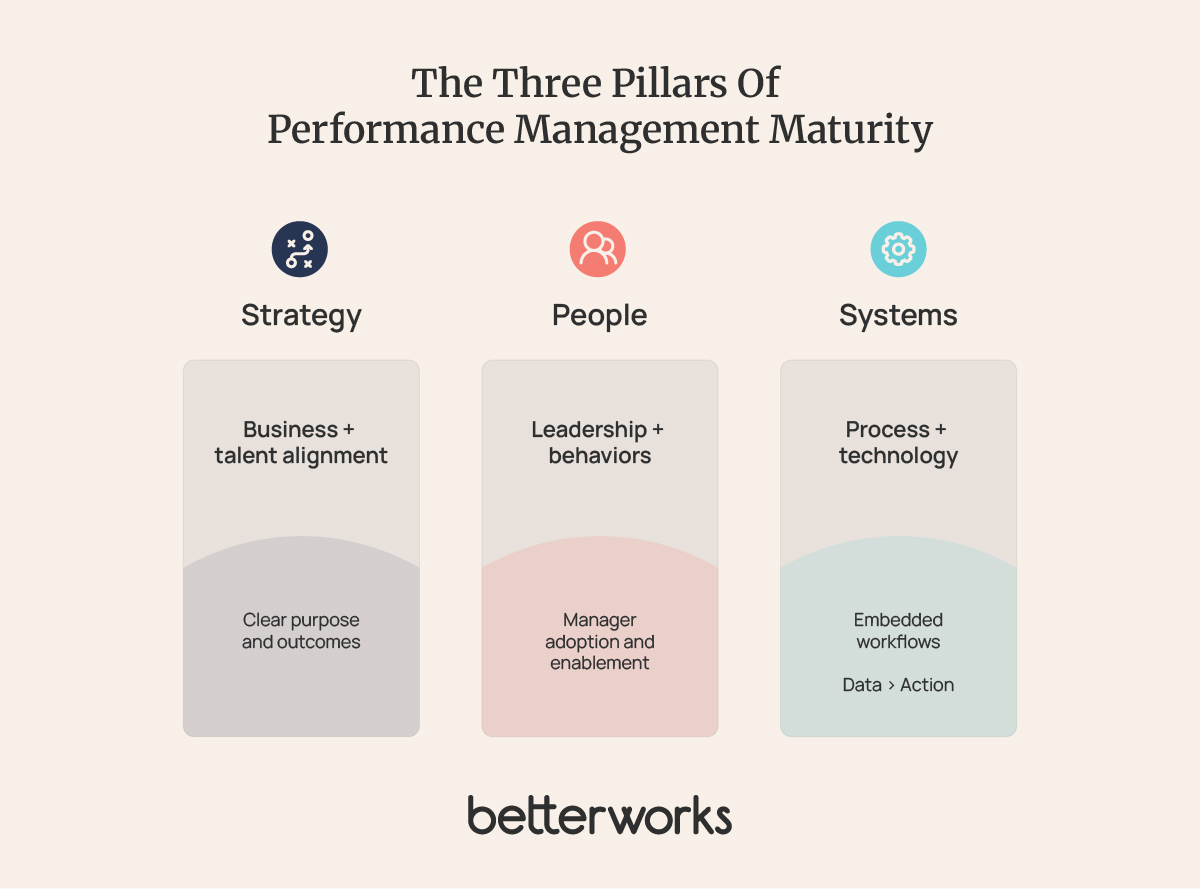
The Betterworks Performance Maturity Assessment evaluates those dimensions across three core pillars: strategy, people, and systems. Maturity levels for each pillar tell you if your performance strategies are built to support continuous improvement and stronger business outcomes.
Why performance management maturity matters
If your company’s performance management practices are essentially checkbox exercises, it’s likely that your organizational maturity is low. They’re technically completed, but they’re not contributing to your employees' growth, developing future leaders, or creating clarity around business impact.
Low performance management maturity shows up in predictable ways.
HR teams struggle to prove that performance processes influence business outcomes.
Managers approach goals, feedback, and coaching inconsistently, which creates very different employee experiences across teams.
Company strategy isn’t reflected in employee goals and priorities, leaving them unsure how their work contributes to business success.
Performance processes become compliance-driven, with employees completing check-ins and reviews because they’re required, not because they’re useful.
Your performance management system collects data, but it’s not used to inform talent decisions.
Performance technology is a standalone tool, disconnected from everyday workflows, resulting in low adoption.
A frustrating performance process isn’t the only impact on the business. Misaligned goals and inconsistent execution slow decision-making, create execution drag, and make it harder for the organization to move with clarity and speed.
Mature organizations aim to create a continuous performance management experience, where expectations are clear, feedback flows freely, and goals are shared.
The 3 pillars of performance management maturity
A mature performance management strategy depends on more than having the right process or technology in place. It requires three parts of the organization to work together: strategy, people, and systems.
The Betterworks Performance Maturity Assessment evaluates each of these pillars separately because an organization can be highly mature in one area and still have significant gaps in another.
1. Strategy
The strategy pillar looks at how clearly your performance management program aligns with broader business and talent priorities.
At a mature organization, performance management isn’t a standalone HR initiative. It also has clearer goals than just a vague need for performance improvement. It’s built to support both your people and the business in reaching goals.
Company priorities are clearly translated into goals and performance management decisions. Leadership understands how performance processes support business outcomes. There’s also clarity around how the program is designed, who makes decisions, and how those decisions are revisited over time.
This pillar also considers whether your organization is ready to evolve its approach to managing performance. That includes having the time, tools, support, and guardrails needed to test new practices, learn from them, and scale what works.
These questions can help gauge the strategic maturity of your approach:
Is the purpose of your performance program clearly tied to business and talent strategy?
Are company priorities translated into actionable goals and program decisions?
Is it clear who owns decisions about program scope, cadence, and success criteria?
Does your organization have a consistent way to test and adopt better approaches?
2. People
The people pillar measures whether leaders, managers, and employees are reinforcing the behaviors your performance strategy depends on.
Creating a strong performance process is the easy part — and it’s not what determines success. Mature organizations have successful programs because leaders visibly support them, managers consistently put them into practice, and employees understand what’s expected of them. Desired behaviors become part of everyday work through goal-setting, feedback, coaching, 1:1s, and team rituals.
This pillar also looks at whether employees are prepared to adopt new ways of working. That means changes are communicated clearly, employees have opportunities to give feedback, and people have access to the training and support they need to use the program effectively.
Ask these questions to get an idea of your org’s people maturity level:
Do leaders and managers consistently model the performance behaviors you expect from employees?
Are goals, feedback, and coaching part of normal team routines?
Do employees feel comfortable suggesting improvements to performance practices?
Are managers and employees given the training and support they need to participate effectively?
3. Systems
The systems pillar looks at whether your processes, technology, governance, and data consistently and effectively reinforce performance management.
In a mature organization, performance practices are embedded in existing workflows and formal processes. They’re not an extra task or a rare occurrence. Processes are documented and repeatable, roles and deadlines are clear, and expectations for participation and quality are actively monitored.
Just as important, performance data doesn’t sit unused. Mature orgs regularly review the information they collect, identify meaningful trends or outliers, and assign actions to owners. They use what they learn to improve programs and make talent decisions.
Get an idea of your systems maturity level with these questions:
Are performance practices embedded into the tools and workflows employees already use?
Are your processes documented and consistently followed across the organization?
Are expectations for leader and manager participation defined and enforced?
Does performance data regularly lead to concrete actions and decisions?
Looking at these three pillars together gives you a much more useful picture of performance management maturity than completion rates alone. More importantly, the gaps between them can show you where your performance strategy is most likely to break down and where to focus first.
A gap in strategy means performance management may be running without a clear connection to business and talent priorities.
A gap in people means the program may be well designed, but leaders, managers, or employees aren’t consistently reinforcing the behaviors it depends on.
A gap in systems means your strategy and behaviors may be sound, but inconsistent processes, disconnected tools, weak governance, or unused data make them difficult to sustain.
The goal isn’t to mature in every area at once. It’s to understand your current state, identify the biggest sources of friction, and prioritize improvements that will have the greatest impact.
The 4 stages of performance management maturity
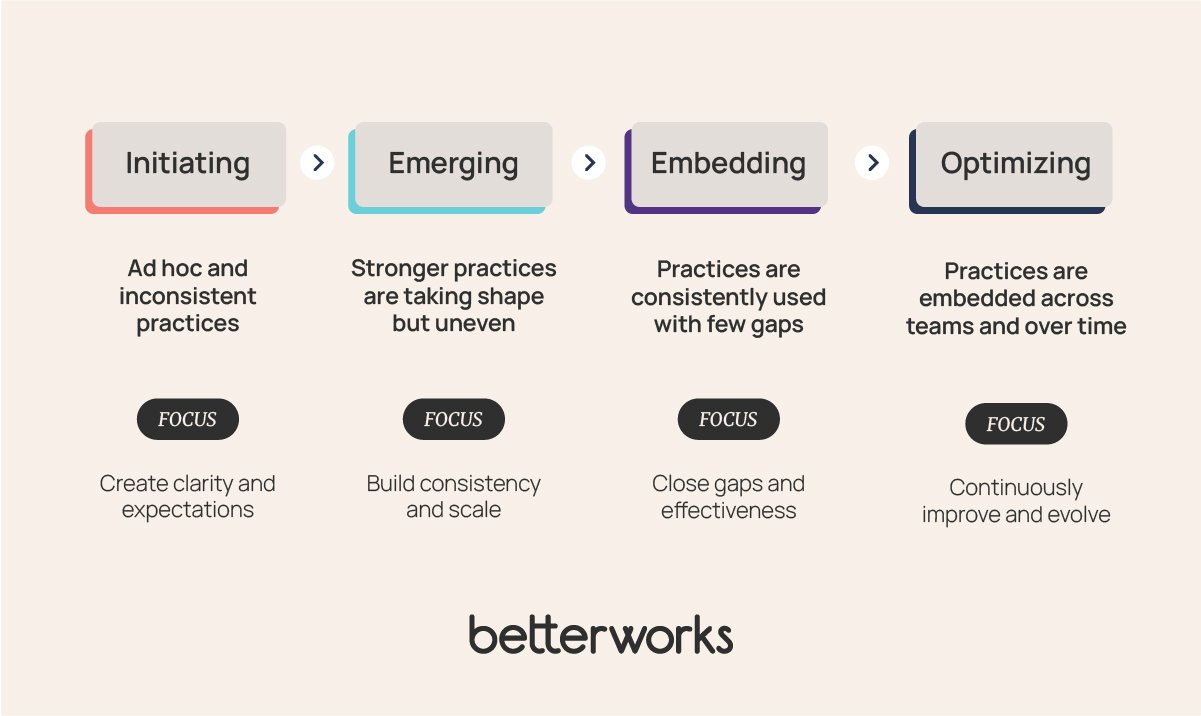
Our Performance Maturity Assessment uses four stages to rate organizational maturity across the three pillars. These stages — Initiating, Emerging, Embedding, and Optimizing — describe how consistently performance practices show up across the organization.
1. Initiating
At the Initiating stage, performance practices are still largely ad hoc. If they exist, they’re inconsistent, unclear, or reactive.
Different teams follow different review processes, managers approach goals and feedback in their own ways, and HR spends lots of time reminding people what to do and when. Performance management is happening, but it’s not operating as a consistent system.
At this stage, your priority is to create clarity. Define the purpose of your performance program, establish core expectations, and identify the processes and behaviors that need to be more consistent.
2. Emerging
At the Emerging stage, stronger practices are starting to take shape, but adoption levels are still low.
You have some teams or leaders using goals, coaching, feedback, and performance data effectively, while others still use an old approach. Processes are documented, but they aren’t always followed consistently. Leaders support the program, but that support isn’t visible across the organization.
The focus for Emerging organizations is on making existing processes consistent, repeatable, and scalable.
3. Embedding
At the Embedding stage, performance practices are in place and consistently used, with only a few remaining gaps.
Managers and employees know what’s expected of them. Performance processes are part of regular workflows and team routines. Company priorities are more consistently reflected in goals, and leaders have better visibility into participation, quality, and outcomes.
Organizations at this stage should focus on closing remaining gaps and strengthening the connections between strategy, people, and systems. The question shifts from “Are people following the program?” to “Is the program working as effectively as it could?”
4. Optimizing
At the Optimizing stage, performance practices are consistently embedded across teams and over time.
Performance management is closely connected to business and talent strategy. Leaders and managers model the expected behaviors, systems reinforce those behaviors in the flow of work, and performance data is regularly turned into insight and action.
An optimizing organization is not stagnant. Teams have the structure and support to test new approaches, learn from results, and make successful practices the new standard.
Reaching the Optimizing stage doesn’t mean your performance strategy is finished. It means your organization has built the habits, systems, and feedback loops needed to continuously improve as business priorities and workforce needs change.
And because maturity is assessed across strategy, people, and systems,your org may fall into different stages for each pillar. You might be Embedding when it comes to systems, for example, but only Emerging in people practices.
That’s useful information. The goal of this assessment isn’t to earn a top score. It’s to identify where your biggest gaps are and what to improve next.
How to improve performance management maturity
Start by evaluating your organization across all three pillars: strategy, people, and systems. The key is to score your organization based on what’s actually happening, not what your policies say should happen or what your strongest teams are doing.
Look at your performance practices over the past few quarters and ask:
Where are practices still ad hoc or inconsistent?
Where are good practices starting to emerge but not yet widespread?
Which practices are embedded across most of the organization?
Where are you consistently using insights to improve the way performance is managed?
Then compare your current state with where you want to be. The largest gap is often the best place to focus first.
If strategy is weakest, clarify the purpose of your performance program, connect it more directly to business priorities, and establish clearer outcomes and decision-making responsibilities.
If people is the biggest gap, focus on leadership modeling, manager behaviors, change readiness, and the training and support employees need to participate effectively.
If systems are holding you back, look for ways to embed performance practices into existing workflows, standardize processes, strengthen accountability, and turn performance data into action.
The ultimate goal isn’t just a more mature process. It’s about building a performance system that helps your people stay aligned, make better decisions, and execute on what matters most to the business.
Where does your org stand?
Ready to see where your organization stands? Find out fast: Start with the Betterworks Performance Maturity Snapshot to identify your biggest gaps and opportunities for improvement.
Performance management maturity describes how effectively an organization's strategy, people practices, and systems work together to connect employee performance with talent and business outcomes.
What is a performance management maturity model?
A performance management maturity model is a framework for evaluating how developed and consistent an organization's performance management practices are. The Betterworks model assesses maturity across Strategy, People, and Systems.
How do you assess performance management maturity?
Assess how performance management operates in practice across strategy, people, and systems, then compare your current state with your desired state to identify the largest gaps and priorities for improvement.
What are the stages of performance management maturity?
The Betterworks Performance Maturity Assessment uses four stages: Initiating, Emerging, Embedding, and Optimizing. They range from ad hoc and inconsistent practices to practices that are consistently embedded and continuously improved.
What does mature performance management look like?
Mature performance management is aligned with business priorities, reinforced by leaders and managers, embedded in everyday workflows, and supported by data that regularly informs actions and talent decisions.
How can an organization improve performance management maturity?
Start with the pillar where the biggest gap exists. That might mean strengthening strategic alignment, improving leadership and manager behaviors, or building more consistent processes, governance, and data-driven action.
Why does performance management maturity matter?
Understanding maturity helps organizations move beyond completion metrics and identify whether their performance practices are actually supporting employee growth, better talent decisions, and business outcomes.
What are the pillars of performance management maturity?
The Betterworks Performance Maturity Assessment evaluates three pillars: Strategy, which measures alignment with business and talent priorities; People, which measures the behaviors and support needed to sustain the program; and Systems, which measures the processes, technology, governance, and data that enable consistent execution.