Performance Management Is Not an HR Process — It’s a Business Execution System
By Aimie LimApril 14, 20267 minutes read
Share
Share
Key Takeways
Performance management is shifting from an HR-owned process to a continuous business execution system that helps organizations align work, adapt faster, and make better talent decisions.
Leading companies are replacing periodic reviews with real-time performance signals — including goals, feedback, coaching, and skills data — to improve visibility and decision-making.
CHROs play a critical role in this transformation, using performance data as strategic infrastructure to drive execution, strengthen managers, and connect talent strategy to business outcomes.
For a long time, performance management lived in a familiar box. It belonged to HR. It showed up on a calendar. It culminated in a review. It generated documentation.
That model made sense in a slower, more stable world.
It makes far less sense now.
In 2026, CHROs are under pressure to do something much harder than run a process well. They are being asked to help the business adapt faster, make better talent decisions, and turn AI from a talking point into something operationally useful. Gartner’s 2026 CHRO priorities reflect exactly that shift: realizing AI value, shaping work in the AI era, mobilizing leaders for growth, and addressing culture as a performance driver.
That changes the role performance management has to play.
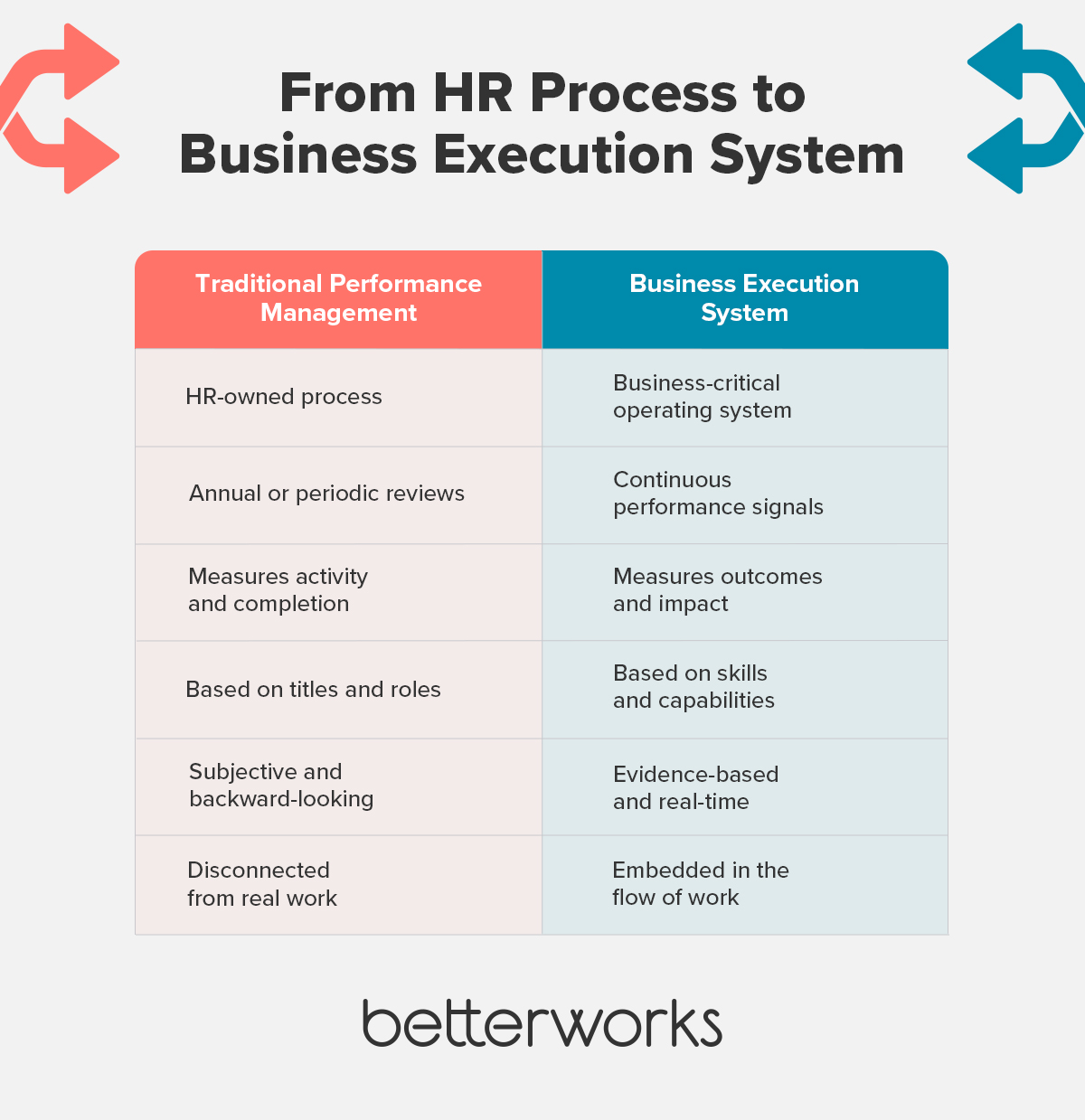
If performance is still treated as a periodic HR workflow, it will remain backward-looking, subjective, and disconnected from how work actually happens. But if it becomes a continuous system for capturing goals, feedback, coaching, skill development, and business progress, it starts to do something much more valuable: it helps the organization execute.
Why the Old Model Is Breaking Down
The problem with traditional performance management is not just that people dislike it.
Work changes faster now. Teams reorganize more often. Priorities shift mid-quarter. Managers are expected to coach, align, and develop people in environments shaped by hybrid work, tighter budgets, and growing AI adoption. Meanwhile, many organizations are still relying on annual reviews, delayed feedback, and goals that get written down once and then quietly ignored.
That leaves leaders with a shallow view of performance at exactly the moment they need a sharper one.
It also creates a strange contradiction. Companies want better decisions on promotions, mobility, succession, and manager effectiveness, but the data they use to make those decisions is often incomplete or stale. They want more agility, but their performance systems are still episodic. They want AI to help, but the signals feeding those systems were never built to support real-time decisions.
The World Economic Forum makes a similar point in its 2026 report on AI at work: organizations do not get transformation from AI just by deploying technology. They get it by redesigning workflows, management practices, governance, and decision systems around how work is actually done.
That is why this is no longer a conversation about improving an HR process. It is a conversation about whether the business has a reliable way to understand how execution is happening in real time.
What High-Performing Organizations Are Doing Differently
The companies pulling ahead are not necessarily the ones with the most AI pilots or the flashiest employee experience language. More often, they are the ones building better performance signal.
They are making goals more visible. They are creating more frequent coaching moments. They are connecting feedback to actual work instead of isolating it inside formal review cycles. And they are getting more serious about understanding skills not as static profiles, but as capabilities that show up in the work itself.
That shift matters because performance becomes more useful when it stops being a snapshot and starts becoming a stream.
A stream of signal tells leaders whether priorities are landing, where execution is slowing down, which managers are helping teams stay aligned, and where capability is emerging faster than the org chart suggests. It gives HR something more defensible than manager memory. It gives executives something more actionable than completion rates. And it gives managers a better starting point for coaching than instinct alone.
Why This Is Becoming a CHRO Issue, Not Just a Manager Issue
One reason this topic matters so much right now is that the burden has shifted upward. CHROs are no longer being evaluated only on whether a program runs. They are increasingly expected to help answer business questions.
Can the organization adapt quickly enough? Do leaders have visibility into talent and capability? Are managers actually improving performance, or just administering it? Is the company building the workforce it will need six months from now, not just describing the one it has today?
Those are not administrative questions. They are operating questions.
SHRM’s 2026 AI in HR research reinforces the pressure on HR teams to mature quickly. Its survey of 1,908 HR professionals found broad AI activity across the function, but also clear gaps in measurement and governance. In other words, organizations are experimenting, but many are still early in proving impact in a disciplined way.
That is exactly where performance data becomes more important.
If HR is going to play a bigger role in workforce strategy, it needs more than policy and process. It needs evidence. Not vague sentiment. Not isolated talent snapshots. Evidence grounded in goals, feedback, work progress, coaching patterns, and skill signals over time.
That is what makes performance useful at the executive level. It stops being a record of what happened during review season and starts becoming a way to see whether the business is building momentum or losing it.
The Quiet Variable in All of This: Manager Quality
A lot of transformation efforts fail in the same place: the manager layer.
That is not because managers do not matter. It is because they matter so much.
When priorities change, managers translate them. When employees need coaching, managers deliver it. When performance problems are caught early, it is usually because a manager noticed a pattern before a dashboard did. And when talent decisions feel arbitrary or late, it is often because the people closest to the work did not have the context, confidence, or cadence to act sooner.
Deloitte’s 2025 Global Human Capital Trends research found that 73% of organizations recognize the importance of reinventing the role of the manager, yet only 7% say they are making great progress.
That gap should get more attention than it does.
Most companies do not need managers to become amateur data scientists. They need them to have better signal: clearer goals, more visible progress, more frequent check-ins, richer feedback, and a more grounded picture of how people are contributing. When those things are present, coaching improves. When they are missing, performance conversations tend to become reactive, vague, or overly dependent on recency and perception.
This is one reason AI alone is not the answer. AI can help summarize, surface patterns, and reduce administrative drag. But it cannot rescue a broken signal environment. If the underlying inputs are inconsistent, disconnected, or thin, the output will be too.
Why Better Data Matters More Than More AI
There is a temptation right now to frame every HR problem as an AI opportunity. In practice, many of them are still data and workflow problems first.
The World Economic Forum’s 2026 report emphasizes that scaling AI requires trust, governance, and high-quality connected data. That is especially true in performance.
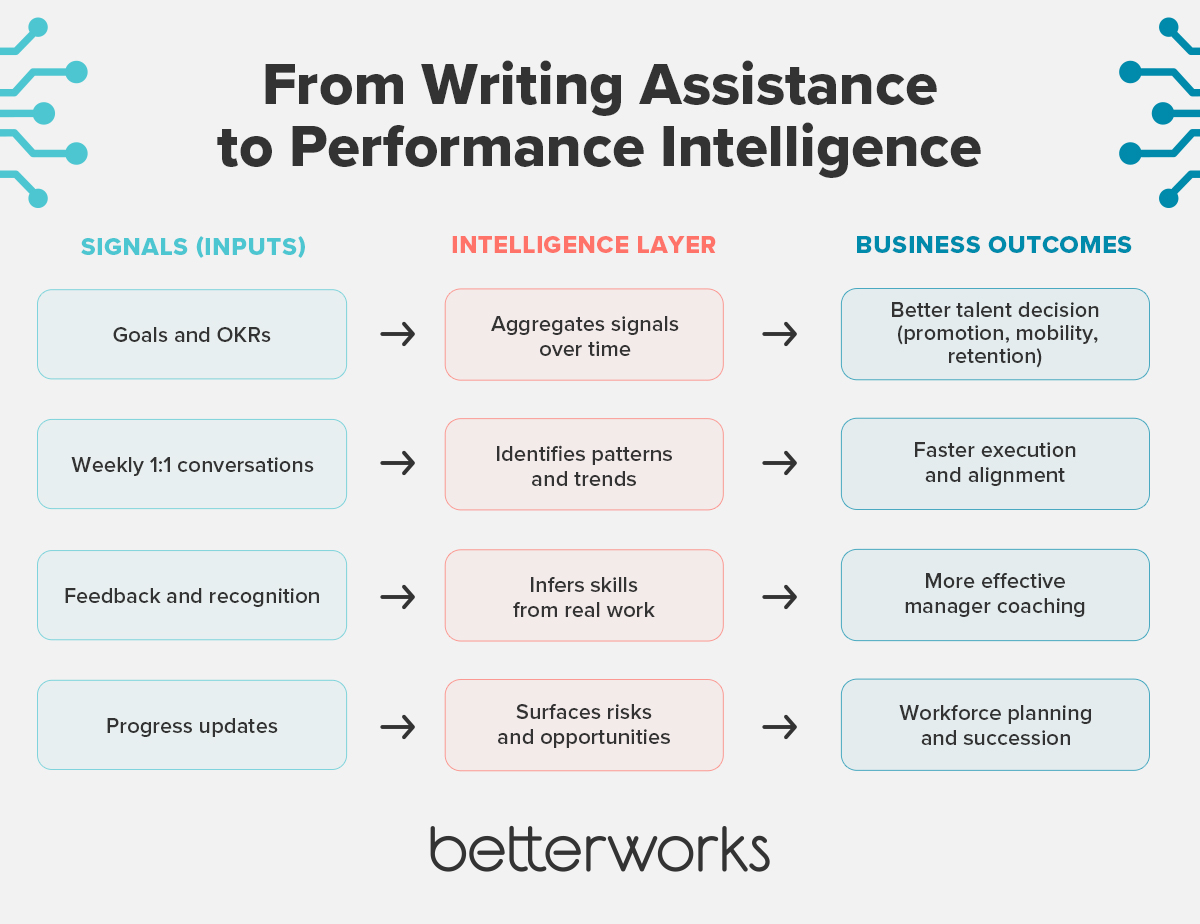
If organizations want better decisions on internal mobility, succession, promotion readiness, or emerging skills, they need better evidence about how work is happening. That means capturing signals continuously rather than periodically. It means connecting goals with feedback and coaching rather than treating them as separate rituals. And it means grounding decisions in actual patterns of contribution, not just polished year-end narratives.
This is where the distinction becomes important: the real advantage is not AI for documentation. It is AI supported by better performance signal.
When that foundation exists, leaders can move faster without feeling reckless. They can spot patterns earlier. They can make talent decisions with more confidence. And they can connect people strategy more directly to business outcomes.
What HR Leaders Should Change First
The instinct in moments like this is to redesign everything at once. That is usually a mistake.
A better starting point is to focus on the few changes that improve signal quality quickly.
One is to shorten the distance between work and conversation. If feedback shows up months after the fact, it loses much of its value. Another is to make goals active rather than ceremonial. If priorities move but goals stay frozen, the system stops reflecting reality. A third is to stop treating skills as a static inventory project and start looking for them in the work itself: what people are doing, how they are progressing, where they are adapting, and what kind of capability is showing up repeatedly.
Most of all, organizations need to stop thinking of performance data as something collected for HR records and start thinking of it as infrastructure for decision-making.
That is the shift.
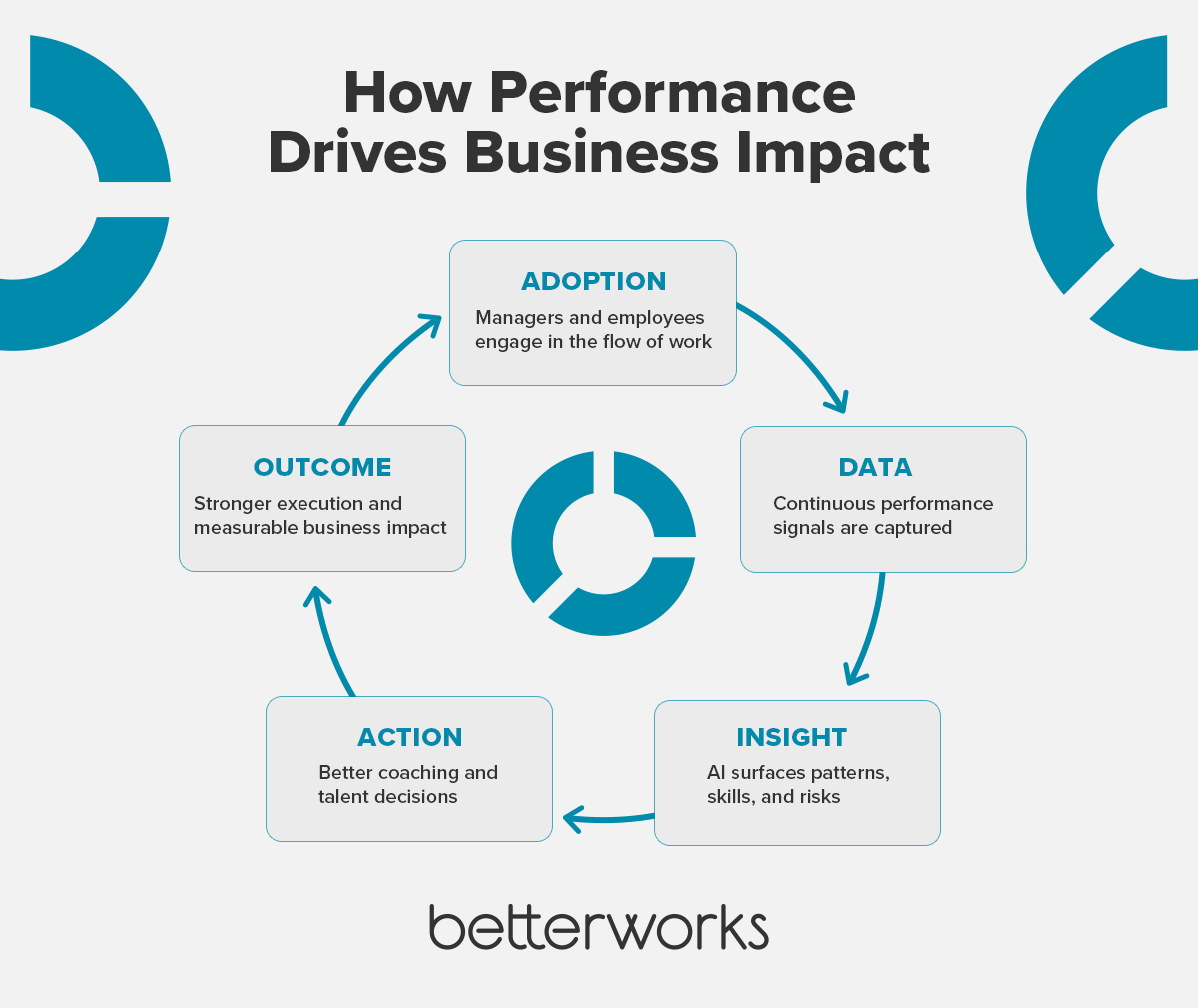
Not from human judgment to machine judgment. Not from managers to dashboards. From fragmented, episodic inputs to a continuous system that helps the business see more clearly.
The Opportunity in Front of CHROs
There is a stronger opportunity here than many HR leaders realize.
AI is already shaping how employees work, write, solve problems, and move through their day. The workplace is not waiting for HR to declare the moment official. The moment is already here.
The bigger question is whether HR will lead with a model that reflects this reality or keep relying on one built for a different era.
The CHROs who stand out over the next year will not just be the ones who talk most confidently about AI. They will be the ones who help their organizations build a better operating rhythm around performance itself: more continuous, more evidence-based, more connected to outcomes, and more useful for decisions that actually matter.
That is what turns performance into something bigger than a process.
It turns it into a business execution system.
Turn Performance Into a System for Better Decisions
When performance is continuous, connected, and grounded in real work, it becomes far more useful than a review cycle.
It becomes a practical advantage: a way to improve execution, strengthen manager effectiveness, and make smarter talent decisions with more confidence.