Quick Answer
-
Lattice is a well-regarded platform for organizations that need a straightforward way to launch performance management. For mid-market and enterprise companies with 500 or more employees, complex org structures, global workforces, or a need to connect performance directly to business execution, Betterworks is the stronger fit. The most common pain points with Lattice at scale are calibration tied to review cycles, goals that run separately from performance data, limited configurability for differentiated populations, and skills data that stays static rather than evolving with the work.
Lattice built a strong business by making performance management approachable. Clean interface, fast time to value, a product people can actually use without an implementation consultant on speed dial. For smaller, fast-moving teams, that simplicity is exactly the point.
But something shifts as organizations grow. The standardization that made performance easy to launch starts to constrain how performance actually runs. Calibration becomes a bottleneck locked to review cycles. Goals live in a separate workflow — or a spreadsheet — disconnected from review data. Global teams hit configuration walls. HR leaders find themselves managing workarounds instead of managing performance.

That is the pattern mid-market and enterprise buyers describe when they come to Betterworks. Not that Lattice is broken. But that they have grown past what it was designed for.
Here is what that evaluation typically surfaces.
1. Lattice calibration is tied to review cycles. Business decisions are not.
For most performance platforms, calibration happens when the review cycle opens. Talent decisions, succession conversations, and promotion readiness discussions get compressed into a short window, once or twice a year.
The problem is that the business does not wait for the next review cycle. A reorganization, a new leadership hire, a team scaling rapidly in a new market — these moments require talent decisions on the business's timeline, not HR's calendar.
Independent reviewers have flagged this as a consistent Lattice limitation. G2 users note that Lattice calibration is primarily useful during formal review periods, with limited flexibility for ongoing talent decisions outside that cadence. A 2025–2026 analysis citing G2 data describes Lattice's calibration as built "to structure the process, not resolve substantive talent questions" — with tools that "miss advanced rating adjustments" and make it "hard to surface the full picture when managers disagree."
Betterworks decouples calibration from the review cycle entirely by tying it to the talent profile instead. Calibration can happen when the business needs it, not only when a process allows it. Admins can create and configure bespoke calibration grids independently without vendor support. The full history of changes is visible across every session. And the data underneath each calibration decision comes from a continuous record of goals, feedback, check-ins, and outcomes — not a single review snapshot.
For organizations making faster decisions on internal mobility, succession, and performance differentiation, this architectural difference is one of the most operationally significant gaps between the two platforms.
2. In most Lattice environments, goals and performance reviews are two separate processes.
A pattern that appears often in Lattice environments: performance reviews live in Lattice. Goals live somewhere else — sometimes in a separate tool, sometimes managed outside the platform entirely.
Capterra reviewers note that goal tracking in Lattice requires extra setup and that connecting goal progress to performance data in a meaningful way is a recurring friction point. When review time comes, there is no reliable thread between what someone was trying to accomplish and how their performance is being evaluated. Reviews become assessments of behavior and impression rather than contributions to actual outcomes.
Betterworks connects OKRs, check-ins, feedback, and performance reviews natively in one system. Goals are set against business priorities. Progress updates happen in the flow of work. When a review opens, managers are working from a continuous record of real contributions — not a memory exercise completed the night before the deadline closes.
For organizations where the CEO, COO, or CFO has made it clear that people programs need to connect to execution, this is not a minor UX distinction. It determines whether performance management actually drives accountability or simply produces documentation.
3. Lattice tracks skills through structured frameworks. Betterworks infers them from the work being done.
Most approaches to skills data share a fundamental problem: they rely on what employees say they can do, or on a competency taxonomy built two or three years ago describing what a role was supposed to require.
By the time a skills inventory is complete, it is already dated. In a world where AI is reshaping job scopes faster than HR can update competency frameworks, static skills data creates a false sense of visibility. Leaders believe they know what their workforce can do. In practice, they are looking at a historical record of what their workforce used to do.
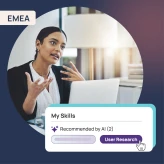
Betterworks Skills Intelligence, released in Spring 2026 as part of the new Talent Intelligence package, takes a fundamentally different approach. Skills are inferred from real work execution signals — goals, outcomes, feedback, and 1:1 conversations. They update continuously as work evolves. A manager verification layer adds human-in-the-loop accuracy, so the resulting picture combines AI inference with the contextual judgment of the people closest to the work.
The result is a dynamic, evidence-based view of workforce capability that leaders can actually use to make deployment decisions, identify succession candidates, and close capability gaps tied to business outcomes. Not a skills database. A skills intelligence layer built on what people are demonstrably doing.
Lattice Grow offers a structured career development framework that is genuinely useful for SMB organizations building defined career paths for the first time. But it is a competency architecture, not an inference engine. For organizations that need to understand what their workforce can actually do today — rather than what a role profile suggests they should know — the distinction matters practically.
4. Lattice's configurability has real limits at scale. Betterworks is built for organizational complexity.
Lattice's standardized approach to review templates and workflows is a deliberate product choice that serves smaller organizations well. Lower administrative overhead. Faster time to launch. A cleaner experience for employees who do not live inside the system every day.
That same standardization creates friction in organizations with differentiated employee populations. Different review processes for different business units. Multiple languages. Distinct calibration structures for global geographies. Manager populations that need separate frameworks from individual contributors. Role-specific templates that cannot follow a one-size-fits-all rubric.
Third-party reviews consistently note that Lattice has "limited appeal for very large enterprises with complex needs," particularly those operating across multiple regions or business structures.
Betterworks supports 29 languages and allows fully differentiated review templates, workflows, and calibration configurations by region, role, business unit, or any combination. HR administrators can build and modify configurations independently without needing vendor assistance. For global mid-market and enterprise buyers managing differentiated employee populations, this level of configurability is consistently one of the factors that moves Betterworks from a consideration to a clear preference.
5. Betterworks AI runs on private infrastructure. Lattice AI routes data through a third-party API.
For enterprise buyers, AI capability has become a procurement consideration — and not only for features. Where performance data goes when AI processes it is now part of serious evaluation conversations.
Lattice uses OpenAI via API to power its AI features, including AI Agent Plus with coaching and writing assistance. That means performance data — review content, feedback, goal information, compensation context — is processed through an external API.
Betterworks AI runs on a private, self-hosted large language model deployed on Betterworks' own cloud infrastructure. Performance data stays within the environment. Organizations retain full control over how data is processed, how quickly they can respond to regulatory changes, and what compliance commitments they can make to employees and stakeholders.
This is not a knock on Lattice's AI investment, which continues to expand with genuinely useful features. It is a question of infrastructure architecture. For security-conscious enterprise buyers, organizations in regulated industries, and companies subject to data residency requirements, the distinction is material and worth raising early in the evaluation.
6. Betterworks implementation is a partnership. Lattice's is more of a handoff.
Every Betterworks customer receives a named Program Architect and a custom statement of work. Implementation is scoped with defined success metrics. The relationship continues through structured executive business reviews, and Betterworks' professional services team brings expertise grounded in organizational psychology to help design programs that drive adoption — not just go live.
Lattice offers customer success support, but the model is more self-service oriented depending on engagement tier. Users on independent review platforms frequently cite the transition from implementation to ongoing support as a point where hands-on guidance decreases.
For organizations making a major investment in changing how performance runs, implementation quality directly affects whether the program drives real behavior change or becomes another system employees learn to work around. This is especially true for HR leaders who need to demonstrate the investment is translating into business impact — not just process completion rates.

Betterworks vs. Lattice: Side-by-Side
Capability | Betterworks | Lattice |
Calibration | Continuous, decoupled from review cycles, tied to the talent profile; bespoke grids configurable by admins | Tied to formal review cycles; no native year-round calibration |
Goals and OKRs | Native OKR platform connected to reviews, check-ins, and feedback in one system | Goal module exists; many customers run goals separately from performance |
Skills intelligence | AI-inferred from real work signals, dynamically updated, manager-verified | Structured competency framework via Lattice Grow |
Global configurability | 29 languages; differentiated templates, workflows, and calibration by region, role, and business unit | Less flexibility for complex global structures and differentiated populations |
AI infrastructure | Private, self-hosted LLM; performance data stays within the Betterworks environment | OpenAI-powered via external API |
Implementation | Named Program Architect, custom SOW, org psychology expertise, ongoing executive reviews | Customer success support; more self-service depending on engagement tier |
Target fit | Mid-market and enterprise, 500+ employees, complex or global structures | Strong fit for SMB; serves mid-market with less flexibility at scale |
Betterworks is built for organizations where performance is not an HR process to manage. It is the operating system through which strategy gets executed.
Book a DemoFrequently Asked Questions
Is Betterworks better than Lattice?
For mid-market and enterprise organizations with complex structures, global workforces, or a need to connect performance to business execution, Betterworks is the stronger choice. Lattice is well-suited to SMB organizations that value simplicity and a broad feature set. The right answer depends less on which platform has more features and more on which was designed for your level of organizational complexity.
What do Lattice users complain about most?
The most consistent themes in independent reviews of Lattice include reporting limitations and limited analytics customization; calibration tools that are primarily useful during formal review cycles rather than for ongoing talent decisions; difficulty connecting goal progress to performance data in a meaningful way; and limited flexibility for global or differentiated organizational structures. G2 and Capterra reviews from 2025 and 2026 reflect these themes across a broad base of users.
Does Lattice work for enterprise organizations?
Lattice serves enterprise customers, but its product is optimized for SMB simplicity. Enterprise organizations consistently encounter limits around calibration flexibility, global configuration, and the connection between goals and performance that Betterworks handles natively. For organizations with multiple business units, distributed global workforces, or sophisticated talent processes, those gaps tend to compound over time.
How does Betterworks handle calibration differently than Lattice?
Betterworks decouples calibration from the performance review cycle by tying it to the talent profile instead. This means calibration can happen when the business needs it, not only when a review cycle is open. Lattice calibration is more tightly linked to formal review events, with no native support for continuous or year-round calibration. For organizations making faster, more defensible decisions on succession, internal mobility, and performance differentiation, this is a meaningful capability gap.
What is Betterworks Skills Intelligence and how is it different from Lattice Grow?
Betterworks Skills Intelligence infers skills from real work execution signals — goals, outcomes, feedback, and 1:1 conversations — and updates continuously as work evolves. A manager verification layer adds human-validated accuracy on top of AI inference. Lattice Grow is a structured career development and competency framework: it defines what skills a role should have, rather than inferring what skills an employee is actively demonstrating. For organizations that need a live view of workforce capability rather than a static competency inventory, the distinction matters practically.
What is the best Lattice alternative for mid-market companies?
Betterworks is the strongest Lattice alternative for mid-market companies that need deeper performance flexibility, continuous calibration, connected OKR management, and evidence-based talent decisions. The combination of a native OKR platform, AI-driven Skills Intelligence, a dedicated implementation model, and 29-language localization makes Betterworks the preferred choice for organizations that have outgrown a standardized approach.
How is Betterworks AI different from Lattice AI?
The primary difference is infrastructure. Betterworks AI runs on a private, self-hosted large language model on Betterworks' own cloud infrastructure, meaning performance data never leaves the environment through a third-party API. Lattice uses OpenAI via API to power its AI capabilities. Beyond architecture, Betterworks AI is embedded throughout the continuous performance workflow — goal creation, writing support, check-ins, performance narratives, and skills inference from real signals — designed to reduce friction in the flow of work. For enterprise buyers with data governance or compliance requirements, the infrastructure distinction is a material part of the evaluation.