Key Takeways
-
The best performance calibration software for mid-market and enterprise organizations in 2026 is Betterworks — the only platform that connects calibration to live performance data, Unified Talent Profiles, skills intelligence, and HRIS sync in one system.
-
For mid-market teams that need configurable review workflows with solid calibration capabilities, Lattice is a strong option.
-
For organizations running engagement-first programs who want calibration paired with survey benchmarks and DEI insights, Culture Amp covers the fundamentals well.
-
This guide reviews seven platforms in depth — with feature breakdowns, honest limitations, and a clear decision framework for organizations with 500 or more employees.
What is performance calibration software?
Performance calibration software helps organizations ensure that performance ratings are consistent, fair, and defensible across teams and managers. Without it, two employees who perform at the same level but report to different managers often walk away with very different ratings — not because of what they've done, but because of how each manager evaluates and communicates.
The best platforms go beyond distributing a spreadsheet before a meeting. They bring together the data leaders need to make good decisions — performance history, goals, skills context, feedback signals — in the same workflow where calibration is actually happening. They support flexible cycles that can run outside of annual reviews. And they create an audit trail so every decision is traceable if it gets challenged.
For organizations with 500 or more employees, this distinction matters. The administrative overhead of manual calibration compounds quickly at scale, and the risk of inconsistency — across geographies, business units, or matrixed structures — grows with every new manager in the room.
Performance calibration software comparison for 2026
Tool | Best for | Key features | Ideal customer size | Integration depth |
Betterworks | Best overall calibration software | Live talent profiles, flexible cycles, HRIS sync, multiple visualizations, change history, OKR + skills connection | 500–10,000+ employees | Deep HRIS integration + Slack, Teams, Jira, Salesforce |
Lattice | Configurable review-to-calibration workflows at mid-market scale | Rating distributions, 9-box grid, CSV bulk edits, compensation planning integration | 200–2,000 employees | Native HRIS (Lattice HRIS) + Slack, Teams |
Culture Amp | Calibration tied to engagement data and DEI benchmarks | Ratings matrix, calibration views, activity log, survey + calibration in one platform | 500–5,000 employees | Standard HRIS sync |
15Five | Teams anchoring calibration in continuous check-in data | 9-box Talent Matrix, Best-Self Review calibration sessions, check-in to review connection | 100–1,000 employees | Standard HRIS sync |
Leapsome | Mid-market teams connecting calibration to learning and development | Calibration as a Pro feature, goal and OKR alignment, learning module integration | 100–1,000 employees | Standard HRIS sync |
Workday | Enterprises already fully committed to the Workday ecosystem | Multi-level sessions, audit trails, advanced compliance, deep configuration | 2,000+ employees | Full HCM suite |
SAP SuccessFactors | Global organizations with complex compliance-driven calibration requirements | Enterprise-grade calibration, compliance tooling, global HR data management | 5,000+ employees | Full HCM + ERP |
Why calibration keeps breaking down
Most calibration processes weren't designed for how work happens today. They were built around the annual review cycle: collect ratings, export a spreadsheet, schedule a meeting, debate, finalize. That cadence was a reasonable fit when performance conversations happened once a year and every employee sat in the same building. It isn't anymore.
A few specific failure modes are worth naming directly.
The data being used is stale by the time anyone looks at it. Most calibration sessions run on review summaries written weeks earlier, working from whatever managers remember about the past 60 days. Goals were set, feedback was exchanged, projects were completed — but none of that signals make it into the room. Leaders calibrate against a point-in-time snapshot, not against how people are actually performing right now.
Recency bias is structural. When the only information available is a static summary and manager memory, decisions default to what's most recent and most memorable. This isn't a manager character flaw — it's a process design problem. When the data can't counterbalance what happened last month, recent events dominate.
Manual processes don't scale. HR teams routinely spend significant time pulling calibration data from multiple systems — HRIS exports, performance review platforms, manager spreadsheets — then stitching it together before a session. By the time it's assembled, parts of it are already out of date.
For organizations with 500+ employees, these failure modes compound. Inconsistency between managers who've never met, ratings that can't be defended in a pay equity audit, calibration data that doesn't flow into succession planning or promotion decisions — these stop being inconveniences and start being business risks.
The right calibration software doesn't just digitize the same broken process. It changes the inputs.

Top performance calibration software for 2026

Betterworks — best overall calibration software
What makes it different
Most platforms treat calibration as a module that activates once a year, runs its cycle, and goes dormant. Betterworks treats it as the moment where continuous performance intelligence becomes a talent decision. The Calibration module was completely rebuilt for the Spring 2026 release — cycles configure and launch directly in the product, with no IT involvement, and they're designed to run anytime, not just at annual review. When a reorg happens or a promotion window opens, calibration runs immediately.
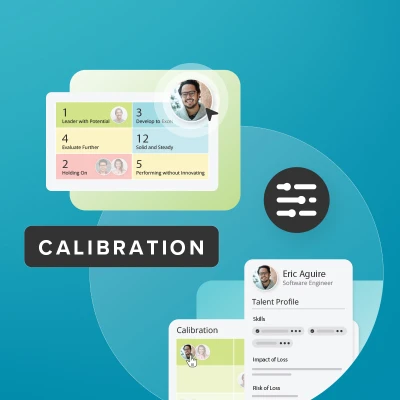
What leaders see inside a session is different from what legacy tools provide. Instead of working from a static rating summary, managers and HR access each employee's Unified Talent Profile directly within the calibration workflow — performance history, skills data, active goals, feedback signals — built from the actual work being done. HRIS data syncs in automatically, so tenure, level, and compensation context are already in the room. Multiple visualizations within a single session, scoped visibility for matrix and cross-functional teams, and a traceable change history round out the workflow.
This isn't a standalone calibration tool. Decisions made in a session flow directly into Skills Intelligence, Succession Planning, and Insights — so calibration becomes the start of a talent decision, not the end of a paperwork cycle.
Key features
Flexible calibration cycles — run anytime, not just at annual review
Live Unified Talent Profiles in-workflow — performance, skills, feedback, and goals accessible without switching systems
Multiple visualizations within a single calibration session, pre-configured for easy analysis
HRIS and external data sync — tenure, level, compensation context included without manual assembly
Matrix and cross-functional team support with scoped visibility
Clear change history — traceable audit trail of rating shifts and who made them
Part of a connected system: calibration outcomes flow into Succession and Talent Intelligence

Ideal customer size
Mid-market and enterprise organizations with 500 or more employees, including those in fast-growth, multi-geo, or matrixed structures. Betterworks is built to scale with the organization — companies that implement at 500 employees don't face a rearchitecting problem at 3,000.
Strengths and limitations
Strengths: The deepest integration between calibration and live performance data of any platform on this list. Flexible cycles that aren't locked to annual reviews. Talent profile context built from real work signals, not self-reported data. Native support for matrix and cross-functional complexity. Connected to succession, skills, and insights in one system.
Limitations: Betterworks is built for organizations that take performance management seriously — it's not a check-the-box tool. Teams that want a lightweight calibration add-on without broader performance infrastructure should weigh whether the full platform is the right fit for where they are today.
Skip this if: You have fewer than 500 employees and aren't yet running structured performance programs. You're primarily looking for a standalone calibration tool with no plans to connect it to broader talent decisions.
See how Betterworks Calibration works →
See how Betterworks Calibration works.
Book a DemoLattice — best for configurable review-to-calibration workflows at mid-market scale
What makes it different
Lattice has one of the more functional calibration modules in the mid-market, and it's been actively invested in. The April 2026 updates added bulk calibration settings, participant access management across groups, and direct links to calibration groups that make it easier to run sessions across larger organizations without manual reconfiguration each cycle.
Inside a session, HR teams can see rating distributions across managers — bell curve views, 9-box grids — adjust individual scores directly, or upload bulk changes via CSV. The workflow connects to compensation planning, so calibration notes and ratings flow into compensation recommendations. AI summaries of calibration insights are also available.
For mid-market teams that want a solid review-to-calibration flow, and especially for organizations already running Lattice for performance reviews, it does the job.
Key features
Rating distribution views across teams (bell curve, 9-box)
Direct score adjustments and CSV bulk upload
April 2026 updates: bulk apply settings and participant access across groups, calibration group links
Connection to compensation planning workflows
AI-generated calibration summaries
Ideal customer size
Mid-market organizations, roughly 200 to 2,000 employees, that want an integrated performance and calibration experience within a single platform.
Strengths and limitations
Strengths: Well-designed interface; configurable review cycles; established calibration module with recent improvements; direct connection to compensation planning.
Limitations: Calibration in Lattice surfaces statistical patterns — rating distributions, outliers — but doesn't bring employee context from live performance signals into the session the way Betterworks does. For organizations that need calibration grounded in ongoing work and current talent data rather than a point-in-time review cycle, there's a meaningful gap. Modular pricing can add up for the full feature set.
Skip this if: You need calibration to run independently of annual review cycles. You want live performance data and skills context in the calibration workflow. You're managing significant org complexity across matrix teams or multiple geographies.
Culture Amp — best for calibration tied to engagement data and DEI benchmarks
What makes it different
Culture Amp is one of the better-known platforms in the people management space, and its core strength is engagement surveying and benchmarking. The performance module includes calibration, and the Ratings Matrix — added in 2025 — gives HR and HRBPs a visual view of how performance ratings distribute across scales like a 9-box or 4x4 grid, with the ability to adjust ratings in real time and track changes through a calibration activity log.
The value for Culture Amp customers is the proximity of calibration to engagement data. Organizations that are already running pulse surveys, DEI analytics, and manager effectiveness tracking can hold both views — engagement signals and performance calibration — within the same platform.
Key features
Calibration Views — create and share calibration cycles with configurable access
Ratings Matrix — visualize performance distribution across rating scales in real time
Calibration Activity Log — visible record of all rating changes
Compare with Past Cycles — view performance rating history across review cycles
CSV bulk import for calibration ratings
AI-powered highlights and opportunities to surface themes from feedback
Ideal customer size
Mid-market to enterprise organizations, typically 500 to 5,000 employees, that want calibration integrated with engagement benchmarks and DEI reporting.
Strengths and limitations
Strengths: Strong engagement and benchmarking infrastructure; calibration and engagement data under one roof; science-backed review templates; AI-powered feedback summaries.
Limitations: Engagement is Culture Amp's core strength — calibration is a meaningful but secondary capability. For organizations where calibration is the primary buying requirement, the depth of the performance module may not match platforms built specifically around the performance workflow. Some users note that accessing calibration support requires working through a customer success team rather than directly in the product.
Skip this if: Calibration is a primary need rather than a complement to your engagement program. You need flexible cycles outside of annual reviews. You want live performance and skills data surfacing automatically in the calibration workflow.
Learn more about Culture Amp →
15Five — best for teams anchoring calibration in continuous check-in data
What makes it different
15Five built its product around a continuous check-in model — the idea that weekly touchpoints between managers and employees create a richer, more current performance picture than annual forms. The calibration capability, part of the Best-Self Review product and available on Perform and Total Platform plans, connects to that check-in data.
The Talent Matrix — a 9-box grid view — lets HR and managers visualize performance versus potential across the organization, which is particularly useful for identifying high performers and succession candidates. Calibration sessions allow managers to see rating distributions and adjust them based on cross-team discussions.
For growing organizations that have built their performance culture around continuous feedback and want to extend that data into a calibration process, 15Five offers a coherent path from check-in to review to calibration.
Key features
9-box Talent Matrix for visualizing performance vs. potential
Calibration sessions tied to Best-Self Review cycles
Rating distribution visibility across teams
Check-in data informs performance context
Available on Perform and Total Platform plans
Ideal customer size
Smaller mid-market organizations, roughly 100 to 1,000 employees, especially those that have built a strong check-in habit and want to extend it into calibration.
Strengths and limitations
Strengths: Coherent connection from weekly check-ins to performance reviews to calibration; approachable UX; useful for manager enablement and coaching culture; strong for teams that are building their first structured calibration process.
Limitations: Calibration capabilities are lighter than more specialized platforms. For organizations managing complex organizational structures, multi-geo teams, or matrixed reporting, 15Five may not provide the depth needed. Advanced enterprise calibration workflows — flexible cycles, live talent profiles, HRIS sync, change history — are more limited here than on purpose-built enterprise platforms.
Skip this if: You're managing calibration across a complex matrixed organization. You need calibration to run outside of review cycles. You need live skills and performance data feeding into each session rather than review-cycle exports.
Leapsome — best for mid-market teams connecting calibration to learning and development
What makes it different
Leapsome takes a modular, all-in-one approach: performance reviews, goals and OKRs, engagement surveys, learning paths, and compensation tools are designed to work together in a single platform. Calibration is available as a Pro feature that organizations can enable through module settings once they're ready to expand their performance program.
The connection to learning and development workflows is where Leapsome differentiates. For organizations that want to use calibration outcomes to feed directly into development plans — identifying skill gaps and linking them to learning paths — the integration between these modules is more native than in most platforms. Leapsome also has a strong footprint in European markets and is built with GDPR compliance architecture that matters for globally distributed teams.
Key features
Calibration as a Pro feature — configurable through module settings
Goal and OKR alignment within the same platform
Connection to learning module for development-linked calibration outcomes
Customizable review cycles and feedback workflows
ISO 27001 certified and GDPR compliant
Ideal customer size
Mid-market and scaling organizations, roughly 100 to 1,000 employees, especially those with European teams or organizations that want to manage performance, learning, and engagement in one product.
Strengths and limitations
Strengths: Strong integration of performance, learning, and engagement in one system; European compliance architecture; modern UX; well-regarded by customers for performance review and goal management.
Limitations: Calibration is a Pro feature rather than a core differentiated capability — it's available but not the product's primary strength. Organizations requiring advanced enterprise calibration depth, complex multi-level sessions, or live performance data in the calibration workflow may find limitations as they scale. The platform is noted as better suited to mid-market than to large enterprise complexity.
Skip this if: Enterprise-grade calibration is a top-three buying requirement. You need calibration connected to live performance signals from goals, feedback, and 1:1s rather than periodic review cycles. You have a workforce significantly above 1,000 employees with complex org structures.
Workday — best for enterprises already committed to the Workday ecosystem
What makes it different
Workday is one of the most widely deployed HCM suites in enterprise organizations, and its calibration capabilities sit within that broader system. For organizations already running Workday for payroll, HR records, benefits, and workforce analytics, the calibration module allows those teams to keep talent decisions within a unified data model without adding another system to the stack.
Workday's calibration supports multi-level sessions, audit trails, and a level of compliance infrastructure that matters in heavily regulated industries. The trade-off is that configuring Workday's calibration to match an organization's actual workflow is a significant undertaking — implementation timelines are measured in months, and configuration typically requires specialized expertise.
Key features
Calibration within a unified HCM and workforce analytics system
Multi-level session support
Compliance and audit trail infrastructure
Integration with Workday's broader payroll, benefits, and talent modules
Ideal customer size
Large enterprises with 2,000 or more employees that are already using Workday as their system of record and prefer to keep calibration within the same ecosystem.
Strengths and limitations
Strengths: Unified HR data model — no integration layer needed if you're already on Workday; strong compliance infrastructure; enterprise-grade security; audit capabilities well suited to regulated industries.
Limitations: Implementation is complex and time-intensive; calibration configuration typically requires specialized resources. The performance module has historically been seen as a secondary capability compared to Workday's payroll and compliance strengths. Organizations that need agile, frequently iterated calibration — or that want live performance signals and skills data in the calibration workflow — may find the Workday approach too rigid.
Skip this if: You're not already on Workday and don't have the implementation budget and timeline. You need a flexible, configurable calibration experience that can adapt quickly as your performance programs evolve. You want calibration connected to continuous performance data rather than locked to HR system configurations.
SAP SuccessFactors — best for global organizations with compliance-heavy calibration requirements
What makes it different
SAP SuccessFactors is an enterprise HCM suite used primarily by large multinationals that need to manage HR, compliance, and performance data across many countries and labor frameworks. Its calibration capabilities are extensive and designed for enterprise complexity — with the audit infrastructure, governance controls, and data security standards that organizations in regulated industries require.
For organizations already running SuccessFactors as their global HR backbone, the calibration module allows talent decisions to stay within a system that's already holding employee records, payroll data, and compliance documentation.
Key features
Enterprise-grade calibration within a full HCM suite
Extensive compliance and audit features
Global workforce data management across regions
Joule AI assistant for HR workflows
Integration with broader SAP ERP ecosystem
Ideal customer size
Very large multinationals, typically 5,000 or more employees, with significant compliance requirements across global operations.
Strengths and limitations
Strengths: Compliance infrastructure at global scale; full HCM suite for organizations that want everything in one system; strong security and data governance.
Limitations: SuccessFactors is a complex system — setup for calibration requires significant configuration time and specialized implementation support. The performance management module is widely noted for prioritizing documentation and compliance over continuous, manager-driven performance enablement. Organizations that need agile, iterative calibration or want live performance intelligence in their calibration workflow are likely to find the system doesn't adapt quickly.
Skip this if: You're not managing global compliance complexity at scale. You need a performance-first platform that calibration connects naturally to. You want to run calibration outside of annual review cycles or need live performance data surfacing in each session.
Learn more about SAP SuccessFactors →
How to choose the right calibration software
The right platform depends on what you're actually trying to solve — and what your organization looks like today.
Start with the data question. Most calibration problems are data problems. If your calibration sessions run on stale review summaries and manager memory, a new visualization tool doesn't fix the underlying issue. Look for platforms where the data feeding into calibration comes from the actual work — goals, feedback, 1:1s, skills signals — not just from what someone wrote in a form at the end of a cycle.
Think about how your organization actually runs. Matrix structures, cross-functional teams, and multi-geo organizations all add complexity to calibration. Not every platform is built to handle that. If your org has dotted-line managers, shared team members, or business units with different rating norms, test specifically for those scenarios before committing.

Decide whether you want a point solution or a connected system. Standalone calibration tools do one thing. Platforms like Betterworks connect calibration to succession, skills intelligence, and talent mobility — so decisions made in a calibration session actually flow into the next planning conversation. That connection has compounding value over time.
Don't overlook the cycle flexibility question. Annual calibration is increasingly mismatched to how organizations operate. Reorgs, promotions, and leadership changes happen throughout the year. If a platform's calibration is locked to review season, you're always calibrating on delayed information when it actually matters.
For mid-market buyers (500–2,000 employees): The best platforms for your size are purpose-built for performance — not calibration buried inside a payroll system. You want something that's fast to configure, doesn't require a multi-month implementation, and will grow with you as your org scales.
For enterprise buyers (2,000+ employees): Depth matters more at this scale — flexible cycle management, matrix org support, HRIS sync, change history, and the ability to connect calibration to succession and mobility decisions.
Frequently Asked Questions
What is performance calibration software?
Performance calibration software is a tool that helps organizations review and align employee ratings across managers and teams to ensure consistency and fairness before those ratings drive compensation, promotion, or succession decisions. Without it, two employees with the same performance level can receive very different ratings simply because their managers evaluate differently.
How is modern calibration software different from traditional processes?
Traditional calibration relies on manually assembled spreadsheets, static review summaries, and whatever each manager remembers from the past few months. Modern platforms bring live performance data, skills context, and HRIS records directly into the calibration workflow — so decisions are based on evidence from the actual work, not reconstructed narratives.
What features should I look for in calibration software?
The most important features are: live or continuous performance data in the calibration workflow, HRIS integration so tenure and compensation context are already available, flexible cycle configuration that isn't locked to annual review season, matrix and cross-functional team support, multiple visualization options, and a visible change history for audit and compliance purposes.
Can calibration software reduce bias in performance reviews?
It can meaningfully reduce structural bias. When calibration is grounded in documented performance data — goals completed, feedback received, skills demonstrated — rather than manager memory and recent impressions, the decisions are less susceptible to recency bias, affinity bias, and advocacy bias. Change history visibility also helps HR identify patterns that need correction before final decisions are made.
How long does it take to implement calibration software?
It depends heavily on the platform. Enterprise HCM modules like Workday or SAP SuccessFactors typically require months of configuration. Purpose-built performance platforms like Betterworks are designed to configure calibration directly in the product, without technical support, and most customers can run their first cycle much faster. The more complex your org structure, the more you'll want to confirm implementation timelines with the vendor directly.
Is calibration software right for mid-market companies?
Yes. Calibration problems don't wait until you have 5,000 employees. Organizations with 500 or more people already face meaningful inconsistency risk across managers, and the manual overhead of spreadsheet-based calibration compounds quickly. Purpose-built performance platforms in this category — Betterworks, Lattice, Culture Amp — are well-suited for mid-market scale without the implementation complexity of full HCM suites.
How does Betterworks Calibration differ from other tools?
Betterworks Calibration is differentiated by its integration with live performance data — goals, feedback, 1:1 conversations, and skills signals — rather than relying on periodic review cycle exports. Leaders access employee Unified Talent Profiles directly within the calibration workflow, synced with HRIS data, so decisions are based on current context, not a snapshot from last quarter. The module also supports flexible cycles outside of annual reviews, multiple visualization options within a single session, visible change history for audit, and native connection to Succession Planning and Skills Intelligence.
See what calibration looks like when it's connected to how your people are actually performing.
Book a Demo