Share Finding
AI Confidence Is Rising — But Clarity Is Missing
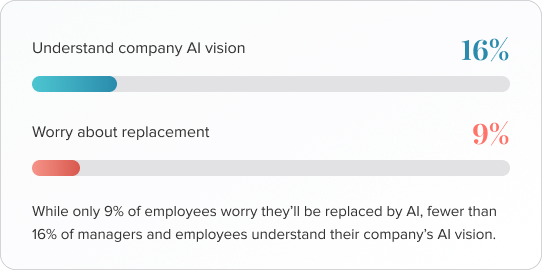
While only 9% of employees worry they’ll be replaced by AI, fewer than 16% of
managers and employees
understand their company’s AI vision.
Over the past few years, the conversation around AI at work has shifted. In 2025, 51% of employees worried about displacement. Today, only 9% say AI is replacing them. Fear is receding; openness is growing. That’s progress.
But confidence hasn't brought clarity. Employees and managers still ask:
"What does this mean for me, my team, and our company?"

Our 2026 survey surfaces a stark paradox:
59%
Executives
VS
8%
Employees
Executives believe they communicate a clear AI vision vs employees who agree
64%
Executives
VS
15%
Employees
Executives say employees understand AI's strategic value vs employees who concur
1/4
Only one-quarter of managers say their company's AI vision is clear, and one-third say the strategic value is clear
Employees and managers see AI in strategy decks but not in day-to-day expectations — goals, workflows, or career paths. That leaves AI feeling abstract: a leadership buzzword rather than a tool that helps people succeed. Without clarity, employees can align skills with the company's direction — and organizations won’t realize the return on AI investments.

Why clarity matters
Confidence without clarity is fragile. Believing in AI is important, but if employees can’t see how it changes their jobs, goals, and growth, they’ll become frustrated and disengaged.
Clarity is more than messaging; it’s a bridge from optimism to action. When people see how AI supports business priorities and their development, they lean in. AI becomes something done with them, not to them.
From reassurance to empowerment
Employees no longer need broad reassurance. They need practical specifics: how AI shapes the business, what it means for their team, and how it opens doors for their careers. Leaders can close the gap by consistently answering three questions:
Company
What does AI mean for our strategy, competitiveness, and business outcomes?
Role
How will AI change responsibilities, skills, and opportunities?
Me
How can I use AI to succeed and grow here?
"AI doesn't fail because people fear it, but because leaders stop at the vision deck. Employees can't follow a strategy they can't see in their day-to-day work. When AI shows up in feedback, goal-setting, and development, it stops being a buzzword. Clarity turns belief into behavior — and that's where transformation really begins."
Jamie Aitken
VP of HR Transformation, Betterworks


Turning optimism into momentum
Employees want to believe in AI and to know how it helps them succeed. When leaders provide clarity across the organization — not just at the top — belief becomes confidence, and confidence becomes commitment.
With managers and HR operationalizing that commitment, organizations see tangible returns: higher adoption, deeper engagement, faster growth, and stronger long-term performance.
Betterworks Recommendations
Six actionable strategies to bridge the AI clarity gap in your organization
1
Show, don't just tell
Empower AI champions and establish centers of excellence to share concrete examples of AI driving outcomes. Then amplify them through all-hands meetings and internal communications.
2
Tailor the message
Design communications that meet people where they are. Employees, managers, and executives need different stories and proofs.
3
Create a common language through goals
Connect teams to company priorities by cascading goals from leadership to managers and teams, and by allowing employees to highlight where their existing goals align with company strategy.
4
Activate middle management
Train them to communicate your AI vision and strategy to employees. Promote ongoing, structured conversations between managers and their reports that connect AI to team goals and daily work.
5
Celebrate small wins
Share real success stories and recognition to make AI practical, personal, and credible, and to inspire others to action.
6
Tie AI to business and professional growth
There are two dimensions to career advancement. Make the link explicit between AI, business outcomes, performance goals, skill building, and career paths.
Are you struggling to translate leadership's
AI vision into action for your workforce?
Get your checklist for turning executive vision into employee value.