Share Finding
Reinventing Performance Management Drives AI Success
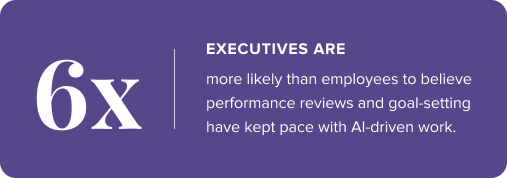
Executives are 6x more likely than employees to believe performance reviews and goal-setting have kept pace with AI-driven work.
As AI transforms how work gets done, one system stands at the center of trust, alignment, and motivation: performance management. It’s where strategy turns into accountability — where behaviors are reinforced, actions are modeled by leadership, managers provide clarity and coaching, and employees map out activities to meet the business’s strategic needs. As such, it is a catalyst to understanding, adoption, and effective utilization of AI in the pursuit of greater business performance. And HR is in the driver’s seat, transforming work through successful AI adoption.
Nearly two-thirds of HR leaders say their performance management system is essential to preparing the workforce for AI adoption. Yet just over half have evolved it to accurately reflect the new human + AI reality.
Executives are
6x
more likely than employees to believe performance reviews and goal-setting have kept pace with AI-driven work.
A familiar divide, now widening
The disconnect between leadership and employees isn’t new, but in an AI-powered workplace, it’s deepening: 90% of HR leaders say AI has changed what a “high performer” looks like. Employees are now expected to collaborate with AI — analyzing faster, automating routine work, and generating insight. Yet reviews still measure human-only outputs.
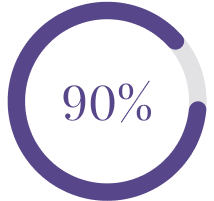
of HR leaders say AI has changed the definition of "high performer"
If performance management systems fail to evolve, those who excel at AI collaboration won’t see recognition, and others will remain uncertain about what’s expected. This undermines trust, discourages adoption, and risks turning AI into a source of anxiety instead of empowerment.
Outdated systems, missed potential
Traditional performance management categorizes employees into tiers: high, middle, and low performers. In the AI era, stacked ranking is outdated. When teams can achieve more with the same or fewer people, the real opportunity lies in continuously elevating everyone’s performance to drive greater productivity and business impact.
Executives often believe their systems are keeping pace. Employees — and many HR leaders — know they aren’t. Modernizing performance frameworks takes time and change management, so it’s frequently deferred. But delay comes at a cost. Legacy systems can’t capture how AI enhances creativity, decision quality, or collaboration. Without new measures, fairness falters and accountability fades.
Performance management systems send the clearest signal about what organizations value, but today, the message is mixed.
88%
of HR leaders agree that AI has changed how performance is evaluated
42%
say their organization includes AI expectations in goal-setting today
53%
believe their organization is very prepared to balance human and AI contributions in a fair way
If performance reviews and recognition systems don’t reward AI-enabled contributions, employees will question why they should bother. Leaders may say AI matters, but without accountability, adoption will remain uneven and its impact limited.
Performance management as a launchpad
Performance management is more than an HR process; it’s where culture meets execution. In the AI era, it must evolve from tracking individual output to recognizing shared outcomes — where humans and AI collaborate to elevate performance.
This shift means moving beyond annual rankings to continuously developing talent in dynamic, AI-augmented roles. It requires managers who don’t just deliver results, but guide their teams through reinvention, helping people grow as technology reshapes how work gets done.
To make this a reality, employees need reassurance that their evolving skills count, leading to team success and career growth. When performance management systems recognize and reward meaningful human + AI collaboration, they build trust, deepen engagement, and amplify both human and technological potential.
“Employees have always wanted to get to the next level. One of the biggest challenges before AI was people wanting to grow to the next level and not having a clear roadmap of ‘what do I need to learn,’ and ‘what do I need to do differently?’ We are at a transition point now. For talent management, what's coming next is AI evolving to guide individuals on how to grow and develop.”
Deanna LaPierre
Sr. Director of Talent Development, LivePerson

The bottom line
Technology drives change, but people sustain it. Performance management determines whether AI adoption translates into real results.
When systems evolve to reflect AI-enabled work, employees see fairness and purpose, managers gain better insight, and organizations unlock full value. Performance management isn’t just the measure of change — it’s the engine that powers it.
Betterworks Recommendations
12 actionable strategies to sync performance management with AI-driven work
1
Redefine success for human + AI performance
Measure speed, accuracy, creativity, and decision quality — not just work volume. Evaluate and reward AI experimentation, adoption, career mobility, and team learning.
2
Results in, results out
Embed AI thoughtfully into performance management systems to generate meaningful, fair insights that align with your talent strategy. Avoid generic tools to ensure performance remains accurate, fair, and aligned with this strategy.
3
Ensure transparency and fairness
Explain how AI-enabled work is evaluated and why expectations are shifting. Build it into performance assessments, calibration, and succession planning. Clarity and consistency build trust, especially when technology changes the rules.
4
Keep goals aligned as work evolves
Set clear company-wide objectives, then align team and individual goals accordingly — but don’t stop there. As work and roles evolve quickly due to AI, your performance management software must support rapid adjustments to goal-setting and shorter performance evaluation cycles.
5
Train managers to coach hybrid performance
Equip them to assess, recognize, and develop AI-empowered work so that AI becomes a development tool, not a threat.
6
Encourage manager-employee, AI-focused conversations
Provide conversation templates and check-in frameworks that help managers guide employees through AI learning, experimentation, and feedback.
7
Promote AI-focused personal development goals
Encourage employees to build AI proficiency by tying growth and performance goals to career advancement.
8
Track skills and capabilities
Use your performance management system to keep your talent and skills profiles current, leveraging AI to identify and validate skills, pinpoint skill gaps, and inform the development of AI-related skills across the workforce.
9
Structure engagement and feedback loops
Measure workforce sentiment and readiness with engagement surveys and pulse feedback, turning insights into action plans for adoption success.
10
Weave AI into calibration and succession
Identify and advance AI-savvy human+AI talent by incorporating AI-related performance measures into calibration sessions and succession planning.
11
Analyze with data and reporting
Use rich performance management data to track and analyze how AI improves individual and team performance, the impact of manager coaching on AI adoption, and to identify correlations between training, productivity, and goal achievement.
12
Turn AI into a trusted partner for performance enablement
When employees see how AI can streamline reviews, reduce bias, and suggest relevant goals, the benefits become tangible. Embedded directly into the performance process, AI isn’t just theoretical — it’s practical, visible, and transformative.
Is your performance management software built for the human + AI era?
Spot and close the gaps in how you evaluate, develop, and reward AI-augmented performance with this checklist.