Share Finding
AI Won’t Pay Off Until It’s Part of Everyday Work
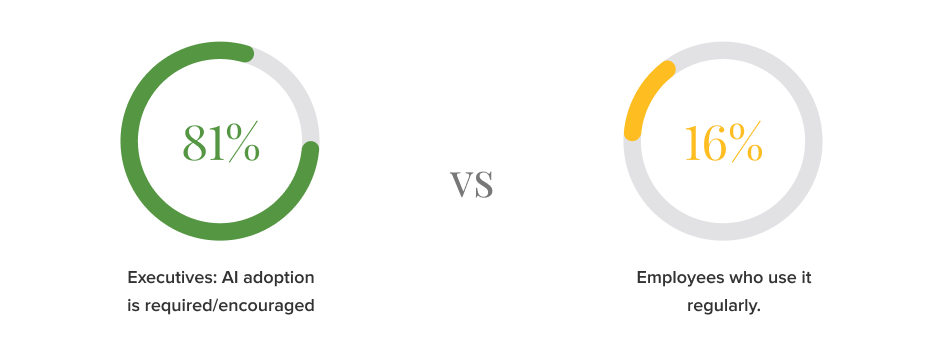
81% of executives say AI adoption is required or encouraged, yet only 16% of employees use it regularly.
The promise of AI lies not in pilot programs or executive dashboards, but in daily work. According to Gartner, employees are becoming more comfortable with using AI, but most engage in occasional experimentation without understanding how it helps them in their work or advances company strategy. Until AI use becomes ingrained across the workforce, organizations will continue missing the compounding benefits of consistency, learning, and shared confidence.
From leadership rhetoric to daily reality
Executives are 4x more likely than employees to use AI daily or weekly. Leaders analyze, automate, and create with AI, but employees often lack time, access, or clarity to follow suit.
Executives are
4x
more likely to use AI daily or weekly compared to employees.
Why everyday use matters
AI delivers its greatest value when woven into the flow of work. HR leaders identify the two biggest drivers of performance today as:
#1
AI-enabled productivity and creativity
#2
strong manager coaching
Yet most employees say they don’t use AI regularly, and they don’t see it reflected in their team goals or performance reviews. That silence sends a message: AI is optional. Only 54% of HR leaders have updated performance management criteria and goals to reflect AI-assisted work. Without recognition or accountability, adoption plateaus.
Do you currently use generative AI tools to help you do your work or as part of software you use in your work daily or weekly?
Team goals frequently include expectations around using AI tools:

Turning AI into an everyday capability
Normalization is where transformation sticks. Frequent, low-risk use builds confidence, reveals efficiencies, and fuels organizational learning. When AI becomes “how we do things here,” it no longer feels experimental — it feels expected.
This cultural shift accelerates over time: processes standardize, new hires learn faster, and a shared language around performance strengthens alignment.
HR’s role in operationalizing change
HR is uniquely positioned to make AI routine. By integrating AI expectations into goals, coaching, and feedback, HR can hardwire adoption into how progress is measured — not as an add-on, but as a foundation of modern performance management.
That means aligning systems and structures so AI use feels supported, not burdensome. True enablement doesn’t require more tools or meetings — it requires clarity, guardrails, and reinforcement.
“Leaders can mandate AI adoption, but sustainable momentum and adoption come from showing employees how it will make their work more meaningful. When people see how AI helps them focus more of their time on activities that energize them — not just faster work — they start to lean in. That’s the tipping point for culture change. HR’s role is to make that connection visible every day.”
Andrea Lagan
Chief Operating Officer, Betterworks

Building a culture of everyday AI
AI maturity depends on behavior, not technology. When employees see AI woven into their goals, feedback loops, and recognition, adoption becomes organic. Small, consistent use builds comfort and momentum, creating a virtuous cycle: the more people use AI, the faster they learn and the greater the impact.
AI won’t pay off until it’s part of everyone’s day — not just executives’. But once it is, it becomes the invisible infrastructure powering smarter performance across the organization.

Betterworks Recommendations
Four actionable strategies to embed AI into everyday work
1
Make AI a core competency
Tie AI outcomes to job descriptions, goals, and reviews — and track progress in scorecards and team check-ins so employees see progress and receive recognition.
2
Train in context
Replace generic “AI awareness” sessions with microlearning tied to real tasks, paired with coaching from managers or designated “AI champions.”
3
Empower managers to lead adoption
Teach them to observe, provide real-time feedback through frequent conversations, reward effective AI use, and include AI learning in development plans.
4
Provide clear guardrails
Establish ethical guidelines and straightforward approval processes so employees can experiment confidently. Ensure your technology also follows such guidelines to enable proper use at scale.
Are your employees using AI inconsistently, and your managers struggling to make AI use a habit?
Use our checklist to unlock AI’s power by putting it into practice.