Share Finding
Overconfident Executives,
Underprepared Teams
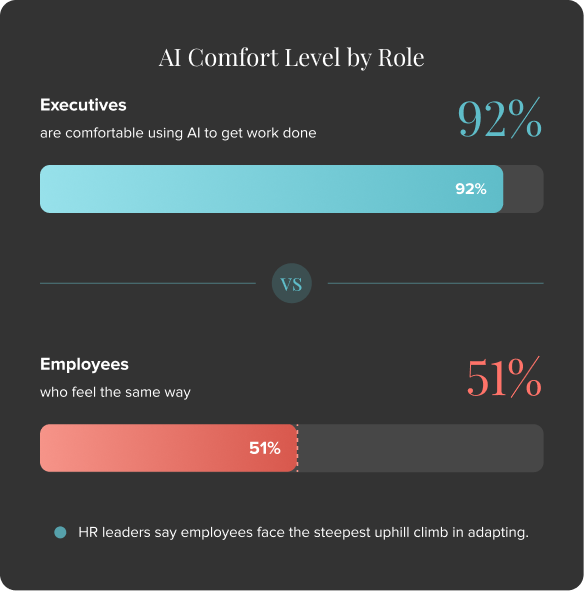
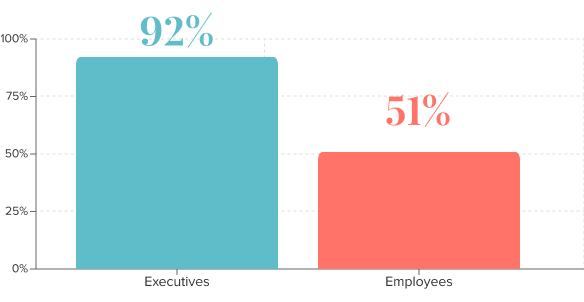
92% of executives are comfortable using AI to get work done, yet HR leaders say employees face the steepest uphill climb in adapting. Executives feel ready for AI. Many employees don’t. The result is a widening readiness gap that could slow adoption, deepen inequities, and undercut the business impact of AI investments.
A tale of two realities
At the top, confidence is high: executives overwhelmingly say they’re ready to work with AI. Among employees, that number drops to 51% — a near-mirror image of preparedness.
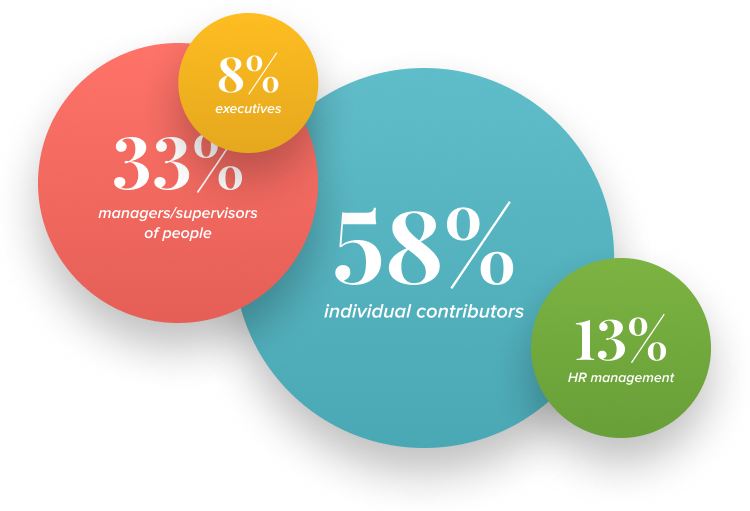
Executives describe AI as a source of productivity, efficiency, and creativity. Employees — especially those in frontline or deskless roles — see little change: 58% of employees report that AI has not improved their day-to-day work at all, compared with only 8% of executives.
AI Readiness: Executives vs Employees
AI has not improved my work:
This isn’t simply a skills issue
HR leaders and managers, who straddle both worlds, confirm that organizations are further behind in practical AI transformation than executives believe they are. HR sees readiness gaps that leaders often miss.
The perception gap in numbers
How far apart are executives and employees in their day-to-day AI experience?
Executives are
7x
more likely than employees to say team goals frequently include expectations to use AI tools.
1.6x
more likely to say AI improves productivity
2.1x
more likely to credit AI for creativity
2.7x
more likely to say AI makes work easier
Executives, in short, are experiencing the benefits — while employees are still waiting for proof.
Team goals frequently include expectations around using AI tools:
Training: enough, but not effective
HR leaders largely agree that lack of training isn’t the problem:
85%
believe employees get adequate AI training
88%
report moderate-to-high AI fluency across their organizations.
So why aren’t employees seeing results? Because exposure doesn’t equal application. Employees may be familiar with AI, but without sufficient time, context, and clarity on where and how to apply AI in actual use cases, training doesn’t translate into meaningful impact. Busy schedules leave little room for experimentation or building a deeper understanding of how to use AI tools strategically. To change behavior, employees must move beyond occasional experimentation with AI. They require coaching, practice, and reinforcement.
For example, a manager might ask an employee to build a chatbot that supports HR communications. This project could be tied to a performance efficiency goal and a developmental goal. The employee receives guidance from their manager, gains hands-on experience building AI tools, develops transferable skills, grows in confidence, and has the opportunity to share their learnings with others.

Leadership disconnects
Executives see AI fueling strategy and decision-making, then assume progress is widespread. But for many employees, AI still feels abstract — something leaders use, not something they do.
Without tangible benefits in their daily work, employees see AI as distant, not empowering. That perception stalls adoption. For AI to succeed at scale, people must experience its value firsthand.
From learning to action
Recent years have brought a surge of AI upskilling. That foundation is valuable — but training must evolve
into everyday
practice. To unlock ROI, employees need to apply AI meaningfully in their actual workflows.
That means:
Embedding AI expectations into team and individual goals and processes, not just executive strategies.
Equipping managers to coach in real time using frequent, structured conversations that ensure that employees are clear about expectations for using AI and how to successfully apply it in their roles.
Providing workers with use case training and tools that solve immediate problems, not theoretical ones.
Recognizing and celebrating the successful application of AI within the organization.
Why HR leaders must be the architects of AI transformation
AI is no longer a pilot or side project. Success depends not just on technology, but on how well HR connects business strategy to the daily experiences of employees.
Yet, according to a recent SHRM report on AI, HR leaders are being frozen out: Only 26% say they've been involved in managing change and employee adoption of AI. Two-thirds believe HR should be involved in activities such as assessing organizational readiness and defining AI objectives and use cases. It's not surprising that only 17% of these HR leaders say their organization's implementation of AI has been successful.
While many organizations see HR's role as a facilitator of AI use and employee understanding, that’s insufficient in Betterworks' view. The C-suite must empower HR leaders to lead strategically — driving clarity, readiness, and alignment across the workforce.
Employees need to see how AI supports their goals and career growth. Managers need tools and confidence to coach in this new era. And performance management software must evolve to fairly measure both human and AI-enabled contributions.
Team goals frequently include expectations around using AI tools:
As a facilitator, helping employees to better understand and team up with AI
60%
As a guardian, creating guidelines for the ethical, responsible use of AI
51%
As an administrator, directing work to AI or humans depending on skill
50%
As the architect of the system, redesigning employees' work with AI
38%
As the steward who protects the human aspect of work
31%
I guide the adoption of AI across the company, but am not directly involved
21%
We're still trying to figure that out
5%
“It’s really important that you… start with a clear and aligned vision between what the [performance] program owners are striving for and what the technologies are able to do, and then really prioritizing user experience and what the reporting or data insights will be needed to showcase the value to the organization.”
Stacie Willoughby
Director of HR Tech, ATB Financial

Closing the readiness gap
Executives are confident. Employees are cautious. HR leaders see both. Bridging those perspectives is the next great challenge of AI transformation.
The good news is that the infrastructure exists — training programs, available tools, and a growing curiosity. What’s missing is translation — turning learning into lived experience. When employees experience AI’s benefits firsthand, the gap closes. And when that happens, AI becomes more than a leadership vision. It becomes a shared journey toward smarter, faster, more connected work.
Betterworks Recommendations
Seven actionable strategies to end the disconnect between leaders and employees
1
Acknowledge the gap
Admit that executive optimism and employee readiness don’t match — transparency builds trust. Regularly survey and listen to your workforce.
2
Support your employees
Work with functional heads and team managers to prioritize practical tools, targeted microlearning, and high-impact skilling initiatives for employees who are least likely to see AI’s benefits today.
3
Empower managers as coaches
Provide them with resources, time, AI-related training, and performance insights and tools to help employees apply their learning in everyday use. In an AI-enabled organization, managers create value by coaching employees on the use of AI, helping to redesign work, and rethinking job roles. Engagement, learning, and innovation — not just output — become the hallmarks of effective managers.
4
Turn training into action
Tie AI usage directly to projects, performance and development goals, and reviews — not just abstract training sessions.
5
Set clear, measurable milestones
Encourage employees to establish AI-related goals to show how AI contributes to the organization’s strategy.
6
Measure broadly
Use performance analytics dashboards to track AI adoption, measure the impact of AI-driven goals on business outcomes, and surface gaps in AI use, skills, and leadership. Then target support where it’s needed most.
7
Cement the HR-CIO relationship
CIOs integrate AI into workflows while HR leads workforce transformation — reshaping development, building trust, and guiding responsible AI use. Create an HR–IT task force to align AI deployment with talent strategy, set ethical standards, and embed AI across work and learning.
Do you need to bridge the AI readiness gap by
making AI a lived experience for employees?
Explore our checklist for making AI’s impact real.