Share Finding
What’s In It for Me? The Missing Link in AI Adoption
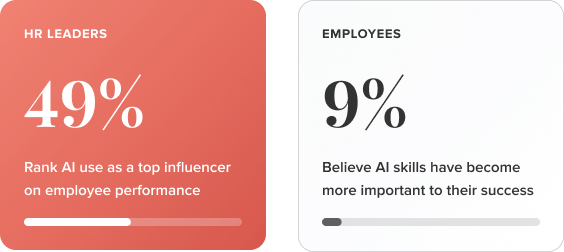
While 49% of HR leaders rank AI use as a top influencer on employee performance, only 9% of employees believe AI skills have become more important to their success.
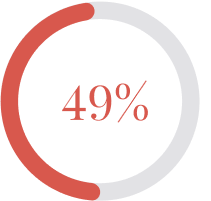
of HR leaders rank AI use as a top
influencer on employee performance.
VS
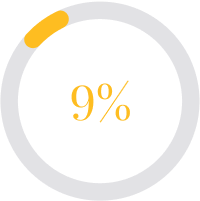
of employees believe AI skills have
become more important to their success.
A turning point with one link missing
The adoption of AI has entered a new stage. Employees are more confident. Executives are optimistic. HR leaders report rising fluency as organizations expand training and exposure. On the surface, the foundation for success appears strong.
Yet one crucial connection is still missing: employees don’t see what’s in it for them.
The "WIIFM?" question
Every major transformation depends on the same question employees quietly ask: “What’s in it for me?”
If that question goes unanswered, motivation fades. Training alone doesn’t inspire change. People need to understand how new skills help them perform better today, grow in their roles, and earn recognition for doing so.
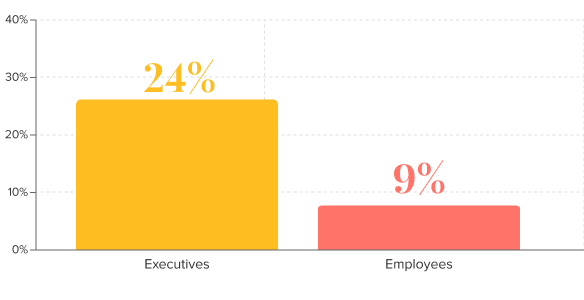
Our 2026 survey reveals the gap clearly. Executives are 2.7x more likely than employees to say AI skills are critical for career advancement. HR leaders agree, viewing AI fluency as a key differentiator for growth. Employees, however, believe the rules for success haven’t changed.
Without visible rewards or recognition, AI feels like another corporate initiative. The message employees receive is clear: AI may matter to leadership, but not to my performance review or my career path.
AI skills have become more important for getting ahead:
Why motivation matters most
HR leaders see AI use as a top influence on performance, on par with manager support and coaching. But employees tell a different story. They are 7x more likely than executives to say AI hasn’t improved their work.
This disconnect matters. Motivation, not just knowledge, drives behavior. When employees don’t see personal benefit — clearer goals, simpler workflows, faster results, or visible growth — they revert to old habits. Compliance replaces commitment. Adoption stalls.
What HR Leaders Say Drives Performance Today:
From compliance to commitment
The solution isn’t more training — it’s more meaning. When employees see a direct link between AI use and career growth, motivation follows. Answering the question “What’s in it for me?” turns AI from an obligation into an opportunity. This will not only unlock the strategic benefits executives envision but also create workplaces where employees feel valued, recognized, and motivated to grow alongside AI.
“Too often, technology is built for the organization, not with the employee in mind. But performance breakthroughs happen when employees experience technology as a partner in their growth, not a system to comply with. When AI augments human potential in ways employees can feel, performance accelerates. Our opportunity isn’t just to train people on AI, but to design work where AI makes people feel smarter, faster, and more valued.”
Cheryl Johnson
Chief Product and Technology Officer, Betterworks

Make it personal
Technology may enable change, but motivation sustains it. When employees see how AI supports their personal success — not just the company’s — they engage more deeply and adopt more willingly.
Answering the question “What’s in it for me?” isn’t just smart communication. It’s the missing link that transforms awareness into action and potential into performance.
Betterworks Recommendations
Six actionable strategies to spark meaning and motivation at work
1
Lead with inclusion and growth
Low engagement with AI and lingering anxiety about AI for some employees make inclusion critical. Performance management conversations should help employees build confidence and a sense of agency, helping them to connect development to growth.
2
Update performance criteria
Include AI-enabled results in goal, recognition, and review software to demonstrate that effective AI use is a core necessity for growth.
3
Tie AI fluency to performance and growth
Set development goals for AI learning and usage with your performance management software. Make sure you can update skills profiles to enhance talent planning and support employees in expanding their career opportunities. Use calibration to link skill development to advancement and internal mobility.
4
Make the AI vision personal
Collaborate with people managers to translate the company's strategy into role-specific use cases. Answer three questions everywhere: what AI means for the company, for the role, and for the individual.
5
Celebrate adoption
Recognize individuals and teams that are using AI creatively and effectively. Acknowledge employees who move into new AI-enabled roles or work environments.
6
Provide feedback
Share progress on how AI-driven work improves individual, team, and company outcomes.
Is AI adoption at your company flatlining?
Get this checklist to drive adoption and get results.