Quick Answer:
-
Culture Amp is one of the strongest employee engagement platforms available. For organizations where performance management needs to drive business execution — connecting goals to outcomes, enabling defensible talent decisions, and giving managers real visibility into performance — Betterworks is the purpose-built alternative.
-
The most consistent friction points with Culture Amp on the performance side are goals that run disconnected from review data, calibration that often requires workarounds, reporting that can be rigid enough to require manual export and spreadsheet work, and a skills approach that does not create the same dynamic talent intelligence Betterworks provides.
Let's give credit where it is due. Culture Amp built a genuinely excellent employee engagement platform. The survey science is rigorous. The people analytics are thoughtful. The company earned its reputation, and that reputation is not under dispute here.
What is worth examining is what happened when engagement wasn't enough.
In 2019, Culture Amp acquired Zugata to enter the performance management market. At the time, industry analyst Josh Bersin noted that Zugata had "yet to build" many of the features a full performance management solution requires, and that rather than complete that build independently, the company chose to join Culture Amp instead. The result is a performance module that was never purpose-built: it came from a separate codebase, absorbed before it was complete, and integrated into a platform designed for a different job.
Culture Amp has invested in closing those gaps over the years. It now has reviews, goals, feedback, calibration, 1:1s, and AI-supported workflows. But the friction points that show up in 2025 and 2026 independent reviews — disconnected goals, limited calibration flexibility, rigid reporting, and manual admin work — trace back to that foundation. These are not just configuration problems. They are signs of a performance product that still behaves like an add-on to an engagement suite.
Betterworks was built from day one for one thing: performance management. Not as an adjacent product to an engagement platform. That difference shows up everywhere.
1. In most Culture Amp environments, goals run separately from performance data
For performance management to actually drive execution, goals and performance data have to live together. When someone’s objectives are set in January and their performance review opens in December, the review should draw on a continuous record of what they were trying to accomplish, how they progressed, and what their manager observed along the way.
In many Culture Amp environments, that connection does not exist in any meaningful way. Goals are available, but they are not the operating foundation of the system. Independent reviewers on Capterra note that Culture Amp's performance workflows are rigid and that linking goal progress to performance data in a meaningful way creates recurring friction. Independent reviews have raised similar concerns around whether Culture Amp’s performance workflows, tooling, and reporting can support more complex organizations without compromise or workarounds.
Betterworks was designed around the opposite premise. Goals and OKRs are not a feature sitting alongside reviews. They are the operating foundation from which everything else — check-ins, feedback, calibration, and review narratives — flows. Betterworks also keeps goals active through Slack, Teams, Gmail, Outlook, Jira, Salesforce, Google Sheets, Asana, and other systems of work, so performance context is captured where work actually happens.
For organizations where the CEO, COO, or CFO has made it clear that people programs need to connect to business execution, this is not a UX preference. It determines whether performance management produces accountability or just documentation.

2. Culture Amp's calibration is built for review cycles. Talent decisions are not.
Talent decisions do not wait for the next review cycle to open. A fast-growing team, a leadership change, a reorganization — these moments require the ability to assess and compare talent on the business's timeline, not HR's calendar.
Culture Amp has calibration functionality, but it is more tightly tied to formal review cycles. Independent reviewers repeatedly point to the same pattern: when calibration needs to get more complex — by region, level, team, manager population, talent grid, or multi-session process — teams often move into spreadsheets or require vendor support. A Director of People Operations described trying to implement a 9-box talent grid: “Despite being assured that this would not be an issue, after reviewing the provided documentation, it has become evident that Culture Amp is not equipped to support this functionality at all.”
Building on their existing dominance in the calibration space, Betterworks further revamped calibration in its 2026 release. The result is a fully configurable system — 4-box, 9-box, or custom axes — that HR administrators can set up and modify independently. Calibration is decoupled from the review cycle and tied to the talent profile instead, so it can happen when the business needs it. Calibration also connects back to the broader talent profile, so decisions made in the room become part of the ongoing talent record — not another spreadsheet that gets filed away.
For organizations making compensation, succession, internal mobility, or promotion decisions with real stakes, the difference between calibration that runs a process and calibration that supports a decision is significant.
3. Culture Amp’s employee experience is strong. The admin experience is where teams feel the pain.
Culture Amp is often praised for its clean employee-facing experience. That strength is real. Employees can complete surveys, feedback requests, and reviews without much friction, and that ease of use is one reason organizations stay.
But easy for employees to complete is different from easy for HR to run.
Independent reviews point to a consistent split: end users often like the experience, while HR admins and People Operations teams feel more of the pain around configuration, reporting, complex cycles, manager changes, exports, and manual work. Customers describe performance workflows as cumbersome or rigid when they need different review cycles for different populations, different templates by level or region, custom rating scales, or more nuanced visibility rules.
Betterworks is built for complex performance programs. HR teams can configure templates, groups, scoped admin roles, permissions, custom talent fields, flexible ratings, and modular rollouts without redesigning the program around system limitations.
For a simple annual review process, Culture Amp may be sufficient. For organizations with multiple populations, geographies, review cadences, leadership needs, or talent decision workflows, Betterworks is designed to reduce the admin burden rather than push it into spreadsheets.
4. Culture Amp tracks skills through a framework. Betterworks infers them from real work.
Most platforms approach skills the same way: build a competency framework, ask employees to self-report, and attach skills to role profiles. The result is a skills inventory that reflects what the organization believed was important when the framework was designed, populated with self-assessments that may or may not reflect what employees are actually doing today.
Culture Amp has strong development capabilities, including career paths, role expectations, competencies, growth goals, and development plans. It also offers AI Skills Coach, which supports manager coaching and micro-learning. Those are useful capabilities, but they are not the same as AI-inferred workforce skills intelligence tied to employee talent profiles and downstream talent decisions.
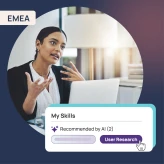
Betterworks Skills Intelligence takes a different approach. Skills are inferred from real work execution signals — goals, feedback, conversations, job title, job description, and performance context. Employees can review, accept, or dismiss AI-recommended skills, and managers can verify them. The Unified Talent Profile then brings those skills together with goals, feedback, conversations, recognition, calibration outcomes, and performance history.
This is not just a competency architecture. It is a skills intelligence layer grounded in what people are demonstrably doing. For organizations trying to make evidence-based decisions on internal mobility, succession, and strategic talent deployment, the distinction is practical and immediate.
5. Culture Amp's performance reporting is consistently flagged as inflexible. Betterworks is built for export.
The reporting gap in Culture Amp’s performance module shows up consistently in independent reviews. Reviewers describe performance reporting as inflexible and difficult to adapt for leadership use, especially when HR teams need to analyze performance data by population, region, level, manager group, or talent decision process. The issue is not that reporting does not exist. It is that rigid reporting often pushes teams back into exports and spreadsheet work.
This matters because performance data has two jobs. It needs to inform decisions in the moment, and it needs to support the business case that HR leaders are increasingly asked to make to CFOs and COOs. When performance reporting is too rigid to answer leadership’s questions directly, HR teams end up exporting data, cleaning it up, and rebuilding the story elsewhere. That makes it harder for performance data to show up in quarterly business reviews, compensation conversations, and workforce planning discussions.
Betterworks analytics are built to travel. Standard and custom reports are structured for export, leadership presentation, and decision-making. Admins can create and filter reports based on conversations, feedback, adoption, goals, and workforce trends. Manager Insights gives managers visibility into team performance and activity, while HR leaders get cleaner access to the data they need for calibration, talent reviews, and executive conversations.
The Head of Talent at an enterprise financial services firm put it directly: since moving to Betterworks, her team spends less time pulling data and performance reports — all of it lives in the platform and is easily accessible, making it a core part of their decision-making process.
6. Culture Amp’s AI is useful. Betterworks AI is deeper in the performance workflow.
Culture Amp has invested in AI features, and they are genuinely useful for what they do: summarizing survey responses, assisting with feedback writing, surfacing themes, and supporting manager coaching. For engagement-focused workflows, that investment is evident.
On the performance side, the AI story is more limited. Culture Amp’s AI features help improve and summarize content, but they do not create the same connected performance and talent intelligence layer across goals, feedback, conversations, skills, calibration, and succession.
Betterworks AI is embedded across the continuous performance workflow: goal creation, review and feedback writing assistance, feedback summaries, 1:1 summaries, performance summaries, and skills inference from real signals. Betterworks also runs on a private, self-hosted large language model deployed on Betterworks’ own cloud infrastructure, so performance data does not move through a third-party API.
For organizations in regulated industries, those with data residency requirements, or those making board-level commitments about employee data governance, this is not a secondary consideration. It is a material part of the evaluation.
7. Culture Amp's implementation model skews self-service. Betterworks treats it as a partnership.
Every Betterworks customer receives a named Program Architect and a custom statement of work. Implementation is scoped with defined success metrics, supported by a professional services team with organizational psychology expertise, and the relationship continues through structured executive business reviews.
Culture Amp’s model skews more self-service, particularly on the performance module side. Independent reviews note that the depth of hands-on support can decrease once initial implementation is complete, and customers sometimes describe support relationships as changing over time.
For organizations making a significant investment in changing how performance runs — not just launching a new tool — the difference between a vendor relationship and a program partnership shows up in adoption rates, behavior change, and whether the investment ultimately connects to business impact or becomes another system that employees learn to work around.
At LivePerson, more than 90% of performance reviews were completed on time after implementing Betterworks. 85% of goals were drafted within the first 45 days. Those are program outcomes, not software metrics. They reflect what happens when implementation is treated as the beginning of a change process rather than the end of a purchase.
Who Should Stay on Culture Amp
If engagement surveys are the primary investment — pulse surveys, lifecycle surveys, manager effectiveness listening, organizational health tracking, employee sentiment, and benchmarking — Culture Amp is genuinely excellent at that work. Their people science team and survey analytics are best-in-class. If the sole need is a sophisticated engagement listening program and performance is a secondary consideration, Culture Amp may still be the right call.
The same is true for organizations with very lightweight performance needs. If all you need is a basic review form once or twice a year, simple feedback collection, and a familiar tool that employees already know, Culture Amp may be good enough.
The organizations that switch are those where the framing has changed.
Where the CHRO is being asked to demonstrate that people programs are connecting to business outcomes. Where performance data needs to reach the CFO in a format that supports real decisions. Where calibration is happening three times a year, not once. Where HR needs different templates by population, region, level, or manager group. Where managers need performance context in one place. Where skills visibility and succession planning are strategic priorities, not checkboxes. Where the question is no longer “did everyone complete their review?” but “are we making better talent decisions because of this system?”
That is the shift Betterworks is designed for.

Betterworks vs. Culture Amp: Side-by-Side
Capability | Betterworks | Culture Amp |
Goals / OKRs | Native OKRs connected to reviews, check-ins, feedback, and performance conversations in one system | Goal management exists, but many teams still struggle to connect goals meaningfully to performance decisions |
Calibration | Continuous, configurable calibration that can run outside formal review cycles | Calibration is more tied to review cycles and may require workarounds for complex talent decisions |
Admin flexibility | Flexible templates, workflows, permissions, and rollouts for different populations, regions, and teams | Works for simpler programs, but can feel rigid when performance processes vary across the business |
Skills intelligence | AI-inferred from real work signals and manager-verified over time | Development and coaching tools exist, but skills are less connected to real-time performance and talent decisions |
Talent profiles | Unified talent profiles connect goals, feedback, reviews, calibration, skills, and performance history | Talent profiles exist, but are less connected to dynamic skills intelligence and downstream talent planning |
Succession planning | Built-in succession planning connects performance data to bench strength and readiness decisions | No true succession planning capability for teams that need to move from performance reviews to talent decisions |
Reporting and analytics | Built for leadership visibility, exports, and decision-ready performance insights | Reporting is available, but reviewers often flag rigidity and the need for manual spreadsheet work |
AI for performance | AI supports goals, feedback, summaries, performance narratives, skills, and talent intelligence | AI supports feedback improvement, summaries, survey insights, and manager coaching |
Flow-of-work integrations | Performance activity can happen through Slack, Teams, Gmail, Outlook, Jira, Salesforce, Google Sheets, and more | Slack and Teams support common notifications and performance tasks |
Implementation model | Named Program Architect, custom SOW, org psychology expertise, and ongoing executive business reviews | Customer success support is available, with a more self-service model depending on needs and tier |
Engagement surveys | Pulse, lifecycle, manager effectiveness, onboarding, exit surveys, and action planning | Core product strength with mature engagement surveys, benchmarks, and people science support |
Best fit | Mid-market and enterprise organizations where performance needs to drive accountability, talent decisions, and business execution | Organizations prioritizing engagement listening or running lightweight performance programs |
Frequently Asked Questions
Is Culture Amp good for performance management?
Culture Amp is a strong employee engagement platform. For organizations with straightforward performance needs — standard review cycles, lightweight feedback, foundational goal tracking — it may be sufficient. For organizations where performance management needs to drive business execution and produce defensible talent decisions at scale, the module's origins matter. Culture Amp entered performance management through its 2019 acquisition of Zugata. Zugata was the entire performance foundation, not an addition to one, and per industry analysis at the time it had not yet finished building out the full range of features a complete performance management solution requires. The architectural limitations that resulted — disconnected goals, limited calibration flexibility, rigid reporting — show up consistently in independent reviews and have not been fully resolved through configuration alone.
What are the most common complaints about Culture Amp's performance module?
The most consistent themes in independent Capterra reviews: reporting that is inflexible or difficult to export in leadership-ready formats; calibration that often requires spreadsheets or vendor support for more complex use cases; goal management that feels disconnected from review, feedback, and talent data; admin workflows that become rigid when organizations need different templates, cycles, permissions, or rating scales; and manual work around exports, manager changes, rating calculations, and performance data cleanup.
How does Betterworks handle calibration differently than Culture Amp?
Betterworks decouples calibration from the performance review cycle by tying it to the talent profile. This means calibration can happen when the business needs it — during a reorganization, a leadership change, a compensation cycle, a succession discussion, or a quarterly talent review — not only when a formal review cycle is open.
Betterworks supports configurable grids, saved views, custom talent fields, comments, scoped permissions, matrix manager access, audit logs, and calibration outcomes that write back to the talent profile.
Culture Amp has calibration functionality, but it is more tightly linked to formal review events. More complex talent grids, multi-session configurations, or population-specific calibration processes may require support or workarounds.
What is the difference between Culture Amp's skills approach and Betterworks Skills Intelligence?
Culture Amp's skills capabilities are primarily engagement-informed and self-reported. Betterworks Skills Intelligence infers skills from real work execution signals — goals, outcomes, feedback, and 1:1 conversations — and updates continuously as work evolves. A manager verification layer adds human-validated accuracy on top of AI inference. The Unified Talent Profile auto-populates from resumes, LinkedIn, and performance signals. For organizations that need a dynamic view of workforce capability rather than a static competency inventory, the difference is meaningful.
Does Betterworks offer succession planning?
Yes. Betterworks includes dedicated succession planning capabilities. Leaders can build successor pipelines, configure readiness levels, assess risk of loss and impact of loss, order candidates, add comments, and filter by department, incumbent, successor, and other talent fields.
Culture Amp can support development planning and talent profiles, but it does not have a dedicated succession planning module. For organizations trying to move from performance data to succession decisions, that is a significant distinction.
Does Betterworks offer engagement surveys?
Yes. Betterworks offers pulse surveys, lifecycle surveys, manager effectiveness surveys, onboarding surveys, exit surveys, eNPS tracking, and action planning — covering the core use cases many organizations need alongside performance management.
For organizations currently running Culture Amp for engagement and a separate tool for performance, Betterworks can consolidate both into one connected system.
What do companies that switch from Culture Amp to Betterworks say?
The most common pattern: an organization adopted Culture Amp for engagement surveys, was upsold on the performance module, and discovered it does not meet their needs as the organization grows. The specific pain points that drive the switch are reporting inflexibility, limited calibration tools, disconnected goal management, and the overall experience that the performance side feels like a different product — because it was built as one.
Betterworks is not the right platform for every organization. It is built for organizations where performance is not an HR process to complete and file away — where it is the operating system through which strategy gets executed. If that is the standard you are trying to meet, we would like to show you what a purpose-built approach looks like.
See why HR leaders are switching to Betterworks’ purpose-built performance management platform.
Book a Demo