LivePerson’s Deanna LaPierre on the AI-Powered Future of Performance Management
By Cassie Fulton FloresMarch 4, 20265 minutes read
Share
Share
We are fortunate to partner with Betterworks customers who continually share their expertise and experiences with fellow customers and the broader HR community. Their generous contributions make them true Work Better Champions, and we are profoundly grateful for their insights. Discover the visionary profile of one such champion, Deanna LaPierre from LivePerson, in the interview below.
When Deanna LaPierre looks back on her career, the throughline isn’t a perfectly mapped plan. It’s curiosity and a willingness to say ‘yes’ before she feels fully ready.
Deanna didn’t start out in HR. She studied English and entered the advertising world, convinced she wanted to be a copywriter. But on her first day, reporting to the HR department sparked something unexpected: “I remember thinking, ‘Gosh, I’d really like to work in this department.’”
It took a few years — and a few bold moves — before she made the leap. She moved from advertising into HR, taught English in Japan, and eventually returned to the U.S., ready to raise her hand when an HR opportunity appeared. That moment changed everything.
“I’ve never for one second regretted being an HR person,” said Deanna.
Why HR experience across functions matters
Over the years, Deanna’s career has spanned from startups to global enterprises, financial services to technology companies. She’s worked as an HR generalist, HR supervisor, and strategic HR business partner at organizations like E-Trade, Wells Fargo Home Mortgage, Sony Electronics, and now LivePerson, where she leads talent development and total rewards.
One theme stands out: the value of breadth.
In smaller organizations, Deanna found herself owning far more than her job description. Instead of specializing early, she learned a little bit of everything — and that has shaped how she leads today.
“It makes you a valuable player on any HR team because you can see the big picture,” explained Deanna. “It positions me to be able to take on any challenge that comes my way.”
That big-picture perspective is especially critical during periods of change. And as Deanna points out, every organization goes through change — constantly.
HR’s shift to a more strategic role
When Deanna entered the field, HR was still called “personnel.” Compliance requirements were lighter. The role was largely administrative.
That’s no longer the case.
Today, HR sits at the intersection of regulations, culture, risk management, and strategy. Leaders are expected to protect the organization and to actively shape how people work, grow, and perform.
Modern HR blends operational excellence with organizational psychology — helping leaders create cultures that are fair, resilient, and aligned to business goals. It’s no longer about paperwork. It’s about impact.
A performance management win she’s most proud of
Ask Deanna about the work she’s most proud of, and you’ll get more than one answer. But one story stands out: building a performance management process that genuinely works for employees.
After managing performance for decades, Deanna knew what didn’t work: disconnected systems, outdated reviews, and processes that created more work without improving outcomes. At LivePerson, she saw an opportunity to overhaul the entire system to drive engagement and lift the employee experience.
She implemented Betterworks to drive goal alignment and support continuous performance and development conversations as a way of unlocking talent.
For the Betterworks implementation and other key initiatives she has led, she said, “In the end, it was about having answers to questions like, ‘How can we make things better for all employees?’ ‘How do we care for our employees, in times of change or when we want to enhance what we offer?’”
Performance management isn’t just an HR checkbox for Deanna. It’s a way to care for people, especially when the organization is evolving and expectations are shifting.
The future of talent management is AI-guided growth
Looking ahead, Deanna is clear on what excites her most: AI’s role in helping employees understand how to grow.
For years, HR teams have heard the same questions from employees: What do I need to learn? What do I need to do differently? How do I need to behave? The answers existed, but they were fragmented, hard to access, and difficult to apply.
AI changes that.
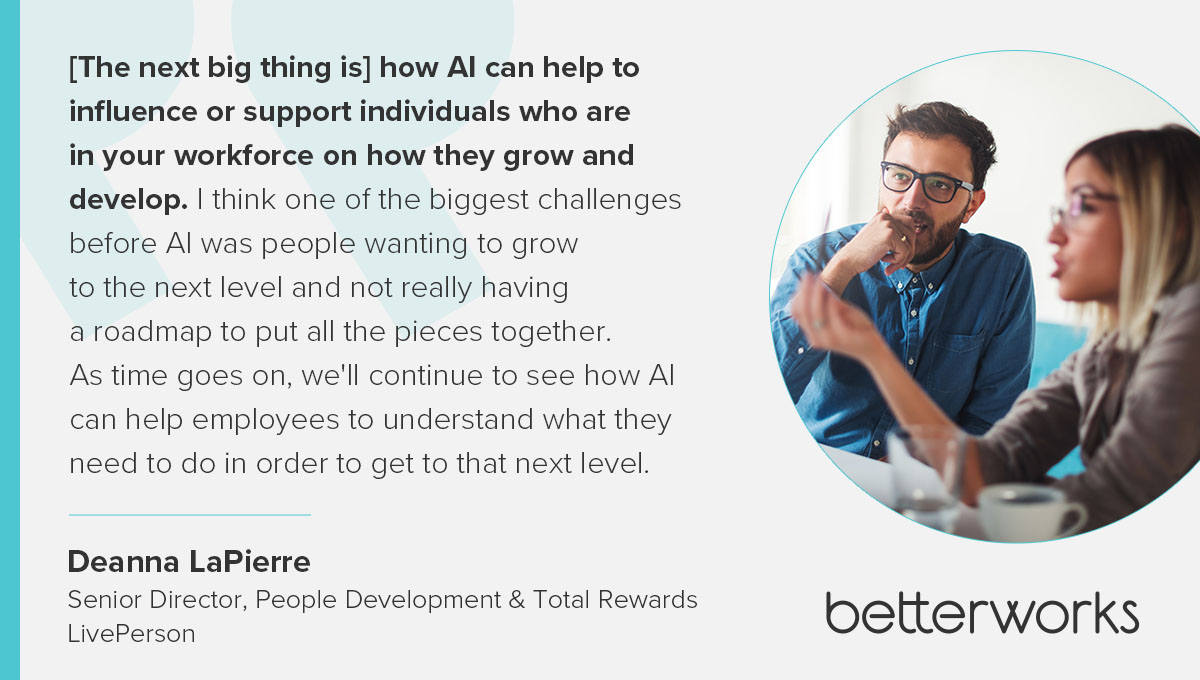
“AI can help to influence or support individuals who are in your workforce on how they grow and develop,” said Deanna. It “can help employees understand what they need to do in order to get to that next level.”
By synthesizing data, clarifying expectations, and guiding development, AI has the potential to turn career growth from guesswork into a roadmap, without replacing human judgment.
Advice for new HR leaders
Deanna’s advice for early-career HR professionals is simple and powerful: say ‘yes’ to new challenges. Say ‘yes’ before you feel ready. Learn multiple functions. Get uncomfortable.
“Human resources continues to grow, and there are lots of opportunities to learn more than one function,” Deanna said. “That can make you into a really great leader because typically, when you're a leader, you have more than one functional area reporting to you. It gives you the ability to say, ‘I've been in your shoes; I get it. So, let's talk about what we can do differently to make it easier for you or more enjoyable for you.’”
She further advised, “Never say no. If you don't understand a particular function of HR, guess what? AI can explain it to you. Then, try to do it because it will help you grow. Those uncomfortable moments are really what set you apart from others.”
Deanna’s year in review, according to Slack
If Slack could summarize Deanna’s 2025 in one sentence, it would be, ‘Wow, you were busy this year.’
With constant change, new challenges, and opportunities to revisit work she’d done years earlier, it’s a fitting summary, and a reminder of what modern HR leadership really looks like.