Key Takeways
-
Most enterprise skills programs are obsolete before they're operational — taxonomy-heavy, self-reported, and too slow for the pace at which work and workforce actually change.
-
Skills data becomes actionable only when it is observed continuously from real work signals — goals, feedback, outcomes, and 1:1s — not collected periodically through surveys or assessments.
-
AI-inferred, manager-verified skills intelligence gives HR leaders a current, defensible picture of workforce capability without requiring employees or managers to originate every data point themselves.
-
Organizations with dynamic workforce skills visibility make faster, more consistent talent decisions — on calibration, internal mobility, succession planning, and workforce planning — than those relying on static records.
Most enterprise skills initiatives share a common fate: they launch with ambition, consume months of stakeholder time and systems budget, and arrive just in time to be wrong.
The urgency is real. The World Economic Forum's Future of Jobs Report 2025 found that 63% of employers now cite skills gaps as the primary barrier to business transformation — and nearly 40% of job skills are expected to change by 2030. That is not a future-state problem. It is a present-day operations problem. And yet most organizations are still trying to solve it with methods designed for a slower world.
The taxonomy gets finalized. The self-assessment survey goes out. Managers add their inputs. And somewhere in that process — usually before the rollout is even complete — the data starts decaying. People change roles. Teams reorganize. Work evolves. But the skills record sits still, a snapshot of a workforce that no longer quite exists.
This is not an execution problem. It is a model problem. And it will not be solved by a better taxonomy, a more sophisticated job architecture, or a more diligent annual refresh.
Why Traditional Skills Strategies Fail
The logic behind most skills programs is sound on the surface: if we know what skills our people have, we can make smarter decisions about deployment, development, and succession. No argument there. The problem is the method used to collect that knowledge.
Traditional approaches treat skills as something to be inventoried — gathered through employee self-assessment, manager input, or structured taxonomy mapping. A McKinsey survey on workforce skills found that 87% of organizations either face current skill gaps or expect to within the next five years — yet most are still relying on the same collection-based methods that created the problem in the first place. The exercise is time-bound, burdensome, and structurally biased toward what people remember or choose to report. Self-reported skills are incomplete by definition. Employees understate capabilities they use habitually. They overstate aspirations. Managers contribute their own biases, coverage gaps, and bandwidth constraints.
Taxonomy-heavy skills projects compound the problem. Organizations invest 18 to 24 months building frameworks that are enterprise-wide, theoretically comprehensive, and practically obsolete before full deployment. Business priorities shift faster than skills architecture can be updated. By the time the program is operational, the workforce and the work it does have already moved.
The result: HR leaders making calibration decisions, internal mobility calls, and succession bets on data that is stale, incomplete, and hard to defend.

What CHROs Actually Need: Skills as a Live Signal
The better model does not ask employees to stop work and document skills. It observes skills continuously, in the course of work already happening.
Think about the signals that flow through a modern performance system every week: goals set and outcomes achieved, feedback given and received, 1:1 conversations, peer recognition, project contributions. Each of these is evidence of capability. Not potential capability. Not self-reported capability. Demonstrated capability, grounded in what a person actually did and how others experienced it.
Skills intelligence — properly defined — is the continuous inference of skills and capabilities from these real work execution signals. It is not a survey. It is not a taxonomy exercise. It is an operating model that treats skills data the way a live system treats any other signal: as something observed, updated, and actionable in near real time.
A modern skills strategy should work more like a live operating signal than an annual census. The workforce changes continuously. The picture of workforce capability should keep pace.

What Skills Intelligence Looks Like in Practice
The distinction matters most when HR leaders describe the decisions they actually have to make: who is ready for a stretch assignment, which internal candidate matches an open role, where capability gaps are concentrated ahead of a product launch, who belongs in the succession pipeline for a critical leadership position.
These decisions require current information. Not current as of last year's performance cycle. Current as of last month's work.
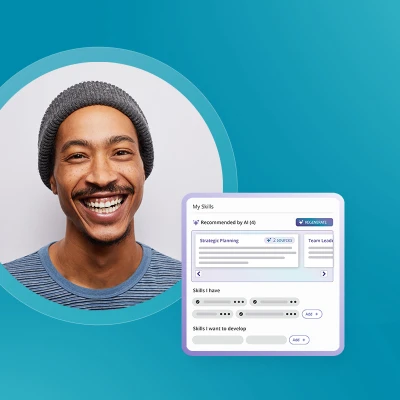
With skills intelligence grounded in performance signals, a manager reviewing a direct report's profile does not see a static list of skills the employee entered eighteen months ago. They see skills inferred from the employee's goals, feedback patterns, contributions, and role context — updated as work happens. They can see which skills appear repeatedly across multiple signal sources, indicating consistent demonstrated capability, and which appear once, suggesting emerging or developing ability.

Introducing Betterworks Skills Intelligence
This is exactly the problem Betterworks' Spring 2026 release is built to address.
With the upcoming May release, Betterworks introduces Skills Intelligence as part of a broader Talent Intelligence offering — a real-time, dynamic understanding of the workforce grounded in actual work, connecting performance, skills, and business outcomes.
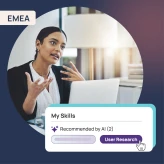
Skills Intelligence infers skills from the real work execution signals already flowing through the Betterworks platform: goals, outcomes, feedback, conversations, and 1:1s. Skills are not static records. They evolve as the employee's work and contributions evolve. And because they are AI-inferred and manager-verified, they carry both the speed of continuous inference and the credibility of human validation.
The inference is transparent by design. When a skill surfaces for a given employee, leaders can see which signals generated it — how many times it appeared in feedback, how it maps to the employee's role context, what work generated the recommendation. This is explainable, evidence-based intelligence — not a prediction without a trail.
Why Manager Verification Matters
Some skills programs have moved away from manager input entirely, treating it as a source of subjectivity and bias. That instinct is understandable but overcorrects.
The problem with purely self-reported systems is obvious. But systems that exclude managers entirely create a different risk: skills data without organizational context. A manager knows whether a demonstrated skill was central to a project or incidental to it. They know whether a capability is ready to be deployed on something consequential, or whether it is still developing. That judgment is not bias to be eliminated — it is context that makes skills data operationally useful.
The right model pairs AI inference with manager verification. The AI does the heavy lifting of continuously synthesizing distributed work signals into skill observations. The manager provides the validation layer that turns an inference into a confirmed capability. Together, they produce skills data that is both current and credible — the combination HR leaders need to make defensible talent decisions.
The Strategic Value: From Capability Visibility to Business Decisions
Skills data that is current and trusted becomes useful across the full talent decision landscape.
Calibration cycles that currently rely on retrospective performance summaries can draw on a live picture of demonstrated capabilities, calibrated against what the role and the business actually require right now. Internal mobility decisions that currently take weeks of informal networking and manager outreach can be grounded in objective, current skills match data. Succession planning that typically relies on a thin pipeline of well-known internal candidates can surface hidden capability across the workforce — including people who have not self-promoted but whose work record demonstrates genuine readiness.
Workforce planning and capability building decisions — which gaps to close, where to invest in development, which capabilities need to be recruited externally — become anchored in evidence rather than estimates. McKinsey's research on organizational capability found that 90% of leaders say capability building is urgent, but only 5% feel their organization's internal capabilities are actually adequate. That gap between recognition and readiness is precisely what a live skills intelligence operating model is designed to close. People ROI becomes defensible because the capability picture is grounded in actual performance, not intentions or impressions.
This is the strategic shift Betterworks calls Talent Intelligence powered by performance: a real-time, dynamic understanding of people that connects what they have done to what they can do, at the individual and workforce level, continuously.
What Modern Talent Leaders Should Expect from a Skills Strategy
The right skills strategy is not a project with a launch date and a completion milestone. It is an ongoing operating capability — a live signal that keeps pace with work, gets more accurate over time, and sits inside the same system where performance, feedback, and development already live.
If your current approach requires a multi-year taxonomy build before it produces anything usable, it will not survive contact with business reality. If it relies primarily on employee self-reporting, the data will reflect what people say about themselves, not what the work reveals about them. If it produces a point-in-time snapshot rather than a continuously updated picture, it will be wrong the moment a reorg, a role change, or a business pivot changes the landscape.
HR leaders should be asking a different set of questions. Not "have we built a skills taxonomy?" but "do we have current, trusted visibility into workforce capability?" Not "did employees complete their skills assessments?" but "are our skills insights connected to the work actually happening?" Not "when did we last refresh the skills database?" but "are skills updating automatically as work signals evolve?"
Those are the questions a modern skills intelligence approach answers. They are also the questions that determine whether workforce planning, internal mobility, calibration, and succession are operational capabilities or aspirational exercises.
Skills data becomes useful when it is observed continuously in the flow of work, not collected periodically as a static record. Betterworks' Skills Intelligence, available in the May 2026 Spring Release, makes that model operational for enterprise HR teams today.
See how Betterworks turns performance signals into current, defensible workforce skills visibility.
Book a Demo