Modern Calibration: How to Make People Decisions That Are Faster, Fairer, and More Defensible
By Aimie LimApril 24, 20267 minutes read
Share
Share
Key Takeways
Most calibration processes rely on stale review summaries and manager memory — not live performance data — making inconsistency and recency bias structural problems, not human ones.
The real calibration problem isn't the meeting format or the visualization. It's that the data feeding into decisions is disconnected from how work is actually happening.
Modern calibration should run outside of annual review cycles, connect to live performance signals and HRIS data, and produce decisions that are traceable and defensible.
Organizations that calibrate on continuous performance data — goals, feedback, skills signals, outcomes — make faster, more consistent, and more equitable people decisions than those that don't.
Betterworks Calibration gives leaders in-workflow access to current employee profiles, multiple data visualizations, HRIS syncs, and change history — so every calibration decision is grounded in evidence, not recollection.
Think about what actually happens in a calibration session. A group of leaders sits down to discuss performance ratings, promotion readiness, and potential — often working from a spreadsheet export, a review summary that was written weeks ago, and whatever a manager remembers most clearly from the past 60 days. The conversation is well-intentioned. The process is sincere. But the inputs are stale.
This is the real problem with calibration today — not the format, not the cadence, not whether you use a 9-box or a performance-potential matrix. The problem is that most calibration processes are structurally disconnected from the actual performance data your organization is already generating every day. Goals, feedback, 1:1 notes, skill signals — all of it exists somewhere. Almost none of it makes it into the room when decisions get made.
Why Traditional Calibration Breaks Down
The standard calibration process wasn't designed around continuous data. It was designed around the annual review cycle: collect ratings, export data, schedule a meeting, discuss, finalize. That cadence worked reasonably well when performance conversations happened once a year. It's increasingly mismatched to how work — and workforce decisions — actually function now.
A few specific failure points are worth naming directly.
Recency bias is structural, not accidental. When leaders are working from static review summaries, they default to what's most recent and most memorable. Many research studies identify recency bias — weighting recent events disproportionately over a full performance record — as one of the most persistent distortions in talent evaluation. The issue isn't manager intent. It's that the process gives leaders no practical way to counterbalance recency with a fuller, current view.
Calibration meetings create their own bias dynamics. AHarvard Business Review analysis found that calibration sessions themselves can introduce new inconsistencies — particularly when discussion is dominated by the most vocal participants or when the underlying ratings aren't well-supported by observable evidence. When leaders go into a session without robust data on the people being discussed, the conversation is inevitably shaped by whoever argues most persuasively, not by what's most accurate.
Manual processes don't scale, and they don't keep pace. HR teams routinely spend significant time pulling together calibration views from multiple disconnected systems — HRIS data, performance review exports, spreadsheets maintained by individual managers. By the time that information is assembled, it's already partially outdated. The people being discussed have likely had additional feedback, completed additional goals, or been involved in new projects since the data was pulled. Leaders make decisions anyway, because the deadline doesn't move.
The Real Issue Isn't the 9-Box — It's Disconnected Performance Data
It's tempting to look at calibration problems and conclude that the visualization is the culprit. Replace the 9-box with something else. Change the rating scale. Redesign the form.
These changes often make calibration feel more modern without actually solving the underlying problem. The issue isn't how the output is displayed — it's what's feeding into it.
Most organizations today have more performance signal than they've ever had. Goals are set and tracked. Feedback is collected continuously. Managers hold regular 1:1 conversations. Skills are surfaced through actual work. But in the traditional calibration process, almost none of that live signal makes it into the room. Leaders are calibrating against a performance summary that represents a frozen moment in time, not how the person is performing right now.
The gap between available performance data and the data actually used in calibration is where inconsistency, recency bias, and low-confidence decisions enter the system. Closing that gap is what modern calibration needs to do.
What Modern Calibration Should Look Like
Modern employee calibration is not a better-designed meeting. It is a different class of process — one in which the quality of decisions depends on the quality of real-time, structured data flowing into it.
A working definition: Modern performance calibration is the practice of evaluating and aligning talent assessments using current, connected performance data — including goals, feedback, skills, and history — so that decisions are grounded in how people are actually performing, not how they performed at a fixed point in the past.
This definition has a few important implications. Calibration should not be trapped inside annual review cycles. Organizations restructure, priorities shift, and talent risk changes throughout the year. A calibration process that only runs in lockstep with annual reviews is always operating on delayed information. Modern calibration should be flexible enough to run whenever a meaningful people decision is being made — a promotion, a reorg, a succession event, a compensation review.
Calibration should also provide a centralized, trusted view of each person being discussed. Not a list of ratings. Not a review summary. A current picture of performance, skills, capabilities, and context — all accessible in the workflow where the decision is happening, not assembled manually before the meeting.
And calibration decisions should be defensible after the fact. When ratings change, leaders should be able to see why and by whom. When decisions are challenged — by employees, auditors, or future leaders reviewing outcomes — the organization should have a reliable record of what was considered.
Faster decisions are only better decisions when they are also more consistent and more defensible.
How Betterworks Calibration Keeps Up With the Business
Betterworks' refreshed Calibration module is built on a straightforward premise: leaders should be making people decisions with the same performance data their organizations are already generating — live, connected, and visible in the workflow where calibration actually happens.
Here is what that looks like in practice.
Flexible by design, not anchored to annual cycles. Calibration in Betterworks is not a module that sits dormant between performance review seasons. It's designed to run whenever a people decision requires it — independent of annual cycles, connected to the business events that actually drive talent decisions throughout the year.
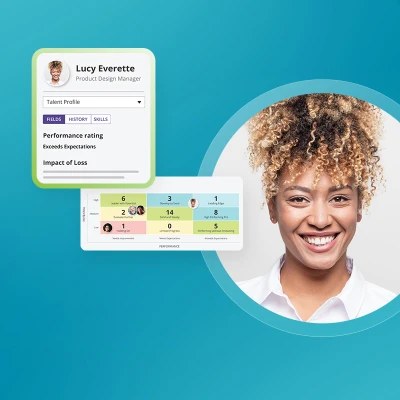
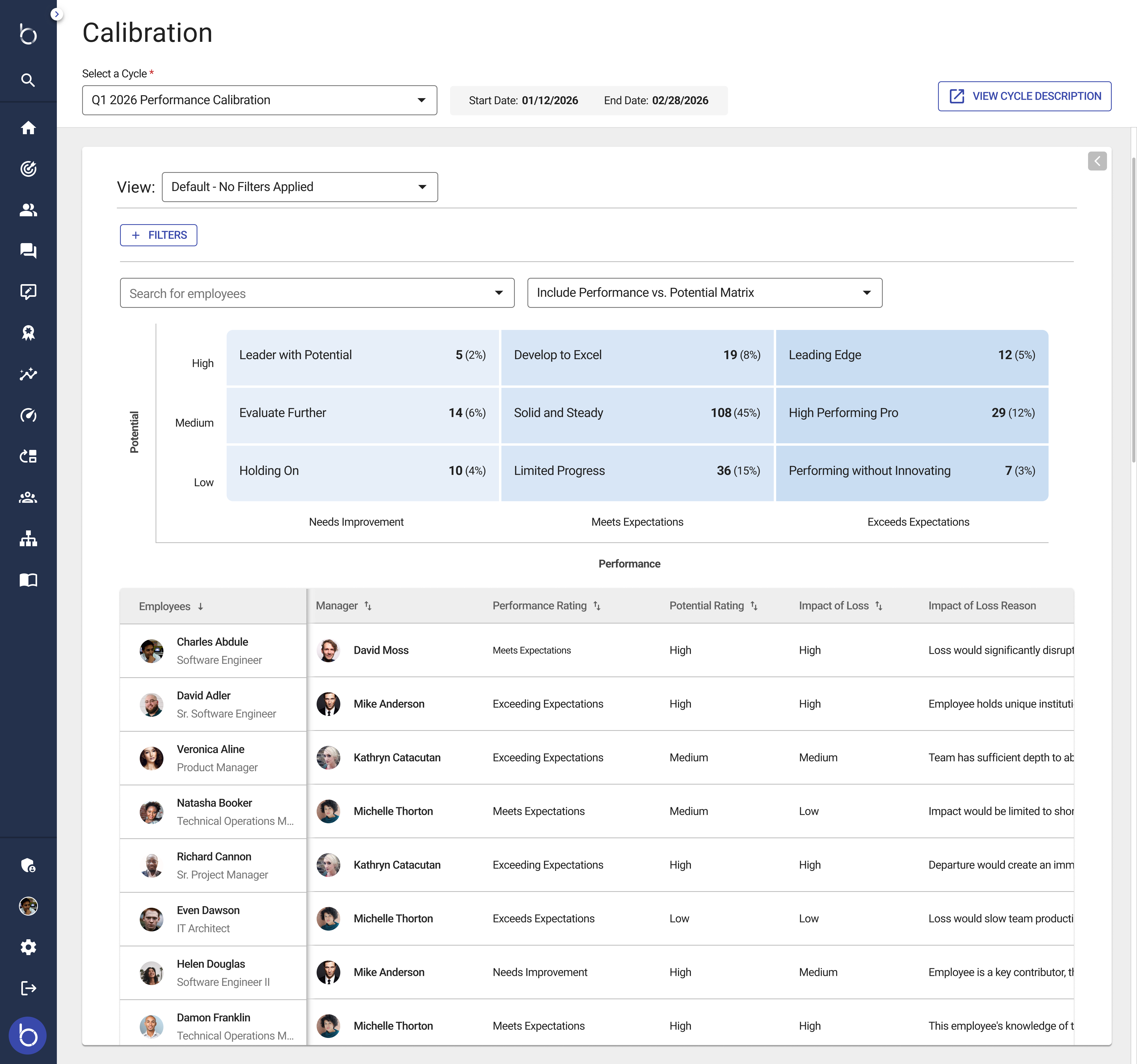
Live performance data in the room. Rather than working from static exports, leaders conducting calibration can access employee profiles directly within the calibration workflow — including performance history, skills data, feedback signals, and other relevant information configured for their organization's specific decision-making needs. The data being discussed is current, not a snapshot from the last review period.
HRIS and external data syncs. Betterworks Calibration supports easy data syncs with HRIS systems and other external data sources, giving leaders comprehensive context — tenure, level, compensation range, mobility flags — without requiring HR teams to manually assemble that information from separate systems. Less prep time, fewer errors, more confident decisions.
Multiple visualizations within a single calibration. Different decisions require different views. Betterworks provides multiple visualization options within a single calibration experience, each configured for easier analysis — so leaders can look at performance-potential distribution, compare across teams, and drill into individual profiles without toggling between systems.
Visibility into change history. Calibration outcomes should be traceable. Betterworks makes change history easily visible, so leaders and HR teams can see how ratings evolved through the process, understand what drove adjustments, and maintain a clear record for compliance, fairness reviews, or future planning.
Reduced bias, greater consistency. By replacing manual, memory-dependent inputs with structured, current performance data, the Calibration module removes a significant source of inconsistency from the process. Decisions are grounded in evidence, not recollection. Expectations are applied consistently across teams — not shaped by which managers prepared the best pre-read or advocated most persuasively in the room.
This is part of a broader shift that defines Betterworks' 2026 Spring Release: talent intelligence powered by performance. The idea is that the performance signals organizations are already generating — through goals, conversations, feedback, and outcomes — should be doing more work. They should be informing calibration. They should be surfacing real skill signals, not just self-reported ones. They should be making talent decisions faster, more consistent, and more credible at the executive level.
Why This Matters for HR Leaders Now
The pressure to make better people decisions faster is not new. What's different now is the cost of getting those decisions wrong. Attrition risk is higher when high performers feel their contributions aren't recognized accurately. Bias exposure is greater when calibration records can't demonstrate how decisions were made. And in organizations under pressure to demonstrate the return on human capital investment, the quality of talent decisions is increasingly a business-level question, not just an HR operations question.
Calibration that relies on stale summaries and manager memory is not just an HR process problem. It is a business decision quality problem. And it's one that mid-market and enterprise organizations now have the tools to solve — not with a redesigned meeting format, but with a fundamentally different data foundation.
Getting Calibration Right Is a Decision-Quality Problem
The calibration meeting itself is rarely the thing that needs to change. What needs to change is what leaders walk into that meeting with — and what they can access, in real time, while the decision is happening.
When calibration is grounded in live performance signals, connected to current talent data, flexible enough to run outside of annual cycles, and designed to produce decisions that are traceable and defensible, it stops being an administrative burden and starts being a genuine advantage. For organizations that are serious about making faster, fairer, and more consistent people decisions, that's the difference that matters.
Performance Calibration FAQs
What is performance calibration, and why does it matter?
Performance calibration is the process of reviewing and aligning employee performance ratings across managers and teams to ensure consistency and fairness. It matters because without calibration, two employees with similar performance can receive very different evaluations depending on their manager's standards, recency bias, or communication style. Structured calibration helps organizations reduce those inconsistencies and make more defensible talent decisions.
What are the most common reasons calibration processes fail?
The most common failure modes are disconnected data, recency bias, and manual preparation burdens. When leaders calibrate from static review summaries and spreadsheet exports rather than current performance data, decisions are shaped by incomplete information. Recency bias — favoring what happened most recently over a full performance record — is a structural risk in any process that lacks ongoing performance signals. And when HR teams spend hours manually assembling calibration views from multiple systems, that effort compounds data quality and timeliness problems.
How is modern calibration software different from traditional calibration approaches?
Modern calibration software connects the calibration workflow directly to live performance data, skills profiles, feedback history, and HRIS records — rather than relying on manually assembled exports or static review summaries. It supports flexible calibration cycles that aren't tied exclusively to annual reviews, provides multiple visualization options within a single session, and maintains a traceable history of how decisions evolved. The result is faster sessions, more consistent outcomes, and decisions that are easier to defend.
How does Betterworks Calibration differ from other calibration tools?
Betterworks Calibration is differentiated by its integration with live performance data across the full employee experience — goals, feedback, 1:1 conversations, and skills signals — rather than relying solely on periodic review inputs. Leaders can access employee profiles directly within the calibration workflow, sync with HRIS and external data sources, and view change history transparently. The module is also designed to run independently of annual review cycles, making it useful for the range of talent decisions that happen throughout the year, not just at year-end.
How does calibration reduce bias in performance reviews?
Calibration reduces bias by creating a structured setting where ratings are reviewed against consistent criteria and compared across teams. When calibration is grounded in current, documented performance data — rather than manager memory and recent impressions — it becomes harder for recency bias, affinity bias, and advocacy bias to dominate outcomes. Visibility into change history and multiple data visualizations further help leaders identify and correct patterns before decisions are finalized.
See what calibration looks like when it's grounded in how your people are actually performing.