At Betterworks, we know that the best goal-setting process, like OKRs, leads to connected, supported, progress-based, adaptable, and aspirational goals.In sales or support, where numbers are ever-present in day-to-day work, setting and measuring the goals is as easy as looking at the latest report or record. But how do those of us who are in less quantifiable roles, like design, measure success?While you could argue that design is attached to metrics in the end (e.g product design leads to sales, etc) these chains of causation are too long to measure. Tying measures like a spike in qualified sales leads to phenomenal work done on a wireframe doesn’t make sense. It’s impossible for that feedback to be real-time, and it dilutes the impact of great design work leaving designers feeling under-appreciated.
Why is Goal Setting Important for Designers?
Goals are a transparent agreement on workload and priorities
Goals provide the context for discussion around requirements and reduces confusion around priorities
They keep track of all the moving pieces
Shared goals with the cross functional team helps you understand the status, keep track of feedback, and avoid duplication
Goals help designers get credit for work
Great design requires lots of iteration, and excellent work often ends up being deferred due to shifting priorities. Additionally, the process of sifting through file sharing systems to look for portfolio work or past projects can be painful. Goals provide the context for recording details and whereabouts of files so you can easily access your past accomplishments.
Setting Great Design Goals
The MissionAn effective first step toward setting goals is to define a mission statement for the next year. Is it to become more well rounded? Be a better team player? Develop management skills? This mission will act as your goal setting lens, while letting you stay focused on the more operational, day to day work.With that mission in mind, I recommend setting 1-3 operational goals. These are the biggest deliverables for a given period of time (i.e we are on a quarterly cadence at Betterworks). For a design lead, the top 3 goals are things like this:Ship visual designs for the best goals product on the market where each feature shown in product one pager grabs the attention of it's consumers
Deliver a best in class integration/partnership experience
Implement a streamlined design prototyping process
Learn Sketch
Speak at a Design Conference
Improve Ability to Frame Projects
Improve work relationships by inviting each engineer to lunch
Submit designs for team Dribbble account
Refer 5 friends to the company
Teach a class internally
Mentor a new intern
Earn a new certification
Building the Goal
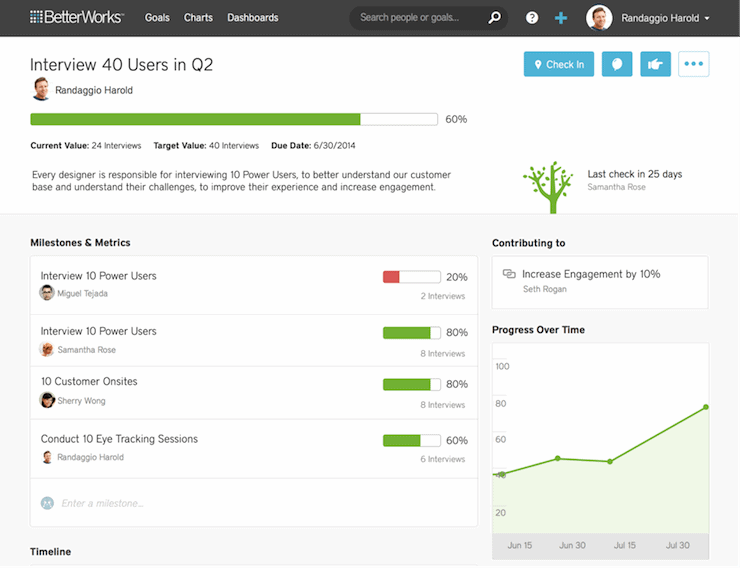
Once your goal is defined, break them down to help you focus on specific deliverables. We call these smaller deliverables milestones. These discrete milestones help you form a plan of action for your goals. They are also your measures for success. When all is said and done, you can point to the milestones you completed as evidence of your accomplishments for the quarter.Milestones: Small, specific chunks of work that add up to your mission-critical goals; the things you need to do in order to hit your goals and keep your job. Milestones are specific to each person and their contribution to the company. They are the measures of a goal’s success.Redesign the Activity Feed
Contribute 3 Modules to the Pattern Library
Complete 20 User Interviews
Connecting your Goals
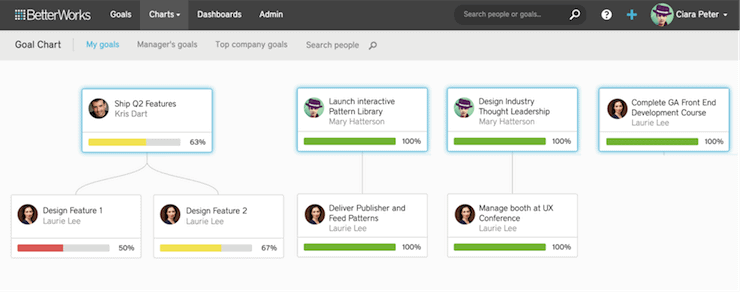
Depending on your goal-setting process, you may have the ability to connect your goals to others. Alignment is especially common in operational goals, as they’re directly tied to the progress of company initiatives. A few benefits of connecting goals include:Tracking dependencies within a project
Seeing how your work aligns to the goals of your company
Directly contributing to the progress of your team goals
In Summary
Building out your goals takes time, but the basic premises are very simple:Know what your mission critical goals are, and limit them in number so you stay focused (3-5 total, 1-3 operational goals)
Break down those bigger goals into discrete milestones
If possible, turn those milestones into quantifiable metrics
Connect your goals lets your progress flow throughout your team and your company, and leads to greater achievement