Key Takeways
-
Most organizations use AI in performance for writing reviews and feedback faster — the lowest-leverage use case.
-
The real value is AI that understands performance across time, connecting goals, feedback, and conversations.
-
This enables continuous performance intelligence, not just end-of-cycle summaries.
-
This shift reduces reliance on memory and manual reconstruction, replacing recall-based reviews with evidence-based evaluation.
-
Reviews shift from recall-based → evidence-based, reducing bias and guesswork.
-
AI should inform judgment, not replace it — surfacing insights while managers interpret and act.
-
The advantage goes to organizations that design for continuous signals, not annual events.
Managers are pasting sensitive review notes into ChatGPT to polish their language. Employees are generating self-reviews in 10 minutes with tools that know nothing about their role, their goals, or what the organization is trying to achieve.
The inputs were all over the place. The output looks professional. What happened in between is a mystery.
That's not just a process problem — it's a signal that the performance management system wasn't up to the job.
The people closest to the work already know the system isn't serving them. When they reach for a public AI tool to fill the gap, they're not being careless. They're improvising around a system that gave them nothing better.

The problem with AI that only shows up at review time
At the individual level, the workaround is understandable. At enterprise scale, it's an HR nightmare. Multiply every manager reconstructing narratives from memory and every sensitive conversation fed into a public tool across thousands of people and you're looking at systemic risk.
Data exposure
When managers and employees use public LLMs to organize the content of their inboxes and message threads, sensitive performance information is leaking out of your system — fed into tools with no accountability for what happens to that data next. (Unlike public LLMs, Betterworks never uses customer data to train its models. Every AI-generated recommendation is explainable, showing the sources behind it. And organizations can enable or limit AI features by department, region, or group, maintaining control over how AI is used across their workforce.)
Eroded trust
When multiple managers feed similar prompts into the same tool, reviews start sounding interchangeable. Employees notice. AI-generated language that replaces a manager's own assessment turns feedback into exactly the kind of generic, trust-eroding exercise organizations have spent years trying to move past.
Reconstructed narratives
By year-end, managers are rebuilding performance stories from whatever they can piece together — the last project that went well, the meeting that went poorly, the teammate who advocated loudest in calibration.
Recency bias isn't just unfair to employees; it creates risk exposure in promotion and compensation decisions, where defensible documentation is increasingly expected.
"AI is being used to summarize history," says Cheryl Johnson, chief product and technology officer at Betterworks. "It's operating at the moment of reflection, and not the moment of performance."
Strategic disconnection
Jamie Aitken, VP of HR transformation at Betterworks, recently asked a roomful of HR leaders how many were formally aligning their HR strategies to business priorities. Only a few raised their hands. If your performance program isn't connected to the outcomes the business cares about, no amount of AI-assisted review writing will bridge that gap.
Our 2026 research found that only 42% of organizations include AI expectations in goal-setting today.
Missed intelligence
AI that only shows up at review time can't track how goals evolved, how coaching conversations shifted, or how an employee's skills developed. Every signal that could have informed a fair, accurate, evidence-based review disappears the moment it happens because nothing was there to capture it in a safe, structured format.
The issue isn't that your people are using AI wrong. It's that the traditional performance cycle was never designed to give AI anything meaningful to work with at all.

From scattered signals to continuous performance intelligence
What if AI showed up before the review? Not to write about performance, but to observe it — tracking how goals progress, how coaching evolves, how skills develop — so that by year-end, the evidence already exists.
A manager with eight direct reports can't hold all of that in their head simultaneously. What someone said in a 1:1 in February, a goal update in April, a peer feedback comment in June — those signals exist, but nothing was there to connect them.
When AI has access to the full context of an employee's work over time, it does that connecting continuously, revealing patterns and gaps that no manager could track manually across a full team. That's the intelligence gap the best performance systems are now designed to close.

Goal setting: from blank page to strategic alignment
On paper, goals are supposed to create alignment by connecting every person in the organization to something bigger than their own task list. In practice, most goal programs become episodic exercises. Employees fill in goals at the start of a cycle, often with limited visibility into what the organization is trying to move, and revisit them only when someone asks about completion rates.
The problem starts with the wrong question. Most employees ask, "What should I work on?" Caitlyn Collins, organizational psychologist and program strategy director at Betterworks, sees something different in organizations where goals drive alignment: "What is the organization trying to do differently? What are they trying to impact? And how do I contribute to that?"
That's a harder question to answer without the right context — and our 2026 research found that only 42% of organizations include AI expectations in their goal-setting today, even as 90% of HR leaders say AI has already changed what high performance looks like. The gap between what the organization is trying to become and what employees are being asked to work toward isn't philosophical. It shows up as misaligned effort, missed priorities, and goals that feel irrelevant by midyear.
Betterworks Goal Intelligence addresses this directly, drawing on manager objectives, past performance context, one-on-one summaries, and role-specific signals to suggest goals that connect individual work to company priorities. It recommends both professional and developmental goals, along with milestones to achieve them. Employees start each cycle with a clear line of sight from their own work to the organization's priorities, rather than piecing it together on their own.
For large organizations, that lack of direction isn't just a management problem — it's a financial one. Project Management Institute research has found that organizations undervaluing strategic alignment waste nearly 11% of their total project investment due to poor performance. At 10,000 employees, even modest misalignment compounds into losses of $144M or more annually in wasted initiatives, redundant work, and unnecessary attrition.
One-on-ones: from scattered notes to shared memory
One-on-ones are where the real texture of performance lives. Coaching moments, recurring blockers, development breakthroughs, the week an employee turned a corner — all of it surfaces in these conversations and then largely disappears before anyone thinks to write it down.
Cheryl recalls keeping a dedicated notebook for every direct report, determined to be the kind of manager who could track someone's growth over time. Even then, synthesizing a year of handwritten notes into a coherent performance narrative was more than any manager could realistically do. "My memory can't do that anymore," she says. "If it ever could."

Betterworks addresses this with what it calls Continuous Clarity for Managers — AI that connects themes, progress, and follow-ups across every one-on-one, summarizing conversations over a defined time period and surfacing the arc of coaching over time. "We're able to detect and surface different kinds of coaching patterns," Cheryl says. "Are we talking about development...or are we staying super tactical in every one-on-one?"
Both the manager and the employee see the same synthesized picture — a shared memory that reduces disputes and counters selective recall. When performance narratives are built from documented conversations, the manager with the best memory no longer has an unfair advantage over the one with the biggest team.
Skills: from self-reported to evidence-based
Most organizations still rely on self-declared skills or learning completions to understand workforce capability. Self-declarations capture what employees remember and choose to share. Learning completions show inputs, not outcomes. Neither one reflects what an employee can do on the job.
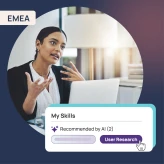
Betterworks infers skills from actual performance signals by synthesizing goals, feedback, one-on-one conversations, and learning activities, then combining that evidence with role and job-family context to surface skill recommendations with transparent sourcing. Employees see exactly why a skill is being attributed to them, and managers can verify or adjust before those signals inform development or mobility decisions.
The case for getting this right is urgent. Betterworks' 2026 State of Performance Enablement research found that 90% of HR leaders say AI has already changed what high performance looks like — yet most organizations still rely on self-declared skills or learning completions to understand what their workforce can actually do. Self-declarations capture what employees remember and choose to share. Learning completions show inputs, not outcomes. Neither reflects what someone can do on the job.
Caitlin frames the equity dimension directly: when the data driving talent decisions comes from actual performance signals — not self-advocacy — "everyone has equal weighting and equal footing." Employees who do exceptional work quietly get the same visibility as those who advocate loudly for themselves. That's a fairness argument, and it's a retention argument. High performers who feel unseen tend to leave.
Independent research backs this up. According to The Josh Bersin Company, organizations that use AI to infer employee skills from performance data see 25% higher employee performance, a 30% better match between skills and roles, and a 20% increase in employee satisfaction with mobility and growth opportunities. When skills intelligence is continuous, it becomes the foundation for internal mobility, succession planning, and the ability to match capability to strategic priorities as the business shifts — without waiting for an annual talent review cycle to surface what the organization already knows.
When these three signals are connected and accumulating in real time, performance risks that used to surface as surprises in calibration — or worse, as attrition — become visible while there's still time to act on them.
Why performance reviews become more powerful with year-round AI

When AI has been present across the performance year, the dynamic at review time shifts. Reviews "stop being an exercise in recall and become an exercise in interpretation,” Cheryl notes.
The evidence layer is already assembled — not from a last-minute data pull, but from signals that accumulated throughout the year. The Betterworks AI-Synthesized Performance Summary consolidates those signals into a clear narrative, surfacing strengths, themes, and development opportunities so managers arrive at the review process with a structured picture of what happened.
What remains is the work that requires a human: interpreting context, weighing tradeoffs, and making judgment calls that a system shouldn't make for them.
This is a moment where Betterworks draws a hard line: AI does not auto-generate reviews. Employees and managers still write in their own voice. AI surfaces the evidence and can help refine language, but the interpretation stays human because reviews that feel machine-written erode the trust the process is supposed to build. The shift isn't from human to AI, but from manual interpretation to informed judgment.
Bias reduction follows from this approach. Full-period evidence counters recency bias. Documented performance signals make halo and horns effects harder to sustain. And when skill attributions are grounded in actual work, promotion decisions start reflecting measurable contributions.
The manager's role sharpens into what it should have been all along.
How to make the shift from writing assistance to performance intelligence
Most HR leaders who want to explore AI in performance make the same first mistake: They start with the technology. Jamie Aitken has seen this pattern across hundreds of conversations. "I talk to a lot of HR folks that, while they're thinking about changing something in performance, focus specifically on the technology and tweaking the process," she explains. "That is one aspect of it. But as important, if not more, are the other two pillars."
The Betterworks Performance Maturity Framework evaluates programs across strategy, people and culture, and systems — helping you identify where you're out of balance and build a sequenced plan to get where you need to go. It maps progress across four maturity levels:
Initiating: Ad hoc processes and thin data mean AI defaults to surface-level tasks — generating review language, polishing self-assessments.
Emerging: Some processes are in place, but inconsistent adoption limits the data AI can draw on — signal exists, but it's too sporadic to synthesize meaningfully.
Embedding: Consistent engagement in goals, feedback, and one-on-ones gives AI structured inputs to connect and generate real intelligence.
Optimizing: Intelligence feeds back into the system, continuously refining how performance drives business outcomes.
Caitlin has seen the framework resonate with leaders who couldn't previously name what was missing. "It puts words to feelings," she says. "There was something I knew wasn't there, but I couldn't quite articulate it."
Knowing your maturity level tells you where you are. These four moves tell you what to do next.
Start with outcomes. Define what success looks like before choosing any tools. "Better reviews" is too vague to drive a strategy. Do you want managers spending less time assembling evidence? Employees who can see how their work connects to what the business cares about? Fewer surprises in calibration? Name the outcome, then work backward.
Audit where AI already lives. Your employees are using it whether you've sanctioned it or not. Get an honest, non-punitive picture of what tools are in play, where the gaps are, and what your policies don't cover. The gap between official policy and actual behavior is where risk lives.
Design for continuous signals. Making review season easier is a side effect, not the objective. If one-on-one conversations aren't being documented, if feedback is sporadic, if goals go untouched between quarterly check-ins, then AI has nothing to synthesize — no matter how sophisticated the tool.
Keep humans at the center. No one wants AI to replace their manager. But be specific about the line. AI should assemble evidence and surface patterns. Humans should interpret context, weigh competing priorities, and have the conversation that a system can't.
The power of AI-native performance enablement
The organizations that will define what's possible in performance over the next decade aren't the ones with the most sophisticated review templates. They're the ones that stop treating AI as a writing tool and start treating it as an intelligence layer — present across the full performance cycle, connecting signals that were never connected before, and surfacing what managers need to act earlier than they ever could.
That's what AI-native performance enablement looks like. Not AI that polishes what you've already decided. AI that helps you understand performance while it's happening — so that by the time review season arrives, the hard work is already done.
Watch the on-demand webinar where Cheryl and Caitlin walk through the full framework.
See how AI can surface real performance insights — not just write reviews.
Book a Demo