5 Performance Review Examples for 2026 (With AI-Era Best Practices)
By Michelle GouldsberryDecember 17, 202314 minutes read
Share
Share
Updated April 10th, 2026
Performance reviews can be a key factor in employee development and business success. They’re an important method of assessing job performance and establishing employee goals. However, many managers find it challenging to deliver constructive feedback that drives lasting growth and progress. That’s why we’ve compiled a list of performance review examples to help you write action-oriented performance reviews.
The performance review is still broken — and the 2026 numbers make the case clearly. According to the Betterworks 2026 State of Performance Enablement Report, which surveyed 2,387 HR leaders, managers, and employees, executives are six times more likely than employees to believe that performance reviews have kept pace with AI-driven work. The gap between what managers intend and what employees actually experience remains wide, and closing it starts with understanding what a high-quality review looks like in practice.
Whether you’re an HR leader or a people manager, looking at performance review examples can help you navigate this complex process and unlock your team’s potential.
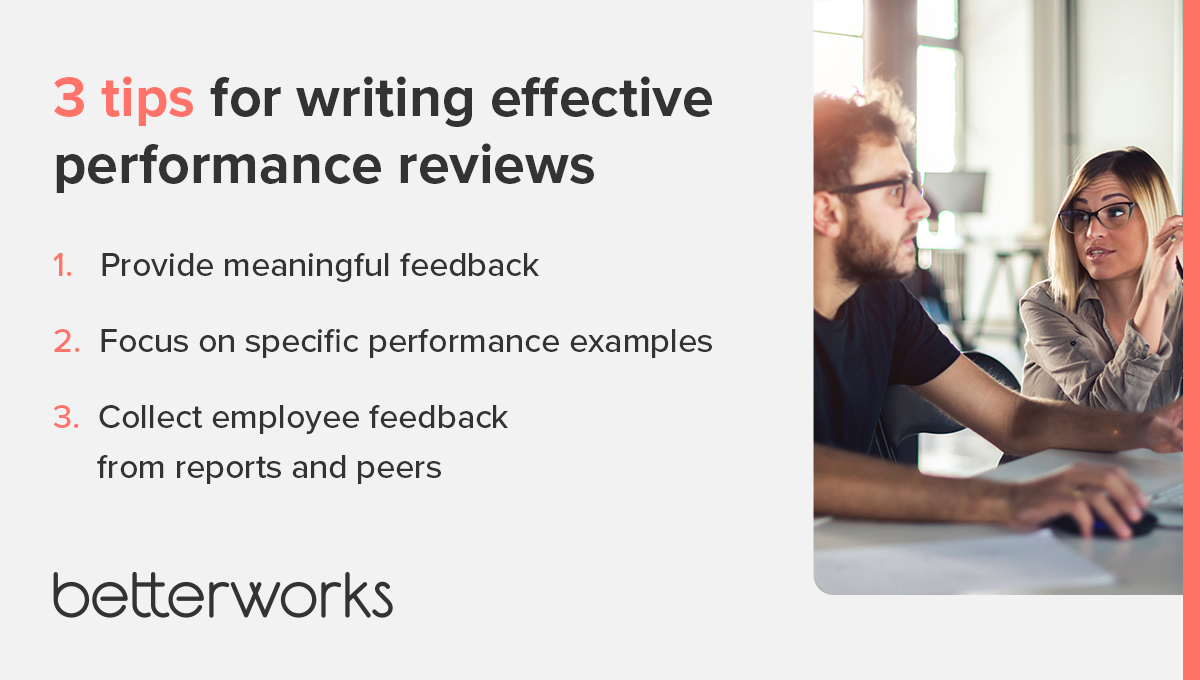
3 tips for writing performance reviews with impact
Consistency with performance reviews starts with a repeatable process. A well-defined process helps you make sure that performance reviews are fair, objective, and focused on the right things. It helps managers gather relevant information, provide constructive feedback, and set meaningful goals.
In this list of tips, we'll explore best practices shared by Caitlin Collins, an organizational psychologist and Betterworks program strategy director. Learn how to navigate the performance review process with confidence and produce employee reviews that are valuable and actionable.
Provide meaningful feedback
Effective performance reviews provide feedback that workers can apply to their behaviors. But writing high-impact performance reviews can be challenging, especially for first-time managers or those struggling to meet their own deadlines and goals.
The scale of the problem is measurable. When managers are stretched, reviews default to generic language that employees immediately recognize as low-effort — which erodes trust rather than building it. "What happens — especially if you have many performance reviews to write — is they become either generic," says Caitlin Collins, organizational psychologist and Betterworks Program Strategy Director, "or there's not much intentional, valid, or really good feedback included." So how can you deliver feedback that's fair and drives change?
“Give yourself some space to be able to write a thorough review for each person so that it's something that's meaningful and future-focused, ensuring there is a clear plan of action for the coming year,” Caitlin says. “Spend time gathering information.” You can do this by reviewing goal progress records, check-in notes, and continuous feedback signals in a platform like Betterworks, which is designed to surface a continuous record of each employee's contributions so managers aren't reconstructing a year from memory at review time.
To ease the end-of-the-year performance appraisal process, provide ongoing feedback throughout the year to address strengths and areas of improvement. Compiling content over time helps you be more thoughtful about what you include in the performance review — and it minimizes the chance of recency bias. Better yet, consider moving to a quarterly review process, which is a lighter lift for all involved and allows employees to apply feedback sooner rather than waiting an entire year or even six months.
Focus on specific performance examples
Great performance management conversations are targeted and specific. Instead of relying on general statements, use specific examples to illustrate an employee's performance. Talk through achievements, challenges overcome, and instances where the person demonstrated exceptional skills or behaviors. This approach makes feedback more tangible and actionable.
“Think back throughout the year, and prioritize the list of projects that each direct report worked on,” Caitlin says. Use that information and your reflections to develop a performance review that's tactical, specific, balanced, and aligned with each employee’s development plan.
Collect employee feedback from reports and peers
Give employees the opportunity to reflect on their performance and provide self-assessments. This empowers them to take ownership of their development while giving you insight into how they perceive their strengths and areas for improvement.
Employee self-assessments also offer a counterbalance to your viewpoint, Caitlin says, since managers can’t see every employee at all times. Similarly, feedback from peers rounds out and balances performance reviews. Peer participation specifically strengthens perceived fairness, and the Betterworks 2026 State of Performance Enablement Report confirms this is a persistent driver of review credibility across organization sizes.
How AI Is Changing the Performance Review Process in 2026
Artificial intelligence has moved from an experiment to a standard part of how reviews are written, calibrated, and delivered. According to the Betterworks 2026 State of Performance Enablement Report, 90% of HR leaders say AI has fundamentally redefined what "high performance" means — yet only 42% of organizations have updated their goal-setting or review criteria to reflect that change. That gap is where reviews go stale and where employees lose confidence in the process.
Used well, AI addresses the most painful part of review writing: getting started. Platforms integrated with goals, check-in notes, and continuous feedback data can generate a structured draft based on actual work signals rather than a manager's twelve-month memory.
What AI should not do is replace the human judgment that makes feedback land. Research from SHRM's 2025 Talent Management Priorities report is explicit: ensuring managers provide objective, constructive feedback remains a top challenge cited by 41% of talent management executives, regardless of what technology assists them. AI can draft and organize. It cannot supply the relational context — the knowledge of how someone handled a difficult Q3, or the encouragement a struggling team member needs to hear — that makes a review meaningful.
A practical approach for using AI in reviews has three steps. First, gather the raw inputs before opening any AI tool: goal completion data, 1:1 notes, peer feedback, and project outcome records. The quality of an AI-assisted draft depends entirely on what the manager provides. Second, use the AI draft as a starting point, not a final product — adding the specific behavioral examples and forward-looking development language only the manager can supply. Third, run a bias check before submitting. Research published by HR Brew analyzing Textio's study of 23,000 performance reviews found that women are 22% more likely to receive personality-based feedback than men, and that Black and Latinx employees receive significantly less actionable feedback than white peers. AI tools with language-pattern detection can flag these tendencies before they become part of the permanent record.
The organizations getting the most value from AI-assisted reviews treat the technology as a drafting partner, not a replacement for the manager's coaching role. That distinction matters both for quality and for the employee trust that makes the whole process worthwhile.
3 elements of a good employee performance review
Every performance review will be unique because of the people involved, but good reviews have a few things in common.
Clear expectations and criteria
When managers and employees agree on what good performance looks like, reviews are easier to conduct fairly and objectively. There’s no disagreement on what the goals were, how success will be measured, and whether success was achieved.
Compare the performance review template against each team member’s job description. “Are there clear definitions for what each rating level means?” Caitlin says. “What has to be observable or accomplished to reach certain rating levels?”
If the criteria aren’t clear, turn to your peers in HR for help. Remember that if the expectations aren’t clear to you, they probably aren’t clear to managers or employees, either. Use the performance review process as an opportunity to help the workforce understand what’s expected of them.
Constructive feedback
Constructive feedback helps employees identify where they can improve their skills, knowledge, and performance. It highlights specific behaviors or actions that need attention and provides suggestions for how to address them. Effective feedback can be a catalyst for professional growth and development, helping employees reach their full potential.
Constructive feedback exists in workplaces where managers and employees are encouraged to communicate openly. Feedback goes in both directions: employees should seek clarification, ask questions, and provide their own perspective on their performance. Two-way communication fosters a culture of continuous improvement and collaboration. One structural safeguard worth building into your process: a bias audit at the calibration stage. Harvard Kennedy School research by Professor Iris Bohnet, analyzing four cycles of performance reviews at a multinational firm, found that managers consistently rated employees of color lower than white employees even when self-evaluations were hidden — meaning the bias came from evaluators themselves, not from anchoring on employee self-scores. Structured calibration sessions, clear rating criteria, and outcome audits by demographic group are the interventions the research identifies as most effective.
Recognition of growth and progress
Recognition is not a courtesy — it has direct, measurable effects on performance and retention. Gallup's research on strengths-based feedback shows that teams whose managers focus primarily on strengths during reviews are 8.9% more profitable and 12.5% more productive on average than teams whose reviews center on weaknesses.
Recognizing an employee's growth also helps managers reinforce those behaviors and actions. This is where specific feedback is effective. Highlight the skills, qualities, or behaviors that led to improvement so employees can understand how they improved. Encourage them to continue developing these strengths.
3 best practices for communication in the performance review process
Here are best practices for effective manager-employee communication during performance reviews.
Tailor reviews to employee needs
Managers can personalize employee performance reviews by understanding each worker’s goals and career development plans. Start by assessing employees against performance indicators that are relevant to their roles and responsibilities. Refer to the job description to tailor your feedback. By aligning reviews with employees' goals, managers can focus on performance and growth areas.
Additionally, draw on your personal relationship to provide actionable coaching and advice. “You can't give a good review if you don't have a good relationship with your employee,” Caitlin says. “You won't have enough honest information to be able to write to it.”
By providing tailored feedback, individualized goals, and personalized development opportunities, managers can create a performance review process that addresses each worker’s unique needs.
Practice active listening and open dialogue
Create a collaborative environment by practicing active listening and open dialogue during performance reviews. Active listening by managers requires full attention, consistent eye contact, and not interrupting. These behaviors demonstrate respect and empathy while creating a safe space for employees to talk through issues and concerns.
Another way to encourage open dialogue is by asking open-ended questions, as well as seeking clarity with follow-up queries. This promotes a two-way conversation, avoids misunderstandings and confusion, and allows the employee to actively participate in the review process.
Provide constructive feedback that avoids personal judgment. Focus on specific behaviors and outcomes rather than personal attributes. When discussing employee strengths and weaknesses, frame the discussion as an opportunity to improve and help them achieve their goals. By practicing active listening and open dialogue, managers create a collaborative atmosphere where both parties feel heard and valued. The results include meaningful discussions, increased engagement, and improved performance.
Anticipate individual differences
Each of your direct reports brings a distinct cognitive and emotional profile to the review conversation — and structural bias compounds individual differences in ways that are now well documented. Research published by HR Brew analyzing Textio's review of 23,000 performance reviews found that 56% of women have been described in personality terms in their reviews, compared to 16% of men, and that women are 22% more likely to receive personality-based feedback overall. That disparity has real career consequences: feedback is the bridge to promotion and expanded opportunity, so low-quality or personality-focused feedback structurally limits advancement for the employees who receive it most. "People think differently and respond differently and have different emotional needs," says Caitlin Collins, Betterworks Program Strategy Director. "The better you know each of your team members, the easier it is to anticipate those differences and adjust your approach."
For example, if an employee prefers written communication, you could provide written performance feedback ahead of the review. This allows the employee to process the information at their own pace and come prepared with questions or concerns.
5 performance review examples
Writing an effective performance review requires tracking many elements. That’s why we’ve generated examples to illustrate how to apply performance review best practices. Here are five examples, each involving a fictional sales executive.
Example No. 1: Highlight goal achievement
“Throughout the year, John has shown exceptional progress in achieving his goals. He consistently met and exceeded his monthly sales targets, contributing to a 20% increase in revenue for the team. John's ability to build and maintain strong client relationships has been instrumental in his success, resulting in a 30% increase in customer retention. His proactive approach to identifying new business opportunities has also led to the acquisition of several high-profile clients.”
The review of John's accomplishments includes specific facts, such as his ability to consistently exceed monthly sales goals and his contribution to a rise in income. These specific accounts of his achievements lend credibility to the review and illustrate John's role in the team's success.
The review showcases the employee's capacity to drive business value and produce tangible outcomes, such as acquiring high-profile clients. These quantifiable successes demonstrate the employee's efficacy and worth to the company.
The review recognizes John's talent for creating and sustaining strong connections with clients as crucial to his success. By tying accomplishments to particular abilities, the review highlights John's aptitudes and emphasizes his meaningful contributions to the team.
The review highlights how John's achievements positively affected the team, such as the increase in revenue and customer retention. This demonstrates the employee's ability to work collaboratively and contribute to the overall success of the organization.
Example No. 2: Call out individual strengths
“John's exceptional communication skills have been a significant asset to the team. His ability to effectively articulate the value proposition of our products and services has consistently impressed both clients and colleagues. Furthermore, John's strong analytical skills have allowed him to identify market trends and adapt his sales strategies accordingly, resulting in a 15% increase in market share. His positive attitude, resilience, and ability to work well under pressure have also been commendable.”
The review cites precise examples of John’s strengths, such as excellent communication skills and powerful analytical skills. These details lend credence to the review and showcase the employee's particular areas of competence.
The review highlights how John used his strengths to positively serve clients and colleagues. For example, the review offers good feedback by connecting John’s analytical strengths to business results.
The review also highlights positive personal traits that contribute to work outcomes — his attitude, resilience, and ability to work well under pressure.
Example No. 3: Recommend areas of improvement
“While John has demonstrated remarkable performance, there are a few areas where he can further enhance his skills. One area for improvement is in leveraging technology to streamline sales processes and improve productivity. By better familiarizing himself with our CRM system and exploring automation tools, John can optimize his workflows and improve efficiency. Additionally, improving his negotiation skills and product knowledge will help him to address client objections more effectively and close deals more efficiently.”
The review offers clear steps John can apply to improve his performance, such as improving his aptitude with specific technology, negotiations, and the company’s product portfolio. All of these areas directly relate to John's role as a salesperson. This level of detail helps employees to recognize how they need to improve their performance and why these requests are relevant to the job
Example No. 4: An action plan for continued growth
“To support John's continued growth and professional development, we will provide him with targeted training sessions on advanced negotiation techniques and product knowledge. Additionally, we will assign John a senior sales mentor to provide guidance and share best practices. Regular check-ins, creation of progress reportand performance discussions will be scheduled to monitor progress and provide ongoing feedback."
The action plan directly addresses the areas for improvement identified during the performance review, such as improving negotiation skills and expanding product knowledge. By providing targeted training and mentorship, the action plan directly makes the manager and employee responsible for following through.
The action plan provides specific actions that John’s manager will take to support John's growth and development, such as training on advanced negotiation techniques. The in-house mentor will offer John advice and demonstrate the most successful sales approaches. This is a commitment to helping John learn and grow in this role.
John’s employee development plan includes regular check-ins and performance discussions to track progress and provide ongoing feedback. This is a guarantee that John’s development will be monitored and that his manager is committed to seeing through the growth plan.
Example No. 5: Collaborative goal-setting
“To ensure continued growth and success, we have identified the following goals for John to focus on in the upcoming performance period:
Reach sales targets: John will aim to consistently meet or exceed his monthly sales targets by implementing effective sales strategies, leveraging his strong communication skills, and proactively identifying new business opportunities. The goal is to contribute to a further 10% increase in revenue.
Develop greater proficiency with technology: John will actively familiarize himself with our generative CRM system and explore marketing automation platforms to streamline sales processes and improve productivity. By effectively using technology, John aims to optimize his workflow and improve efficiency, resulting in a 20% reduction in administrative tasks.
Improve negotiation skills: John will actively participate in targeted training sessions on advanced negotiation techniques to improve his ability to address client objections and close deals more efficiently. The goal is to increase the negotiation success rate by 15% and secure more favorable terms for the company.”
This goal-setting section outlines specific and measurable goals for John to achieve in the upcoming performance period. Each goal is realistic, attainable, defined, and aligned with team and business objectives — and each goal helps John achieve professional growth.
Additionally, the goals are relevant to John's role as a sales executive and address key areas for improvement. By setting these goals, the performance review establishes how John will pursue professional development and how progress will be assessed.
Write great performance reviews for your team
By following these best practices and using these examples as a starting point, managers can provide feedback that is specific, fair, and actionable — regardless of whether AI assists the drafting or not. The direction of travel in 2026 is clear: according to the Betterworks 2026 State of Performance Enablement Report, 90% of HR leaders say the definition of high performance has already changed, and organizations that don't update their review criteria to reflect AI-augmented work are evaluating their people on the wrong things.
Start with the examples above, anchor every piece of feedback in specific evidence, and build the check-in habits that make the formal review a summary of an ongoing conversation rather than a once-a-year surprise.
Frequently Asked Questions About Performance Reviews
What should a good performance review include?
A good performance review includes three core elements: clear expectations tied to the employee's actual role and goals, constructive feedback grounded in specific behavioral examples rather than generalizations, and recognition of concrete growth and progress since the last review cycle.
How is AI changing performance reviews in 2026?
AI is changing performance reviews in two primary ways: drafting and bias detection. On the drafting side, managers can now feed goal completion data, 1:1 notes, and continuous feedback signals into AI tools that generate a structured first draft — reducing the blank-page problem that causes reviews to default to generic language. On the bias detection side, tools that analyze review language can flag patterns before they become part of the permanent record, such as personality-based feedback directed disproportionately at women or non-actionable feedback given more frequently to employees of color — a disparity documented in Textio's analysis of 23,000 performance reviews. Importantly, AI does not replace the manager's judgment — it removes the administrative friction that degrades quality when managers are stretched thin.
How do you write a performance review that avoids bias?
Start with behavioral specificity: describe what the employee did and what outcome it produced, not what kind of person they are. Research from Harvard Kennedy School found that managers rate employees of color lower than white employees even when controlling for self-evaluation anchoring, meaning bias comes from evaluators themselves, not just from skewed self-assessments. Structural interventions that help include calibration sessions where ratings are reviewed across demographic groups, clear rating rubrics that define what each level looks like in behavioral terms, and hiding self-evaluations from managers until after they have submitted an initial rating for new employees. If your organization uses AI drafting tools, choose platforms with bias-detection features that flag personality-based language or patterns inconsistent with the employee's documented contributions.
What is the difference between a performance review and continuous performance management?
A performance review is a formal, structured evaluation — typically annual or quarterly — that documents an employee's performance against agreed goals and provides a rating or written assessment. Continuous performance management is the ongoing system of check-ins, feedback, coaching conversations, and goal updates that feeds into that formal review. According to the Betterworks 2026 State of Performance Enablement Report, organizations that embed performance conversations into the flow of work — rather than treating them as periodic HR events — give leaders real-time visibility into execution, skills gaps, and team alignment. The formal review works best when it is a synthesis of an ongoing conversation, not the only conversation of the year.
Check out the manager’s ultimate guide to great conversations.