Why do employees book large conference rooms just to sit alone? Or crowd into office phone booths all day? These small signals tell a bigger story about how workplaces succeed — or fail — at supporting people.
Workplace design isn’t just about floor plans. It shapes how employees feel supported, valued, and heard. And while occupancy data shows how space gets used, only employee listening explains why those patterns emerge. Put together, the two reveal what employees need to stay engaged and connected.
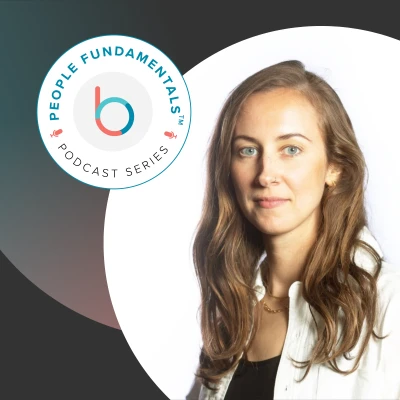
On this episode of People Fundamentals, host Ashley Litzenberger is joined by Annie Cosgrove, director of analytics and insights at Density, a space analytics platform for measuring and improving workplaces. With an architect’s eye and a data leader’s mindset, Annie shares how organizations can pair analytics with employee voice to design spaces that foster collaboration, focus, and belonging.
Subscribe wherever you listen to podcasts: Apple Podcasts | Spotify | YouTube Music
Your data always needs a ‘why’
At Density, Annie’s team uses occupancy analytics to understand how workplaces actually function. The numbers alone, however, don’t explain the why behind employee behavior. That’s why data must be paired with direct employee listening to uncover the full story.
“We use sensors that anonymously track how people use space,” Annie says. “Knowing how much your space is used and when and for how long, […] it can tell you a lot about how it’s going, but it doesn’t give you the whole story. What’s really important is pairing sensor data with qualitative insights, actually talking to your employees, figuring out the ‘why’ to go along with that.”
This dual approach allows organizations to spot disconnects between design and reality. For example, when employees consistently book solo meetings, it’s often a signal that the environment isn’t offering the quiet focus space they need. As Annie notes, “Solo meetings in particular are really important to pay attention to, because what they often mean is that there aren’t the spaces that those employees need to do the work that they need to do.”
Different teams, different spaces
Office design isn’t one-size-fits-all. Different functions thrive in different settings, and providing choice is essential for both productivity and belonging.
“It can totally depend, and it doesn’t just depend on the company, it depends on the team,” Annie says. “An engineering team might really need a desk that’s dedicated to them so they can do continuous heads-down work, whereas a sales or a marketing team might not need that dedicated space, because they’re mostly in meetings collaborating.”
That’s why a mix of environments matters. “The most important thing is having a variety of spaces, having a menu of spaces for people to choose from, but measuring how your spaces are used can help you figure out what the personas that are really in play here,” she adds.
Thoughtful variety does more than boost productivity. It signals to employees that the workplace was designed with them in mind — removing friction, reducing negative experiences, and ensuring the right space is available when they need it.
Bathrooms, booths, and belonging
How employees actually use a space often tells leaders more than the floor plan ever could. Subtle patterns can uncover overlooked friction and point to culture gaps hiding in plain sight.
Bathrooms are an example. “We actually found that there were a few bathrooms that were seeing really high usage patterns at certain times. …Sharing this data with our customer helped them actually figure out a better cleaning schedules,” Annie recalls. Those kinds of details can shape daily experience.
Or, consider quiet rooms. “[With] one customer, we saw some evidence of those being used for collaboration. That’s the opposite. So people were always sitting next to each other, kitty-cornered. Again, not the intention of the space. It maybe means that they need a collaborative space instead of the quiet space.” Employees will always adapt spaces to fit their needs — sometimes in ways design never intended.
And then there are office phone booths, known as call booths. “In some ways, maybe the phone booth has been like a Band-Aid solution for offices that were not set up properly for our current work styles,” Annie says. “Spending all day in a little box — that can’t be the right solution.”
By pairing analytics with employee voices, leaders can see beyond the data points. The result is a workplace that evolves with real behavior, supports focus and collaboration, and signals to employees that their needs are recognized.
People in this episode
Annie Cosgrove: LinkedIn

Transcript
Expand
Annie Cosgrove:
I get to use data to influence design, and that’s really what I’m passionate about, is not just designing based on intuition, but actually designing based on the facts and what you’re learning from measuring who you’re trying to design for. Pairing occupancy data with observation, visiting these spaces, serving your employees, talking to them, listening to what’s working and what’s not can really work well. One customer had a lot of different desk shapes and sizes that they had, or configurations that they were testing, and it was very obvious that the desks, though they were visually pleasing in a circular configuration, we heard from surveys, as well as it was very obvious in the utilization data, that employees didn’t like sitting with their back exposed to the whole office. And so, little details like that, I think, are really important.
Ashley Litzenberger:
Hi, and welcome to Betterworks’ People Fundamentals podcast. I’m your host, Ashley Litzenberger, senior director of product marketing. Betterworks’ core belief in People Fundamentals revolves around helping HR lead through constant change by focusing on core values, like fairness, support, balance, and enabling growth opportunities for employees. These tenets empower everyone in the workforce to strive for excellence, to foster creativity, and to acknowledge each other’s contributions. Betterworks believes that strategic HR leaders can translate these principles into action, shaping their workforce for the better and helping drive meaningful business outcomes. And in this show, we’re diving even deeper into these principles by listening to experts share how you can make them come alive at your organization.
Hi, Annie. It’s so good to have you on the podcast today.
Annie Cosgrove:
Hi, Ashley. Thanks so much for having me. I’m really happy to be here.
Ashley Litzenberger:
Yeah. So I am excited to dig into this episode, because there are so many companies that are implementing return-to-office policies, going from coming in one day a week to five days a week, and we often talk about company policies and team cultures being drivers to bring people back into the office. If you have a policy, then people will show up. If you have a strong team culture in the office, people will show up. But I feel like the actual space itself is an under-talked-about and really impactful lever that folks can use to draw people into the office, to make them want to show up and want to be there on a day-to-day basis, or something that will just create a lot of frustration and make them want to try and get out of coming into the office as much as they can.
Annie Cosgrove:
There’s a ton that we can do to make sure that our workplaces are really welcoming to our employees, and a lot of different, really helpful data sources that we can use to monitor how it’s going. And I think you’re right, it’s really something to pay attention to. I think ultimately, we want people to want to show up to work and to enjoy the work environment in all the ways.
Ashley Litzenberger:
Yeah. And I think because this is really a season focused on data, let’s talk about the data that you can use to start understanding how do you design spaces and understand if your spaces are designed well for being in the office. So you’ve got access to detailed space usage data, but there’s not always a why behind that behavior. So when you’re working with HR teams, you’re working with organizations, how do you bridge that gap? How do you surface what is the interesting data points that you’re finding, and then guide folks to dig in to understand what is the why behind the behavior that you’re seeing that’s happening?
Annie Cosgrove:
Yeah. So like you said, my team at Density has incredible access to a really objective lens on workplace usage and performance. So Density is an occupancy analytics company, and we use sensors that anonymously track how people use space. And so, we partner really closely with large companies that are trying to understand how their workplaces are performing and really trying to match their employee needs to their behaviors.
So like you said, knowing how much your space is used and when and for how long and all of the good stuff that we can get from devices like sensors in the workplace, it can tell you a lot about how it’s going, but it doesn’t give you the whole story. What’s really important is pairing sensor data, card swipe data, just measures of how much the space is used and when, with qualitative insights, actually talking to your employees, figuring out the why, like you said, to go along with that. And I think together, these qualitative and quantitative insights can really give a full picture on how your workplace is doing, what you might need to change, and where there might be pain points for your employees.
Ashley Litzenberger:
Yeah. And so, when companies bring employees back to the office, what does your data show that they tend to overlook, and how does that impact culture and retention?
Annie Cosgrove:
Yeah. So at Density, we’ve gotten to measure the RTO of several companies, and companies who are making a big change to their policy or a big RTO change, maybe they’re going from no days to five days in office or they’re going from three to five days in office, this has been a really common trend and we’ve been really uniquely positioned to measure it. And so, I think the basics are really important, like I said, just generally understanding how much your space is used and what spaces you’re running out of and what busy times look like in your space. But I think in general, it’s important to look for workarounds that your employees are putting together, workarounds that they’re using to get what they need out of the space.
So a big thing that we see and we’re tracking generally for companies with our sensors is the occurrence of solo meetings. So how often is there one person squatting in a meeting room, or using it for a call, that’s an okay use of a meeting room, but how often is there this big mismatch between the number of people in the room and the size of the room, what it’s designed for? Solo meetings in particular are really important to pay attention to, because what they often mean is that there aren’t the spaces that those employees need to do the work that they need to do. We’re calling them meetings, but it’s not necessarily a meeting, they’re either in there trying to get away from the noise and be in a quiet space that they can get their work done and focus, or they’re in there because they have a video call and they need a quiet place to take that phone call.
So it’s trying to find the mismatch, we expected this space to be used this way and this is what we’re seeing, and then identifying what would be a better way to address that. And sometimes, there are behavioral nudges that can be used to teach people how to use their space, that’s a really important part too of bringing people back to the office is that change management or helping people orient to their space and how it should be used. But also, finding those moments to change something or provide it in a different way.
Ashley Litzenberger:
Do employees, when they come into the office, need a desk where they can do solo work and need a space where they can actually go to do Zoom meetings or do quiet focused work where they actually need that sound barrier for whatever reason? Are you finding that one person needs multiple types of spaces to actually be effective in the office, or can you actually reduce the number of desks and increase the number of booths or telephone boxes or meeting spaces? What are you finding is working or not working for organizations as RTOs come into play over the last few years?
Annie Cosgrove:
Yeah. So it can totally depend, and it doesn’t just depend on the company, it depends on the team. So it depends on the particular work styles or needs of different functions. An engineering team might really need a desk that’s dedicated to them so they can do continuous heads-down work, whereas a sales or a marketing team might not need that dedicated space, because they’re mostly in meetings collaborating. So it depends, it depends on how much your team is going to be in the office, it depends on which teams, and then it also depends on… Some of it’s cultural.
So one of the ways that we look at desk usage at Density is not just by looking at if a desk is used or not, but by looking at what kind of behavior happens at that desk throughout the course of the day. And this is really helpful for our customers who are trying to figure out, do we need a desk for everyone, do we need all these desks? We’ve worked on a range of problems, a situation where employees are coming back to work or they come back to work and they don’t have a desk and there is not enough space and they feel like they don’t have a place to work, or I come back and there’s nobody here, this isn’t the experience I wanted, the desks are a ghost town. And so, getting the right amount of each space type is really important.
And for desks in particular, it’s not just whether or not someone used it once that day, but did they use it for continuous periods of time? Did they use it as a coat rack, come in and out throughout the day, or did they barely touch it? And so, by quantifying desk usage behavior in that way, we can help our customers or our clients make decisions about really how many do they need, and again, match that behavior to what they’re seeing. This is really important for making sure that, especially in the situation of an RTO, that your employees show up and they feel like their needs are being met. And sometimes, it’s not desks, it might be there’s a variety of spaces that people need, but knowing what the ratios of those different types of programs should be is really important to a good experience.
Ashley Litzenberger:
I think that’s a really interesting segue, because something that is also becoming more and more commonly talked about and addressed in workplaces is neurodivergence within your employee base and ensuring that you are setting everyone up to succeed in their home offices or in their physical offices. Are you seeing that different types of spaces in an office cater to different tendencies that people might have or people might be looking for to be able to work in their most efficient, in their most comfortable way?
Annie Cosgrove:
So yeah, I think providing a variety of settings and types of spaces is really important. And then, again, tuning the quantities of that based on data is how you can get to a workplace that people really thrive in.
Ashley Litzenberger:
Annie Cosgrove:
Yeah. So there are lots of things that we measure for our customers who are trying to understand their workplaces and how they’re performing. One area that maybe doesn’t get as much attention that might be a little surprising is we did a study for one of our big workplace clients on looking at how much their bathrooms were getting used. So Density has a couple of kinds of sensors, but the sensor that we used for this study was just our entry sensor, which we install at the door to the bathrooms with a lot of stalls, so again, it’s completely anonymous and it’s just tracking in and out over the course of the day, so a really simple thing to measure.
And it was very interesting, because in an analysis looking at all of the bathrooms in the building, we actually found that there were a few bathrooms that were seeing really high usage patterns at certain times, and there was one that was whenever there was an event, it would get many, many visits. And then, there were a couple of other ones that, particularly on this one floor, men’s rooms were being used a lot more than the female bathrooms. And so, sharing this data with our customer and showing them how the different bathrooms were being used, based on their location and proximity to different parts of the workplace, helped them actually figure out a better cleaning schedule for the bathrooms and address those bathrooms that were definitely… You don’t need to go in them to know that they probably need to be cleaned and those are maybe the ones we should pay attention to first.
So I think there’s a lot of operational efficiency that facilities and operations teams can also really use this data to try to fine tune how the workplace is working, and those little things, like knowing that the bathroom’s going to be clean and that the cafe is going to have enough space for you, there’s a lot of ways that we help our customers understand the amenity spaces as well, making sure that those spaces are working well is very important, again, to having a good experience when you go to the office.
Ashley Litzenberger:
Absolutely. So we’ve been talking a lot about intentionality of space design and then looking at data to understand traffic usage and flows, and then layering on top of that how often do those places need to maybe get cleaned or get restocked or whatever the question is, but we do also know that culture is another big part of coming back to the office. So tell me a little bit about leadership presence and team culture and how that affects who shows up in the office. What role does management play in shaping successful RTO outcomes?
Annie Cosgrove:
Yeah. So I think you said it before, the policy is really important. In order to get people to show up, having a policy in place is a helpful first step. An interesting thing that we saw, we did a report on what happens after RTO, is that you see occupancy peak in the first week or two, and then really stabilize after that and is not as high as initially. So it’s not just getting people to come back when you make the policy change, it’s getting people to keep coming back and want to be there. And so, having the policy is the first step.
But I think we’ve seen anecdotes, and we don’t have a lot of data on this, but we’ve seen anecdotes where teams that had large companies, where we looked at how much different teams were coming into the office, and the teams where the leader was co-located with the team and also coming in, so their upper management was also coming in, that seemed to make a difference. We also know for our own Density, our CEO has done a good job also in our San Francisco office and bringing people in and being really intentional about when people are together. We have core hours in our San Francisco office, so everyone is expected to be overlapping between 10:00 and 3:00, and that’s been really useful for, you’re a really early morning person, will come in early, just make sure you’re here for this core time so that we can have our meetings then, and it also gives flexibility for those who have kids for drop-off or pick-up at the end of the day.
So I think the leader being present seems to really make a difference, not even to mention the mentoring aspect of this and how important it is to have multiple levels. But I think we’ve definitely seen organizations where leaders are there, it seems like it has an impact.
Ashley Litzenberger:
That’s really interesting. So your background is obviously looking into a lot of data and space utilization information and analytics, but you also have an architecture background, and so I’m curious what your thought is around this thoughtful design intersecting with performance and engagement in today’s hybrid workforce. What design elements do you think really lead to increased engagement from your employees, and what design elements really lead to increased productivity or innovation or outcome, whatever it is that companies might be driving towards?
Annie Cosgrove:
Yeah. So like you said, I started my career in architecture, and I’m at Density now getting to do my dream job, in a way, because I get to use data to influence design, and that’s really what I’m passionate about, is not just designing based on intuition, but actually designing based on the facts and what you’re learning from measuring who you’re trying to design for. You want to create an environment that people want to be in, and there’s removing the friction, any negative experiences, so making sure that the space that you need is available when you need it. When I need to have a meeting of this size, there’s a room that’s available for that, making sure I have a place to hide and do my focus work.
Before I worked at Density, I was at WeWork for six years, and WeWork did a really good job of providing the variety of spaces. Even though I never had a desk, I knew I would have the place I needed because there was such a variety. It was either that corner on the couch over there or that phone booth in the back and I knew, all right, I have this call, I can go, I’ll have the space that I need for that. It’s about, again, creating a good experience, so removing the pain points, anything negative, the bathrooms were a good example of something that could really detract from your workplace, and then creating a delightful space to be in.
At Density, we get to measure occupancy and how much space is used, and that paired with an understanding of the design or the physical space and the attributes of it can be really powerful for understanding what’s working. In some cases, we’ve looked at the way the location of desks or rooms on a floor in proximity to windows and views, plants, there’s a variety of signals, I think, that you can use to figure out, again, what’s working, and in general, creating a space that people feel good in. Daylight, we talked a little bit about quiet, but also noise, a little bit of noise, activity, buzz, there’s all these environmental pieces that go into making a place that you want to be.
Ashley Litzenberger:
I think that’s really interesting. Are there any anecdotes or stories of when a company designed a space for a specific purpose, but then when folks started to come in and use it, it evolved in a surprising way, beyond just office rooms that became team rooms that became solo offices essentially, but what else? Do you ever find any other interesting stories along those lines?
Annie Cosgrove:
So some of our customers are testing out new types of spaces and we’re able to help them monitor if those are being used. So examples are a communicating stair or a connecting stair between multiple floors, how is that impacting usage of the cafe spaces? There are different types of not just regular conference rooms, but more casual type conference room set-ups. I think in the same way that we look at desk behavior, so we look at how long and in what pattern over the course of the day our space is used, we can also learn a lot from looking at what sizes of groups and also how long of time are people spending together.
So not super surprising, but there’s definitely different uses of those different types of meeting rooms, so more casual spaces tend to have longer brainstorming sessions, whereas we see more strict 30-minute, one-hour meetings in more formal meeting rooms. We’ve looked at quiet spaces quite a bit, I mentioned before libraries, and those have been a little bit… We definitely can’t tell all of it from the occupancy data, but just looking at where people sit and when do those spaces fill up, how comfortable are people being packed in, is it too dense? A surprising thing about the quiet rooms is we saw, at one customer, we saw some evidence of those being used for collaboration, that’s the opposite. So people were always sitting next to each other, kitty-cornered. Again, not the intention of the space, it maybe means that they need a collaborative space instead of the quiet space.
So again, pairing occupancy data with observation, visiting these spaces, serving your employees, talking to them, listening to what’s working and what’s not can really work well. We’ve also seen one customer had a lot of different desk shapes and sizes that they had, or configurations that they were testing, and it was very obvious that the desks, though they were visually pleasing in a circular configuration, we heard from surveys, as well as it was very obvious in the utilization data, that employees didn’t like sitting with their back exposed to the whole office. And so, little details like that, I think, are really important.
Ashley Litzenberger:
Annie Cosgrove:
I think that setting the right metrics is really important. Which metrics are right for which team? Again, it’s going to depend on what the goals are. But I think defining a set of metrics that does either reduces a negative experience, the availability issue in the office, or monitors a positive experience, which might be collaboration actually happening in my meeting rooms or people attending the events or hanging out in the kitchen at the end of the day, I think there are different signals that can help sum up the experience. And especially when you’re making a change, having those set up ahead of time and then checking in on them throughout and looking for that stabilization or even that what does it look like a few weeks after we made the change, because sometimes there can be a lag a little bit in terms of what the real situation is going to be, I think having those metrics ahead of time and then checking on them together is a really good way to bring those teams together.
And our operations team can be better prepped to clean the conference rooms or make sure the event space is ready, there’s a lot of things they can do that can make their lives easier with that data. And then, design teams need to hear how what they put into place is performing and know how to iterate. And then, I think the HR team, again, in order to retain employees and to make sure that the whole package is there for the workplace is fundamental. There’s no question that those teams should be working together, and I think that’s the key to, I think, ultimately moving a company along.
Ashley Litzenberger:
Yeah. Have you ever had a client, where you’ve looked at the office space that they’re going to ask you to start measuring, and you already know that it’s not going to be a successful office space? Are there specific layouts or structures, where when you see something is missing or something is there, you already can gauge a sense of how successful the RTO will be?
Annie Cosgrove:
Yeah. So we spend a lot of time trying to understand what the right mix of space is for behavior in the workplace generally, because we’re constantly looking across our portfolio in order to benchmark for our customers, and then we also look specifically at and dive deep on individual offices, and there’s some things that are really obvious. I think one of the things we’ve been working on recently quite a bit is developing meeting room programming ratios and guidelines based on actual behavior. So a lot of design guidelines and standards are developed from rules of thumb, which are really years of experience designing offices. There are rules of thumb for getting to the right ratios of maybe you need one 20-person conference room for 100 employees or something like that. And so, we’ve been developing behavior-based standards based on what we’re seeing in the portfolio.
And so, it’s pretty easy for us, being really familiar with what’s best practice right now, to see when a workplace is maybe way out of whack. Sometimes, it’s that there’s way too many of a resource, meeting rooms or desks, and sometimes that it’s way too few. And I think it goes back to having a mix of space, a variety of sizes and types of environments is really important. And sometimes, workplaces, depending on their age… There were workplaces that were designed before the pandemic, most of them which have been that we’re looking at right now may not quite match anymore. I also think we’ve maybe over-rotated on phone booths, so sometimes there’s way too many phone booths. And so, yeah, because we’re familiar with looking at availability and what happens when all of your meeting rooms are saturated and you’re running out of space, what that threshold is, we can pretty easily see a busy floor, inadequately programmed, is going to be a problem, and it’s only going to get worse when you bring people back.
Ashley Litzenberger:
I was just thinking as you were talking about phone booths, it sparked, phone booths are one of my least favorite places to work, and they’re all over, they’ve been presented as this great solution to if you just need to jump in for a Zoom meeting. But the reality is we’re often in back-to-back meetings and those tiny rooms create these micro-climates that get really hot really quickly, you’ve got these stools that are never ergonomically designed, you’re on this tiny little ledge that you can barely fit a laptop on, let alone take notes. Every time I go into one of those, I’m like, this is the worst situation, I would give anything to be back at my desk, back at home, because it’s just not as comfortable as being in a different space.
And so, I’m wondering, is there any data that says people hate phone booths, or is there any data that shows if you’re going to put in a large number of phone booths and you expect people to be in, needing to have private meeting space for up to two-plus hours of back-to-back time, are different spaces better for that?
Annie Cosgrove:
Yeah. So we measure a lot of phone booths, so we know how much they’re used and when our customers run out of them. It can be a little hard for us to tell if camping is actually happening, someone’s staying because of that back-to-back nature, your meeting ends and someone goes in, and because we’re an anonymous sensor solution, we don’t know who it is, so we wouldn’t be able to tell-
Ashley Litzenberger:
You tend to know if the door got opened or closed.
Annie Cosgrove:
Yeah, right. So generally, we can just see, all right, these are in demand for the course of the day. In some ways, maybe the phone booth has been like a Band-Aid solution for offices that were not set up properly for our current work styles or where we’ve gotten to since the pandemic. Imagine if you could take that call or work at your desk or the environment that you needed was somewhere else. And so, I think we have a lot of customers that are focusing more on that two to four-person size focus rooms and being more intentional about what the room should be used for, like this is a room for calls, this is a room for quiet, this is a room for one-on-ones. I think there’s no question that spending all day in a little box, that can’t be the right… There’s going to be a better solution. But sometimes, you’re escaping, this is the only place to go.
Ashley Litzenberger:
Sometimes you just need a moment, sometimes that is the best solution for your 30-minute meeting, because if you’re like me, maybe you forgot to book a room at the very last minute and they are all full, and so having an overflow space is critical.
Annie Cosgrove:
Yeah, definitely. But maybe it would be nice if it was by the windows with plants and there was a couch. There’s a lot of acoustic treatments that really can make a workplace easier for people to be taking calls in open, and there’s tons of things we can do beyond just let’s isolate everyone into their own back-to-back… Sometimes we look at the data and it’s like, huh, seems like you need a lot of one-person rooms, but we know that would be going back to, well, why don’t you just give everyone an office? Which is not the solution.
So I also think it’s okay for there to be a little bit of discomfort, and I think we need to be comfortable with that. Again, it’s a transition. When people are coming back to the office, they’re used to working at home, they’re used to full control or they’re not used to being at the office as much. But if we could just get back to all the other reasons we enjoyed being in the office before, I think that we’ll figure it out. So I think maybe just some advice for leaders is to just be… It’s okay to make changes and it’s okay for there to be a period, but I think it’s monitoring it closely and making sure that the experience isn’t too painful, you don’t want to alienate your employees.
Ashley Litzenberger:
Well, I’d love to butt in, because what I was thinking about was the story you told earlier about designing your RTO at Density in the San Francisco office around a subsection of time, that 10:00 to 3:00 PM. What that does is it creates this opportunity where you are bringing folks back into the office, but you’re allowing a smoother transition, you’re allowing being in the office to work around someone’s life. So if they need to come in a little bit later because they tend to be a night owl, or if they are a morning person and they need to do a pick-up at a certain time, they can come in and come out, they have the right overlap time. But you also create this opportunity where getting into the office doesn’t create so many hurdles that you resent the time you’re spending in the office.
I often also hear from a lot of parents, when they do get the chance to go into the office in a low stress way, actually being out of their house and being in a space where they can focus and be in a different environment is a huge bonus, and being able to spend time around other adults and being able to have small talk conversations is actually a huge value-add to their day-to-day life. And so, making sure that you’re balancing, how do you create those opportunities for how being back in an office actually enriches an employee’s experience, alongside, how do we mitigate the things that make that transition a little bit tough?
Annie Cosgrove:
Yeah. So I think that flexibility has worked really well for our San Francisco team. I also think you want to have some control. No one likes being told what to do, so a policy being put in place, that can be frustrating, because you’re going to have to change your behavior. But again, giving individuals some agency around, okay, so I have to be in, but I could come in for these times, I think that definitely really helps.
Ashley Litzenberger:
Well, thank you so much, this has been a wonderful conversation. I’ve been enjoying picking your brain, learning more about space design, learning about what the data says, and learning about what spaces are optimized for different experiences in the office. So thank you, Annie, so much for coming in and talking to us today.
Annie Cosgrove:
Thanks, Ashley, I really enjoyed it. Lots of fun talking about all the things, so thanks so much for having me.
Ashley Litzenberger:
As we wrap up today’s conversation with Annie, here are a few things to take back to your own workplace. First, understand the impact of your organization’s design space. Annie showed us how choices like desk shape, meeting room set-up and access to private spaces can influence collaboration, focus and belonging. Second, remember that data is only part of the picture. Understanding how employees use the workplace from data is powerful, but leaders also need to listen directly to people’s experiences and perspectives. Third, focus on adaptability. The most effective workplaces are designed to evolve with changing needs, helping employees feel supported, no matter how work gets done. By paying attention to design, combining data with listening and creating flexible environments, you can build workplaces that strengthen both engagement and performance. So be sure to stay tuned for our next episode of the People Fundamentals podcast. Subscribe to us on Apple Podcasts, Spotify or YouTube Music, and if you like what you hear, share us with your friends and colleagues. We’ll see you again soon.